What are Research Team metrics? Finding the right Research Team metrics can be daunting, especially when you're busy working on your day-to-day tasks. This is why we've curated a list of examples for your inspiration.
Copy these examples into your preferred tool, or adopt Tability to ensure you remain accountable.
Find Research Team metrics with AI While we have some examples available, it's likely that you'll have specific scenarios that aren't covered here. You can use our free AI metrics generator below to generate your own strategies.
Examples of Research Team metrics and KPIs 1. User Satisfaction Score Measures overall satisfaction of users with the design through surveys and feedback.
What good looks like for this metric: Average score of 75%
Ideas to improve this metric Gather regular user feedback Implement a user-centred design approach Conduct usability testing Iteratively refine designs based on user input Ensure consistent design standards 2. Task Success Rate Percentage of users able to complete tasks without issues in the design.
What good looks like for this metric: 80% completion rate
Ideas to improve this metric Simplify navigation paths Provide clear instructions Ensure responsive design Identify and fix usability issues Use tools to track task completion 3. Time on Task Average time users take to complete specific tasks using the design.
What good looks like for this metric: Depends on task complexity
Ideas to improve this metric Analyse task flows for efficiency Reduce unnecessary steps Provide shortcuts for frequent actions Test design with diverse user groups Enhance layout clarity and intuitiveness 4. Design Consistency Score Evaluates how consistently the design elements are applied across the interface.
What good looks like for this metric: 90% consistency level
Ideas to improve this metric Establish design guidelines Conduct regular design audits Use style guides and templates Train team on design standards Promote a culture of consistency 5. Feedback Implementation Rate Ratio of user feedback items successfully implemented into design improvements.
What good looks like for this metric: 70% implementation rate
Ideas to improve this metric Track all user feedback Prioritise feedback based on impact Implement feedback in agile cycles Engage users for feedback validation Communicate feedback impacts to users
← →
1. Completion Progress Percentage of the project's or task's progress visualised in the doughnut chart
What good looks like for this metric: Typically aims for 100% by project's end
Ideas to improve this metric Ensure data accuracy before visualisation Update data regularly to reflect current progress Use clear and contrasting colours Limit the amount of data to avoid clutter Provide contextual information or labels 2. Audience Understanding Percentage of the audience that correctly interprets the doughnut chart
What good looks like for this metric: 85% understanding rate for visualisations
Ideas to improve this metric Include a legend explaining the chart Use annotations or callouts for key data points Simplify complex data into more straightforward visuals Conduct a test presentation and gather feedback Ensure the chart is accessible to all audience members 3. Visual Appeal Measure of the how visually pleasing the doughnut chart is to the audience
What good looks like for this metric: High engagement and positive feedback from over 75% of viewers
Ideas to improve this metric Use a consistent and appealing colour palette Maintain a balance between data and design Ensure the chart is appropriately sized for readability Incorporate interactive elements if possible Seek graphic design feedback 4. Information Retention Percentage of information retained by the audience after viewing the chart
What good looks like for this metric: Over 70% retention of key data
Ideas to improve this metric Highlight key figures and trends within the chart Use bite-sized information for easier digestion Include a summary or recap of important data Engage the audience with interactive features Regularly review the chart's impact through surveys 5. Narrative Coherence How well the doughnut chart complements and enhances the presentation or report
What good looks like for this metric: Cohesive integration leading to smooth presentations
Ideas to improve this metric Align chart data with the overall narrative Use consistent theming between charts and texts Ensure clarity in the transition between topics Provide story-driven context around numbers Regularly refine presentation flow and sequence
← →
1. Income Inequality (Gini Coefficient) Measures the degree of inequality in income distribution within a population. It ranges from 0 (complete equality) to 1 (complete inequality).
What good looks like for this metric: Values typically range between 0.25 and 0.60
Ideas to improve this metric Implement progressive taxation policies Increase access to education and skills training Enhance social safety nets Promote wage growth in low-income sectors Encourage public-private partnerships for economic development 2. Unemployment Rate The percentage of the labour force that is unemployed and actively seeking employment.
What good looks like for this metric: A typical healthy range is 4% to 6%
Ideas to improve this metric Invest in job creation programmes Enhance vocational training and apprenticeships Support small and medium enterprises Facilitate business innovation and entrepreneurship Promote flexible working conditions 3. Poverty Rate The percentage of the population living below the poverty line, typically below $1.90 per day.
What good looks like for this metric: Usually ranges from 5% to 30%, varying by country
Ideas to improve this metric Increase social welfare programmes Encourage economic growth through infrastructure investments Enhance financial inclusion efforts Support affordable housing initiatives Improve access to quality healthcare and education 4. Public Debt to GDP Ratio The ratio of a country's public debt to its Gross Domestic Product, indicating the country's ability to pay off its debt.
What good looks like for this metric: Typically ranges between 40% and 60%
Ideas to improve this metric Implement fiscal responsibility laws Diversify the economy to increase GDP Enhance tax collection efficiency Rationalise public spending Promote investment in productive sectors 5. Economic Diversification Index Measures the variety of productive sectors within an economy, reducing reliance on a single industry.
What good looks like for this metric: Values differ but higher indicates more diversification
Ideas to improve this metric Encourage sectoral growth and innovation Invest in new industries and technologies Support start-ups in emerging sectors Promote research and development Facilitate trade and export market exploration
← →
1. Recall Rate The percentage of information accurately remembered after a specified period
What good looks like for this metric: 70-90%
Ideas to improve this metric Implement spaced repetition techniques Utilise mnemonic devices Regularly test yourself on the material Take notes in your own words Teach the information to someone else 2. Processing Speed The amount of time required to process and understand new information
What good looks like for this metric: Varies by subject complexity
Ideas to improve this metric Practise active reading techniques Summarise information in bullet points Prioritise focus on understanding over memorisation Break information into manageable chunks Reduce distractions during study sessions 3. Comprehension Accuracy The percentage of correctly understood concepts out of total assessed
What good looks like for this metric: 85-95%
Ideas to improve this metric Engage with interactive learning tools Clarify doubts immediately Participate in group discussions Search for additional resources on complex topics Self-reflect on misunderstandings 4. Long-term Retention The ability to recall information over an extended period
What good looks like for this metric: 50-80% of initial recall after one month
Ideas to improve this metric Apply information to real-life situations Revisit the material periodically Utilise storytelling techniques Maintain a regular review schedule Associate new information with prior knowledge 5. Mind Map Quality The complexity and accuracy of mind maps as a tool for structuring and retaining information
What good looks like for this metric: Includes all key elements, clear structure
Ideas to improve this metric Ensure clarity by limiting information on each branch Use colours and images for associations Regularly update mind maps to include new insights Integrate cross-links between related concepts Review mind maps routinely for completeness
← →
1. Accuracy Rate Percentage of content free from errors or inaccuracies
What good looks like for this metric: 98% accuracy
Ideas to improve this metric Conduct regular content audits Implement a strict review process Provide training for content creators Use advanced grammar and spell-check tools Automate accuracy checks with AI tools 2. Timeliness of Updates Frequency with which content is updated to reflect the latest legal standards and practices
What good looks like for this metric: Monthly updates
Ideas to improve this metric Create a content refresh calendar Track changes in legal practices regularly Hire researchers to monitor legal developments Implement automated update alerts Schedule regular content revision sessions 3. Source Verification Rate Proportion of content that is backed by verified and reputable sources
What good looks like for this metric: 100% verified sources
Ideas to improve this metric Build a list of trusted sources Verify all references in content Utilise a peer review process Cross-check with external experts Maintain a source validation checklist 4. User Feedback Score Average rating given by users regarding the helpfulness and trustworthiness of the content
What good looks like for this metric: 4.5 out of 5
Ideas to improve this metric Collect regular feedback through surveys Implement a feedback loop for improvements Enhance user engagement with content Monitor social media mentions Hold focus groups for direct feedback 5. Content Comprehensiveness Degree to which content covers all necessary aspects and scenarios in the legal field
What good looks like for this metric: 90% completeness
Ideas to improve this metric Perform gap analysis on current content Incorporate user case studies and scenarios Regularly benchmark against competitors Enlist domain experts for content creation Utilise AI to identify under-represented areas
← →
1. Defect Density Defect density measures the number of defects confirmed in the software during a specific period of development divided by the size of the software.
What good looks like for this metric: Less than 1 defect per 1,000 lines of code
Ideas to improve this metric Implement peer code reviews Conduct regular testing phases Adopt test-driven development Use static code analysis tools Enhance developer training programmes 2. Code Coverage Code coverage is the percentage of your code which is tested by automated tests.
What good looks like for this metric: 80% - 90%
Ideas to improve this metric Review untested code sections Invest in automated testing tools Aim for high test case quality Integrate continuous integration practices Regularly refactor and simplify code 3. Cycle Time Cycle time measures the time from when work begins on a feature until it's released to production.
What good looks like for this metric: 1 - 5 days
Ideas to improve this metric Streamline build processes Improve collaboration tools Enhance team communication rituals Limit work in progress (WIP) Automate repetitive tasks 4. Technical Debt Technical debt represents the implied cost of future rework caused by choosing an easy solution now instead of a better approach.
What good looks like for this metric: Under 5% of total project cost
Ideas to improve this metric Regularly refactor existing code Set priority levels for debt reduction Maintain comprehensive documentation Conduct technical debt assessments Encourage practices to avoid accumulating debt 5. Customer Satisfaction Customer satisfaction measures the level of contentment clients feel with the software, often gauged through surveys.
What good looks like for this metric: Above 80% satisfaction rate
Ideas to improve this metric Gather feedback through surveys Implement a user-centric design approach Enhance customer support services Ensure frequent updates and improvements Analyse and respond to customer complaints
← →
1. Compliance Rate Percentage of compliance with industry standards and regulations
What good looks like for this metric: 95%-100%
Ideas to improve this metric Conduct regular training sessions Implement automated compliance tracking tools Enhance communication between departments Schedule frequent compliance audits Develop a regular review process 2. Audit Findings Closure Time Average time taken to close audit findings once identified
What good looks like for this metric: 30-60 days
Ideas to improve this metric Streamline remediation processes Increase accountability through defined roles Implement a tracking system for open findings Set clear deadlines for resolution Regularly monitor progress on findings 3. Training Participation Rate Percentage of employees completing mandatory compliance training
What good looks like for this metric: 90%-100%
Ideas to improve this metric Simplify access to training materials Send timely reminders for upcoming sessions Incentivise high training participation Provide flexible training schedules Offer diverse training formats 4. Incident Reporting Rate Frequency of compliance incidents reported per reporting period
What good looks like for this metric: Increase in number reported followed by decrease over time
Ideas to improve this metric Encourage a culture of transparency Simplify the incident reporting process Educate staff on identifying compliance incidents Ensure anonymity in reporting processes Evaluate and improve reporting systems regularly 5. Regulatory Update Implementation Time Average time taken to implement changes following regulatory updates
What good looks like for this metric: 30-90 days
Ideas to improve this metric Establish a task force for rapid response Maintain regular contact with regulatory bodies Prepare a contingency plan for swift implementation Educate staff on emerging regulatory trends Utilise project management software for tracking
← →
1. Number of Parameters Differentiates model size options such as 1 billion (B), 3B, 7B, 14B parameters
What good looks like for this metric: 3B parameters is standard
Ideas to improve this metric Evaluate the scalability and resource constraints of the model Optimise parameter tuning Conduct comparative analysis for various model sizes Assess trade-offs between size and performance Leverage model size for specific tasks 2. Dataset Composition Percentage representation of data sources: web data, books, code, dialogue corpora, Indian regional languages, and multilingual content
What good looks like for this metric: Typical dataset: 60% web data, 15% books, 5% code, 10% dialogue, 5% Indian languages, 5% multilingual
Ideas to improve this metric Increase regional and language-specific content Ensure balanced dataset for diverse evaluation Perform periodic updates to dataset Utilise high-quality, curated sources Diversify datasets with varying domains 3. Perplexity on Validation Datasets Measures the predictability of the model on validation datasets
What good looks like for this metric: Perplexity range: 10-20
Ideas to improve this metric Enhance tokenization methods Refine sequence-to-sequence layers Adopt better pre-training techniques Implement data augmentation Leverage transfer learning from similar tasks 4. Inference Speed Tokens processed per second on CPU, GPU, and mobile devices
What good looks like for this metric: GPU: 10k tokens/sec, CPU: 1k tokens/sec, Mobile: 500 tokens/sec
Ideas to improve this metric Optimise algorithm efficiency Reduce model complexity Implement hardware-specific enhancements Utilise parallel processing Explore alternative deployment strategies 5. Edge-device Compatibility Evaluates the model's ability to function on edge devices with latency and response quality
What good looks like for this metric: Latency: <200 ms for response generation
Ideas to improve this metric Optimise for low-resource environments Develop compact model architectures Incorporate adaptive and scalable quality features Implement quantisation and compression techniques Perform real-world deployment tests
← →
Tracking your Research Team metrics Having a plan is one thing, sticking to it is another.
Having a good strategy is only half the effort. You'll increase significantly your chances of success if you commit to a weekly check-in process .
A tool like Tability can also help you by combining AI and goal-setting to keep you on track.
More metrics recently published We have more examples to help you below.
Planning resources OKRs are a great way to translate strategies into measurable goals. Here are a list of resources to help you adopt the OKR framework:
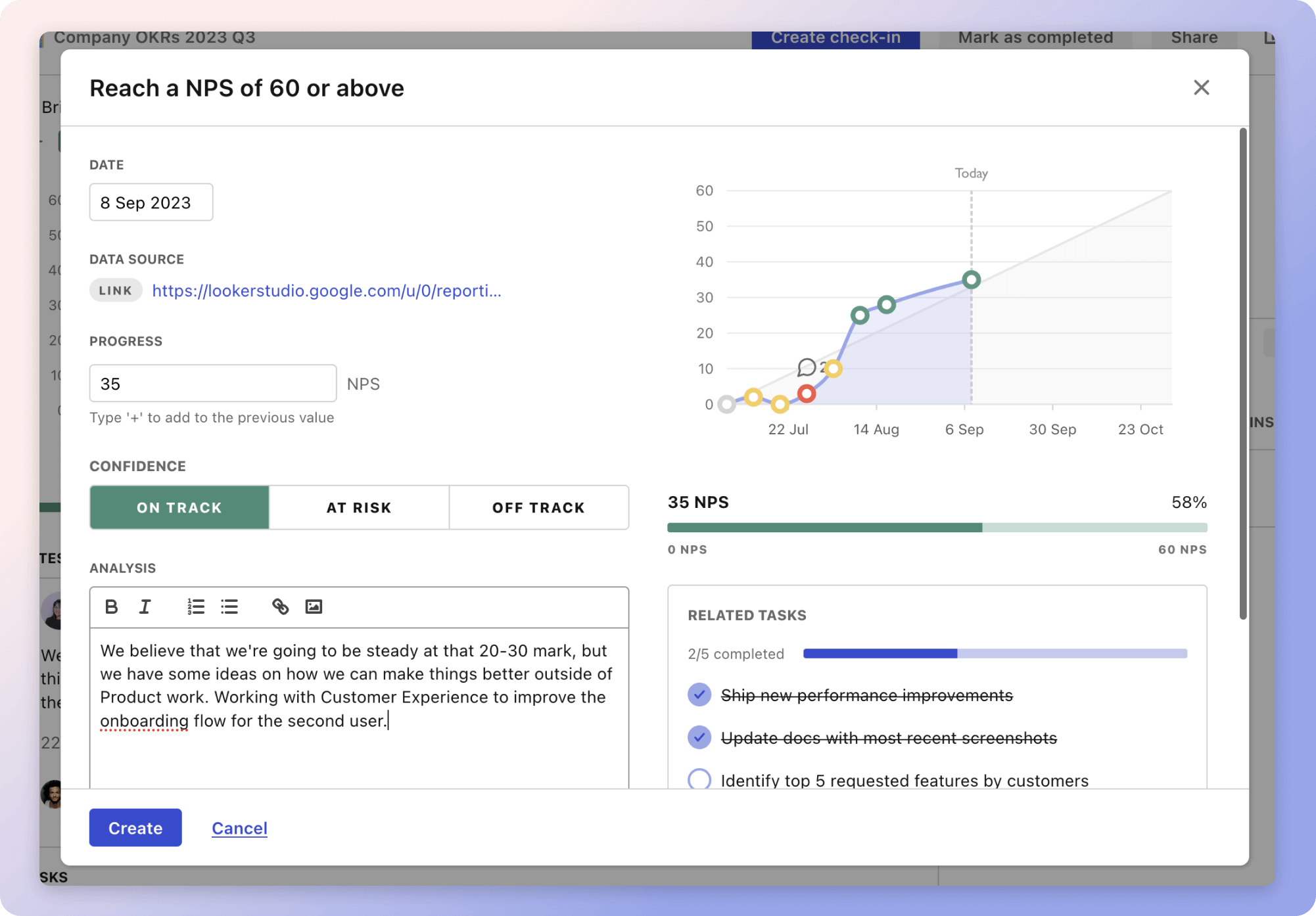 Tability's check-ins will save you hours and increase transparency
 The best metrics for Increase Calls Through Google My Business