Get Tability: OKRs that don't suck | Learn more →

Ai Engineer metrics and KPIs

What are Ai Engineer metrics?

Identifying the optimal Ai Engineer metrics can be challenging, especially when everyday tasks consume your time. To help you, we've assembled a list of examples to ignite your creativity.

Copy these examples into your preferred app, or you can also use Tability to keep yourself accountable.

Find Ai Engineer metrics with AI

While we have some examples available, it's likely that you'll have specific scenarios that aren't covered here. You can use our free AI metrics generator below to generate your own strategies.

Examples of Ai Engineer metrics and KPIs

Metrics for AI Model Performance Evaluation

  • 1. Number of Parameters

    Differentiates model size options such as 1 billion (B), 3B, 7B, 14B parameters

    What good looks like for this metric: 3B parameters is standard

    Ideas to improve this metric
    • Evaluate the scalability and resource constraints of the model
    • Optimise parameter tuning
    • Conduct comparative analysis for various model sizes
    • Assess trade-offs between size and performance
    • Leverage model size for specific tasks
  • 2. Dataset Composition

    Percentage representation of data sources: web data, books, code, dialogue corpora, Indian regional languages, and multilingual content

    What good looks like for this metric: Typical dataset: 60% web data, 15% books, 5% code, 10% dialogue, 5% Indian languages, 5% multilingual

    Ideas to improve this metric
    • Increase regional and language-specific content
    • Ensure balanced dataset for diverse evaluation
    • Perform periodic updates to dataset
    • Utilise high-quality, curated sources
    • Diversify datasets with varying domains
  • 3. Perplexity on Validation Datasets

    Measures the predictability of the model on validation datasets

    What good looks like for this metric: Perplexity range: 10-20

    Ideas to improve this metric
    • Enhance tokenization methods
    • Refine sequence-to-sequence layers
    • Adopt better pre-training techniques
    • Implement data augmentation
    • Leverage transfer learning from similar tasks
  • 4. Inference Speed

    Tokens processed per second on CPU, GPU, and mobile devices

    What good looks like for this metric: GPU: 10k tokens/sec, CPU: 1k tokens/sec, Mobile: 500 tokens/sec

    Ideas to improve this metric
    • Optimise algorithm efficiency
    • Reduce model complexity
    • Implement hardware-specific enhancements
    • Utilise parallel processing
    • Explore alternative deployment strategies
  • 5. Edge-device Compatibility

    Evaluates the model's ability to function on edge devices with latency and response quality

    What good looks like for this metric: Latency: <200 ms for response generation

    Ideas to improve this metric
    • Optimise for low-resource environments
    • Develop compact model architectures
    • Incorporate adaptive and scalable quality features
    • Implement quantisation and compression techniques
    • Perform real-world deployment tests

Tracking your Ai Engineer metrics

Having a plan is one thing, sticking to it is another.

Having a good strategy is only half the effort. You'll increase significantly your chances of success if you commit to a weekly check-in process.

A tool like Tability can also help you by combining AI and goal-setting to keep you on track.
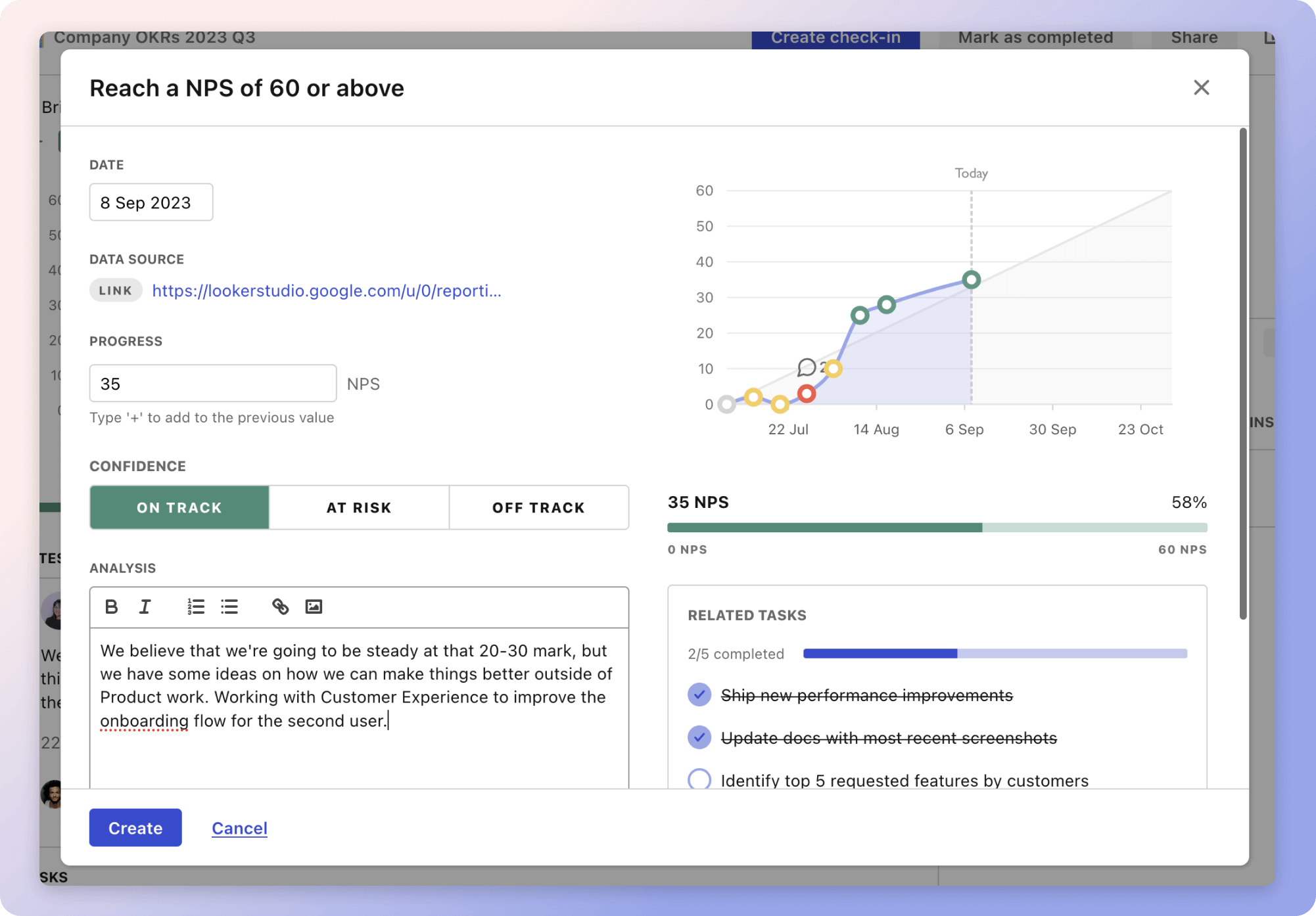
Tability Insights DashboardTability's check-ins will save you hours and increase transparency

More metrics recently published

We have more examples to help you below.

Planning resources

OKRs are a great way to translate strategies into measurable goals. Here are a list of resources to help you adopt the OKR framework:

Table of contents