What are Business Support Team metrics? Finding the right Business Support Team metrics can be daunting, especially when you're busy working on your day-to-day tasks. This is why we've curated a list of examples for your inspiration.
You can copy these examples into your preferred app, or alternatively, use Tability to stay accountable.
Find Business Support Team metrics with AI While we have some examples available, it's likely that you'll have specific scenarios that aren't covered here. You can use our free AI metrics generator below to generate your own strategies.
Examples of Business Support Team metrics and KPIs 1. Average Triage Time The average time taken to assess and assign issues to a technician
What good looks like for this metric: 2 hours
Ideas to improve this metric Implement automated ticketing system Train staff on swift issue identification Set clear prioritisation guidelines Regularly review triage processes Maintain an up-to-date technician skillset directory 2. Percentage of Issues Triaged Within 2 Hours The proportion of issues that are assessed and routed within the two-hour goal
What good looks like for this metric: 90%
Ideas to improve this metric Utilise time-tracking software Analyse bottlenecks in the triaging process Provide incentives for fast triaging Allocate sufficient resources during peak times Conduct regular training sessions 3. First Contact Resolution Rate The percentage of issues resolved without the need for additional follow-up
What good looks like for this metric: 75%
Ideas to improve this metric Expand technician training programmes Increase accessibility of status updates Improve communication between teams Ensure access to comprehensive knowledge base Implement real-time support tools 4. Customer Satisfaction Score The average satisfaction score given by customers regarding the triage process
What good looks like for this metric: 4 out of 5
Ideas to improve this metric Gather regular feedback from customers Reduce hold and transfer times Provide clear status updates Streamline communication channels Customise support to match customer needs 5. Backlog of Untriaged Issues The number of issues that remain unresolved or unassigned past the two-hour window
What good looks like for this metric: 5 or fewer issues
Ideas to improve this metric Regular audits of untriaged issues Enhance staffing levels during peak times Integrate advanced triage software Develop a quick response task force Set up alerts for untriaged issues
← →
1. Monthly Recurring Revenue (MRR) The total revenue generated from all active subscriptions in a month. Calculated as the sum of all subscription values per month.
What good looks like for this metric: $10,000 - $500,000 depending on industry
Ideas to improve this metric Increase the price of your subscription plans Upsell existing customers to higher-tier plans Acquire new subscribers through marketing campaigns Improve product offerings to reduce churn Implement annual or semi-annual billing cycles 2. Customer Lifetime Value (CLTV) The total revenue a business can reasonably expect from a single customer account throughout their relationship. Calculated as average revenue per account multiplied by average customer lifespan.
What good looks like for this metric: $100 - $1,500 depending on industry
Ideas to improve this metric Enhance customer support to increase retention Develop loyalty programs Segment customers for personalized marketing Offer cross-sell and upsell opportunities Collect and act on customer feedback 3. Customer Churn Rate The percentage of customers who cancel their subscriptions over a given period. Calculated as the number of customers who left divided by the total number of customers at the start of the period.
What good looks like for this metric: 2-8% per month
Ideas to improve this metric Improve customer onboarding experience Regularly engage with customers through communication channels Offer limited-time promotions to retain wavering customers Analyse reasons for cancellation and address common issues Introduce long-term subscription discounts 4. Average Revenue Per User (ARPU) The average amount of money earned from each active user or subscriber. Calculated by dividing total revenue by the number of active users.
What good looks like for this metric: $10 - $200 per month
Ideas to improve this metric Encourage customers to upgrade their plans Introduce add-ons and premium features Bundle products and services Improve user experience to enhance perceived value Use targeted pricing strategies 5. Subscriber Growth Rate The rate at which new subscribers are acquired over a given period. Calculated as the percentage increase in subscribers from one period to the next.
What good looks like for this metric: 5-10% per month for growing businesses
Ideas to improve this metric Invest in digital marketing campaigns Offer referral incentives Enhance presence on social media platforms Partner with influencers or other businesses Continuously optimize your website for conversions
← →
1. Number of Youths Trained The total number of youth participants who have completed the training programme
What good looks like for this metric: 500 youths annually
Ideas to improve this metric Increase outreach efforts in low-income areas Partner with local community centres Utilise social media for recruitment Provide online training options Collaborate with schools and universities 2. Business Registration Rate Percentage of trained youths who successfully register a business
What good looks like for this metric: 50% of trained youths
Ideas to improve this metric Simplify the registration process Guide participants through registration steps Provide incentives for registration Host workshops on business planning Establish partnerships with registration bodies 3. Employment Opportunities Created Number of new jobs generated as a result of the startups
What good looks like for this metric: 2 new jobs per startup
Ideas to improve this metric Encourage scalable business models Provide mentorship for business growth Facilitate networking events Support access to funding opportunities Promote collaboration among startups 4. Business Sustainability Rate Percentage of businesses still operational after their first year
What good looks like for this metric: 70% sustainability rate
Ideas to improve this metric Offer follow-up coaching sessions Provide financial management workshops Connect with local business networks Regularly assess and adapt business strategies Encourage continuous learning and innovation 5. Funding Secured by Startups Amount of financial support secured by startups through grants, loans, or investments
What good looks like for this metric: $10,000 per startup
Ideas to improve this metric Assist in grant application processes Create pitch training sessions Connect startups with potential investors Host startup demo days Guide on developing detailed business plans
← →
1. Installation Time Time taken from the initiation to the completion of the software module installation
What good looks like for this metric: Typically 1 to 3 hours
Ideas to improve this metric Ensure all prerequisites are met before starting Use automated installation scripts Perform a test installation prior to the actual installation Ensure high-speed internet connection Allocate experienced IT personnel 2. Installation Success Rate Percentage of installations completed without errors
What good looks like for this metric: 95% or higher
Ideas to improve this metric Conduct thorough pre-installation checks Follow a detailed installation guide Keep software and system dependencies updated Use error-checking tools during installation Engage vendor support for troubleshooting 3. User Acceptance Percentage of users satisfied with the new software module post-installation
What good looks like for this metric: 85% or higher satisfaction rate
Ideas to improve this metric Provide comprehensive user training Gather user feedback post-installation Resolve any issues promptly Ensure the software aligns with user needs Encourage user involvement in the testing phase 4. Downtime During Installation Amount of system downtime incurred during the software installation
What good looks like for this metric: Less than 30 minutes
Ideas to improve this metric Schedule installations during off-peak hours Perform installations in stages Develop a backup plan for critical functions Communicate expected downtime to stakeholders Optimise system resources before installation 5. Installation Cost Total cost associated with the installation process, including labor and resources
What good looks like for this metric: $500 to $2,000
Ideas to improve this metric Negotiate service contracts Utilise in-house expertise where possible Opt for bundled service packages Regularly review and optimise resource allocation Plan and budget accurately in advance
← →
1. Customer Retention Rate Measures the percentage of customers who continue to use a product over a given period.
What good looks like for this metric: 85%
Ideas to improve this metric Enhance customer support Create loyalty programs Implement regular feedback sessions Offer personalised experiences Improve product features regularly 2. Net Promoter Score (NPS) Evaluates customer satisfaction and likelihood to recommend your service to others.
What good looks like for this metric: 70
Ideas to improve this metric Collect customer feedback regularly Identify and address detractor concerns Reward promoter behaviour Analyse feedback for continuous improvement Train staff in customer service excellence 3. Churn Rate Represents the percentage of customers that stop using your service over a specific time period.
What good looks like for this metric: 3-5%
Ideas to improve this metric Analyse reasons for customer exit Improve onboarding experience Provide usage tutorials Monitor and address complaints swiftly Adjust pricing for flexibility 4. Monthly Recurring Revenue (MRR) Calculates the total predictable revenue from all active subscriptions on a monthly basis.
What good looks like for this metric: $10,000
Ideas to improve this metric Upsell existing customers Offer tiered pricing Develop partnerships for bundle offers Enhance product features Target new customer segments 5. Customer Satisfaction Score (CSAT) Measures how satisfied customers are with a particular aspect of your business or service.
What good looks like for this metric: 80%
Ideas to improve this metric Simplify user interfaces Increase response time on queries Ensure product reliability Empower staff to resolve issues Utilise customer feedback for improvements
← →
1. Percentage of Systems Fully Functional Measures the percentage of business systems across departments that are fully functional without any issues
What good looks like for this metric: 90-95%
Ideas to improve this metric Implement regular system maintenance schedules Upgrade outdated software and hardware Conduct frequent system audits Train staff on system usage and troubleshooting Establish a rapid response team for critical issues 2. Average System Downtime Calculates the average time that business systems are non-operational
What good looks like for this metric: Less than 1 hour per month
Ideas to improve this metric Optimize backup and recovery processes Use automated monitoring tools Schedule updates during off-peak hours Develop and test robust disaster recovery plans Enhance infrastructure reliability with redundancy measures 3. Support Request Resolution Time Measures the average time taken to resolve support requests from different departments
What good looks like for this metric: Less than 4 hours
Ideas to improve this metric Set clear priority levels for support tickets Implement a ticketing system with tracking capabilities Provide customer service training for IT support staff Create a comprehensive FAQ and knowledge base Encourage self-service for common issues 4. User Satisfaction Score Summarises user feedback on their satisfaction with systems support
What good looks like for this metric: Above 80%
Ideas to improve this metric Conduct regular satisfaction surveys Analyse feedback to identify common issues Engage users in system improvement discussions Provide transparent updates on resolution progress Recognise and reward high-performance support teams 5. Frequency of System Changes Tracks how frequently systems undergo significant updates or changes
What good looks like for this metric: Monthly or quarterly updates
Ideas to improve this metric Plan updates based on user feedback and needs Test updates thoroughly in a controlled environment Communicate changes effectively to users Incorporate user feedback for improvements Balance system stability and innovation
← →
1. Annual Sales Volume The total quantity of plastic products sold within a year
What good looks like for this metric: 10,000 MT in 2025, increasing to 50,000 MT by 2035
Ideas to improve this metric Expand market reach through marketing Increase product quality to boost sales Enhance sales team training and incentives Identify and target key industries needing plastic Collaborate with international partners 2. Production Yield The percentage of produced items that meet quality standards
What good looks like for this metric: 95% in 2025, aiming for 99% by 2035
Ideas to improve this metric Implement quality checks at each production phase Invest in modern machinery and technology Train employees on quality control processes Conduct regular maintenance on equipment Incorporate lean manufacturing practices 3. Customer Retention Rate The percentage of customers who continue to buy over time
What good looks like for this metric: 80% in 2025, increasing to 95% by 2035
Ideas to improve this metric Enhance customer service and support Implement a loyalty program Regularly seek customer feedback for improvements Offer personalized deals and discounts Ensure high product quality and consistency 4. Cost per Metric Tonne (MT) The cost incurred to produce one metric tonne of plastic
What good looks like for this metric: 10% reduction by 2026, aiming for 20% reduction by 2035
Ideas to improve this metric Streamline procurement processes Negotiate better deals with suppliers Optimize production scheduling for efficiency Minimize waste during production Utilize energy-efficient machinery 5. Training Hours per Employee The average number of hours each employee spends in training annually
What good looks like for this metric: 20 hours in 2025, increasing to 60 hours by 2035
Ideas to improve this metric Develop a comprehensive training calendar Encourage online and external training sessions Introduce mentorship programs Link training to career development plans Utilize technology for training modules
← →
1. Number of Businesses Registered Tracks the total number of businesses registered by participants post-training
What good looks like for this metric: 50% of participants registering businesses
Ideas to improve this metric Increase networking opportunities with successful entrepreneurs Offer mentorship programs beyond the training period Provide step-by-step guidance on the registration process Facilitate access to legal support for business registration Encourage business idea validation workshops 2. Participant Engagement Rate Measures the level of active participation by youths during and after the training sessions
What good looks like for this metric: 80% active participant engagement
Ideas to improve this metric Incorporate interactive and hands-on activities Offer incentives for active participation Use feedback forms to tailor content to participants' needs Include real-world case studies and success stories Assign project-based tasks that encourage teamwork 3. Business Sustainability Rate Assesses the percentage of businesses still operational 12 months post-registration
What good looks like for this metric: 60% business sustainability rate after one year
Ideas to improve this metric Provide ongoing business support services Help secure initial funding and investment Conduct regular follow-ups and check-ins Encourage the development of a solid business plan Organise financial literacy and management workshops 4. Increase in Household Income Monitors the change in average household income for participants after starting their businesses
What good looks like for this metric: 20% increase in household income
Ideas to improve this metric Offer additional training on income-generating strategies Facilitate access to high-demand market sectors Encourage diversification of income streams Promote collaboration and partnerships for larger contracts Guide in effective cost management and budgeting 5. Job Creation Rate Measures the average number of jobs created by participant businesses within six months of operation
What good looks like for this metric: 2 jobs created per business
Ideas to improve this metric Support business expansion opportunities Encourage hiring from local communities Provide training on effective employee management Facilitate networking with potential partners and clients Organise workshops on scaling operations
← →
Tracking your Business Support Team metrics Having a plan is one thing, sticking to it is another.
Don't fall into the set-and-forget trap. It is important to adopt a weekly check-in process to keep your strategy agile – otherwise this is nothing more than a reporting exercise.
A tool like Tability can also help you by combining AI and goal-setting to keep you on track.
More metrics recently published We have more examples to help you below.
Planning resources OKRs are a great way to translate strategies into measurable goals. Here are a list of resources to help you adopt the OKR framework:
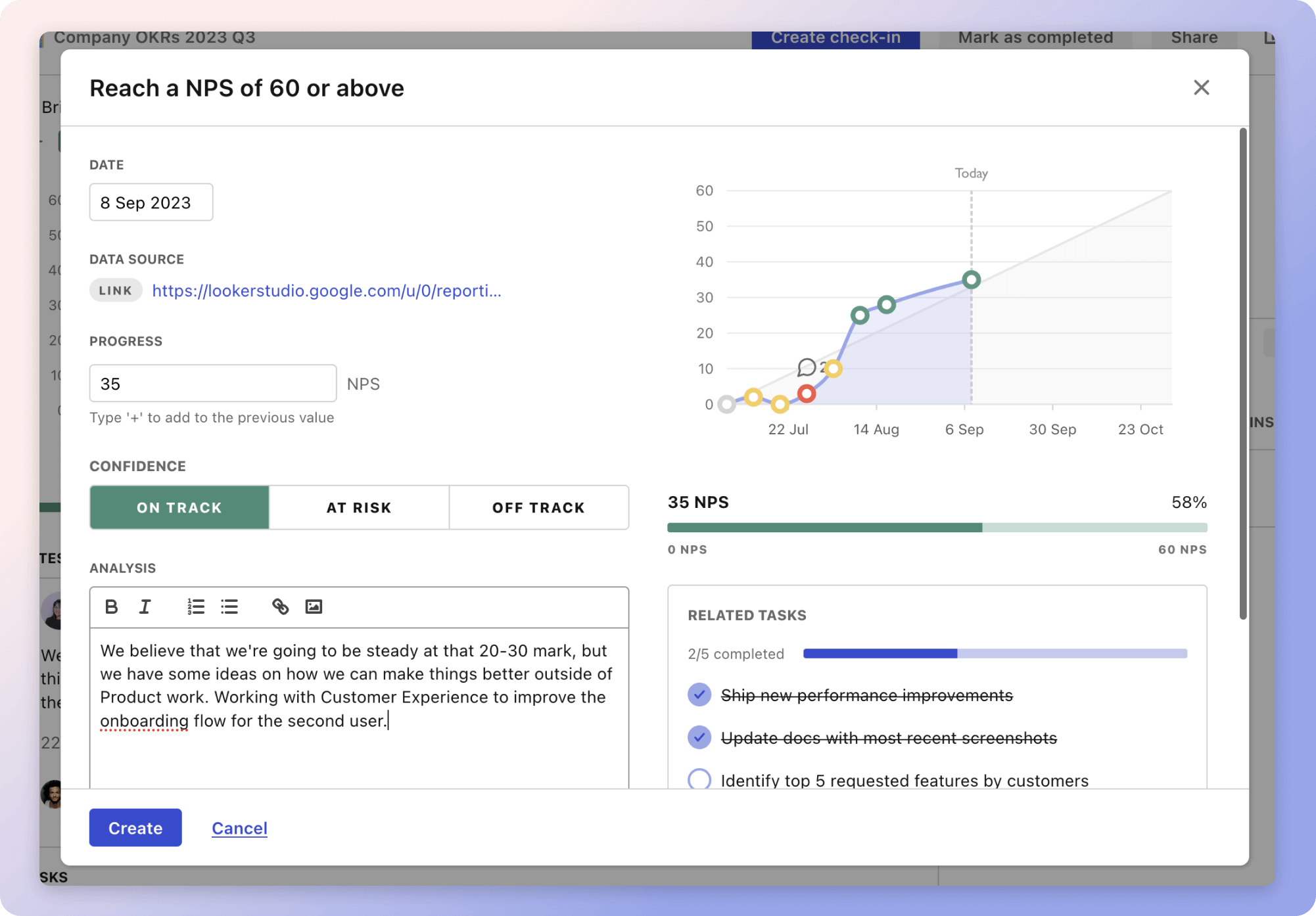 Tability's check-ins will save you hours and increase transparency
 The best metrics for Increase Calls Through Google My Business