In short
What is a good ux design team OKR?
A good ux design team OKR pairs one clear objective with two to four measurable key results the team can score every week. It describes an outcome rather than a list of activities, sets targets that are ambitious but scoreable, and is reviewed weekly so blockers surface before the quarter gets away from the team.
These UX Design Team OKR templates are meant to help teams move from ideas and projects to measurable business outcomes. Use them as a starting point, then tailor the metrics and initiatives to the reality of your company.
This page shows the top 7 of 7 templates for ux design team, with internal links to related categories and guidance for adapting the examples to your team.
Last template update in this category: 2025-02-02What this category is for
- Teams that need a clearer operating rhythm for ux design team work.
- Managers who want examples they can adapt into outcome-focused quarterly plans.
- Leaders comparing adjacent categories before choosing the best OKR direction.
Best outcomes to track
- UX Design Team priorities tied to measurable business outcomes.
- Weekly check-ins that surface blockers before they become delivery issues.
- Better alignment between initiatives and the metrics that matter.
Related categories
Use these linked categories to explore adjacent planning areas and strengthen the internal topic cluster around ux design team.
UX Design Team OKR examples and templates
Start with these top 7 examples from 7 total templates in this category, then adapt the metrics and initiatives to fit your team's constraints and operating cadence.
OKRs to enhance understanding of our users' needs and motivations
 ObjectiveEnhance understanding of our users' needs and motivations
 KRAnalyze and report findings from user interviews in a comprehensive document
 Compile and write comprehensive report document
- Analyze findings and identify key insights
- Review and categorize data from user interviews
- KRDevelop and implement 3 changes based on top user research findings
- Analyze top user research findings for improvement areas
- Draft a development plan for the identified changes
- Implement the changes and gather user feedback
- KRConduct 30 qualitative interviews with diverse user profiles to gather insights
- Schedule and conduct 30 qualitative interviews with diverse users
- Analyze recorded interview data for actionable insights
- Develop interview questions relevant to user experience and needs
OKRs to comply with UX laws and execute an effective audit
- ObjectiveComply with UX laws and execute an effective audit
- KRConduct a meticulous UX audit, identifying and resolving 100% of non-compliance issues
- Identify all existing non-compliance issues
- Review current UX design for compliance with industry standards
- Implement solutions to resolve non-compliance issues
- KRComplete a comprehensive course on UX laws to improve professional development by 50%
- KRImplement a UX optimization strategy, improving user satisfaction scores by 20%
- Regularly monitor and adjust strategy based on feedback
- Develop and implement a targeted UX improvement plan
- Conduct thorough user experience research and analysis
OKRs to successfully launch the MVP of our e-commerce platform
- ObjectiveSuccessfully launch the MVP of our e-commerce platform
- KRImplement user testing and ship the final product with adjustments by next quarter
- Develop a comprehensive user testing plan
- Conduct user testing and gather feedback
- Adjust product based on feedback and ship
- KRDefine the necessary functions and features of the platform within two weeks
- Outline desired features for user interface
- Identify key functions required for the platform
- finalize functions and features list in two weeks
- KRFinish designing the platform and begin development by month's end
- Initiate the development process
- Finalize all design elements for the platform
- Establish a clear development timeline
OKRs to enhance intuitive feature navigation and findability
- ObjectiveEnhance intuitive feature navigation and findability
- KRIncrease customer satisfaction rate by 20% via enhanced feature findability
- Conduct user research to understand feature usage problems
- Implement UX training for customer support team
- Update product design for improved feature accessibility
- KRAchieve 15% less customer queries relating to feature discovery and navigation
- Implement intuitive user interfaces for easier feature discovery
- Initiate customer training sessions for navigation assistance
- Improve feature-related content in user manuals and FAQs
- KRReduce user navigation time by 30% through improved design usability
- Conduct usability tests to identify current site navigation issues
- Implement A/B testing to refine navigation elements
- Develop a more intuitive, user-friendly interface layout
OKRs to enhance web usability to boost conversions and lead quality
- ObjectiveEnhance web usability to boost conversions and lead quality
- KRDecrease bounce rate by 15% via improving website navigation
- Implement intuitive, clear, and user-friendly navigation menus
- Optimize page loading speed to decrease visitor frustration
- Perform user experience testing and make necessary adjustments
- KRReduce page load time by 20% to improve user experience
- Optimize image sizes to improve webpage loading speeds
- Remove unused scripts and unnecessary plugins
- Implement Lazy-loading for content elements
- KRIncrease conversion rate by 10% through refining call-to-actions
- Implement successful changes site-wide
- Conduct A/B testing on revised call-to-actions
- Review existing call-to-actions for clarity and attraction
OKRs to improve efficiency and effectiveness of our CRM system
- ObjectiveImprove efficiency and effectiveness of our CRM system
- KRIncrease sales productivity by 25% through better CRM system integration with sales processes
- Implement necessary upgrades and modifications to CRM system for seamless integration
- Analyze current CRM system and identify areas for improvement and integration
- Monitor and measure sales productivity regularly to track progress and make further adjustments
- Train sales team on effective utilization of CRM system and integrated sales processes
- KRImprove customer satisfaction by achieving a 15% increase in CRM system usability
- Regularly monitor user feedback and make incremental adjustments to enhance CRM system usability
- Collaborate with UX designers to redesign the user interface based on user feedback
- Conduct user research to identify pain points and areas for improving CRM system usability
- Implement training sessions to educate employees on how to effectively utilize CRM features
- KRReduce time spent on data entry by 30% through automation and streamlined processes
- Implement data entry automation tools and software
- Analyze data entry processes and identify bottlenecks for streamlining
- Train employees on efficient data entry techniques and tools
- Regularly monitor and evaluate data entry processes for ongoing improvements
- KRIncrease user adoption rate of the new CRM system by 20%
- Implement regular communication channels to share success stories and benefits of the CRM system
- Assign CRM system ambassadors who can provide ongoing support and guidance to users
- Provide comprehensive training sessions for all employees on using the new CRM system
- Offer incentives and rewards for employees who actively use and promote the CRM system
OKRs to develop an AI application
- ObjectiveDevelop an AI application
- KRImprove accuracy by achieving an average precision rate of at least 90% on test data
- KRIncrease adoption by acquiring at least 1000 active users within the target market segment
- Implement targeted social media advertising campaigns and track user acquisition metrics
- Offer exclusive promotions and incentives to current users for referring new users
- Collaborate with influential industry bloggers and request product reviews and endorsements
- Conduct market research to identify untapped customer needs and optimize product offering
- KREnhance performance by reducing AI response time to under 500 milliseconds for real-time processing
- Optimize algorithms and models to reduce AI response time below 500 milliseconds
- Utilize distributed computing to parallelize AI tasks and accelerate real-time processing
- Continuously monitor and fine-tune system parameters to achieve optimal performance benchmarks
- Improve hardware infrastructure to support faster processing and minimize latency
- KRIncrease user engagement by implementing a user-friendly interface with intuitive navigation
- Collaborate with UX designers to create wireframes and prototypes for the new user-friendly interface
- Conduct usability testing to gather feedback on the intuitiveness of the new interface design
- Implement the finalized user-friendly interface with intuitive navigation based on user feedback
- Conduct user research to identify pain points and areas for improvement in current interface
How to use UX Design Team OKRs well
Strong OKRs keep the team focused on measurable outcomes instead of a long task list. That means picking a clear objective, limiting the number of competing priorities, and reviewing progress every week.
Use UX Design Team OKRs to define what success looks like this quarter, then track them weekly so the team can quickly spot blockers, learn, and adjust execution.
Choosing software to run UX Design Team OKRs?
Move from ux design team examples to execution with sourced comparisons from The OKR Software Benchmark.
- Best OKR software rankingSee the overall verdict and the criteria behind each platform score.
- OKR software pricing comparisonCompare verified prices, minimum commitments, and costs at different team sizes.
- Benchmark methodologyReview the published scoring model, source standards, and conflict-of-interest policy.
Related OKR template categories
If you are building a broader plan, these related categories can help you connect ux design team work to adjacent company priorities.
- product manager OKR templates
- sales manager OKR templates
- sales team OKR templates
- leadership OKR templates
- strategic planning OKR templates
- operations OKR templates
More OKR templates to explore
- OKRs to elevate donor engagement levels
- OKRs to expand our base of regular donors
- OKRs to boost donor engagement significantly
- OKRs to enhance supporter engagement significantly
- OKRs to enhance ability to handle challenging customer situations
- OKRs to enhance client relations through first art refusals' follow-up
Not seeing what you need?
Use Tability AI to generate OKRs based on a prompt
Tability allows you to describe your goals in a prompt, and generate a fully editable OKR template in seconds.
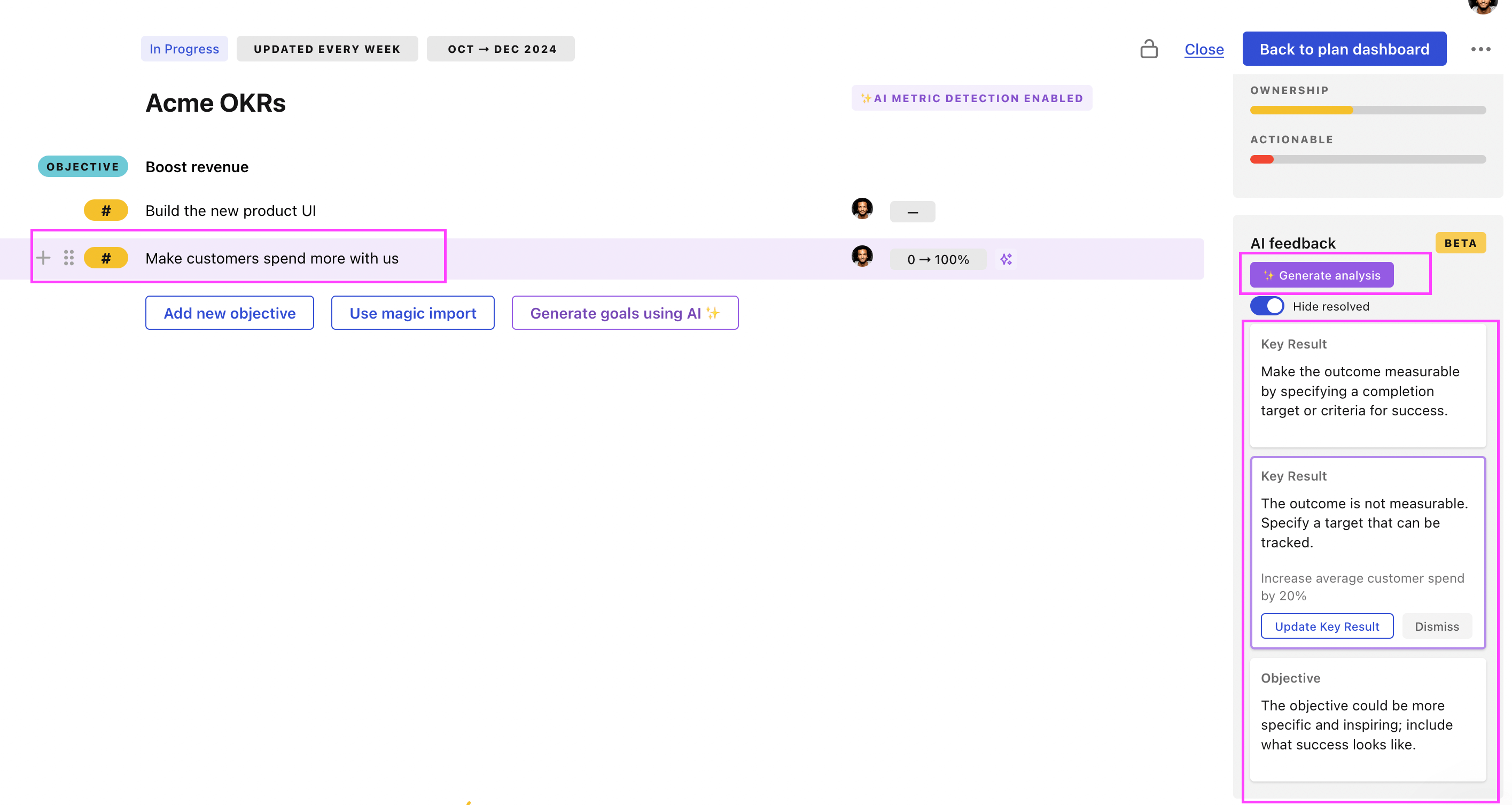
Use Tability feedback to improve existing OKRs
You can also use Tability's AI feedback to improve your OKRs if you already have existing goals. Just import them to the platform and click on the Generate analysis button.
Tability will scan your OKRs and offer different suggestions to improve them. This can range from a small rewrite of a statement to make it clearer to a complete rewrite of the entire OKR.