Tability is a cheatcode for goal-driven teams. Set perfect OKRs with AI, stay focused on the work that matters.
What are Okr Manager OKRs?
The Objective and Key Results (OKR) framework is a simple goal-setting methodology that was introduced at Intel by Andy Grove in the 70s. It became popular after John Doerr introduced it to Google in the 90s, and it's now used by teams of all sizes to set and track ambitious goals at scale.
How you write your OKRs can make a huge difference on the impact that your team will have at the end of the quarter. But, it's not always easy to write a quarterly plan that focuses on outcomes instead of projects.
We have curated a selection of OKR examples specifically for Okr Manager to assist you. Feel free to explore the templates below for inspiration in setting your own goals.
If you want to learn more about the framework, you can read our OKR guide online.
The best tools for writing perfect Okr Manager OKRs
Here are 2 tools that can help you draft your OKRs in no time.
Tability AI: to generate OKRs based on a prompt
Tability AI allows you to describe your goals in a prompt, and generate a fully editable OKR template in seconds.
- 1. Create a Tability account
- 2. Click on the Generate goals using AI
- 3. Describe your goals in a prompt
- 4. Get your fully editable OKR template
- 5. Publish to start tracking progress and get automated OKR dashboards
Watch the video below to see it in action 👇
Tability Feedback: to improve existing OKRs
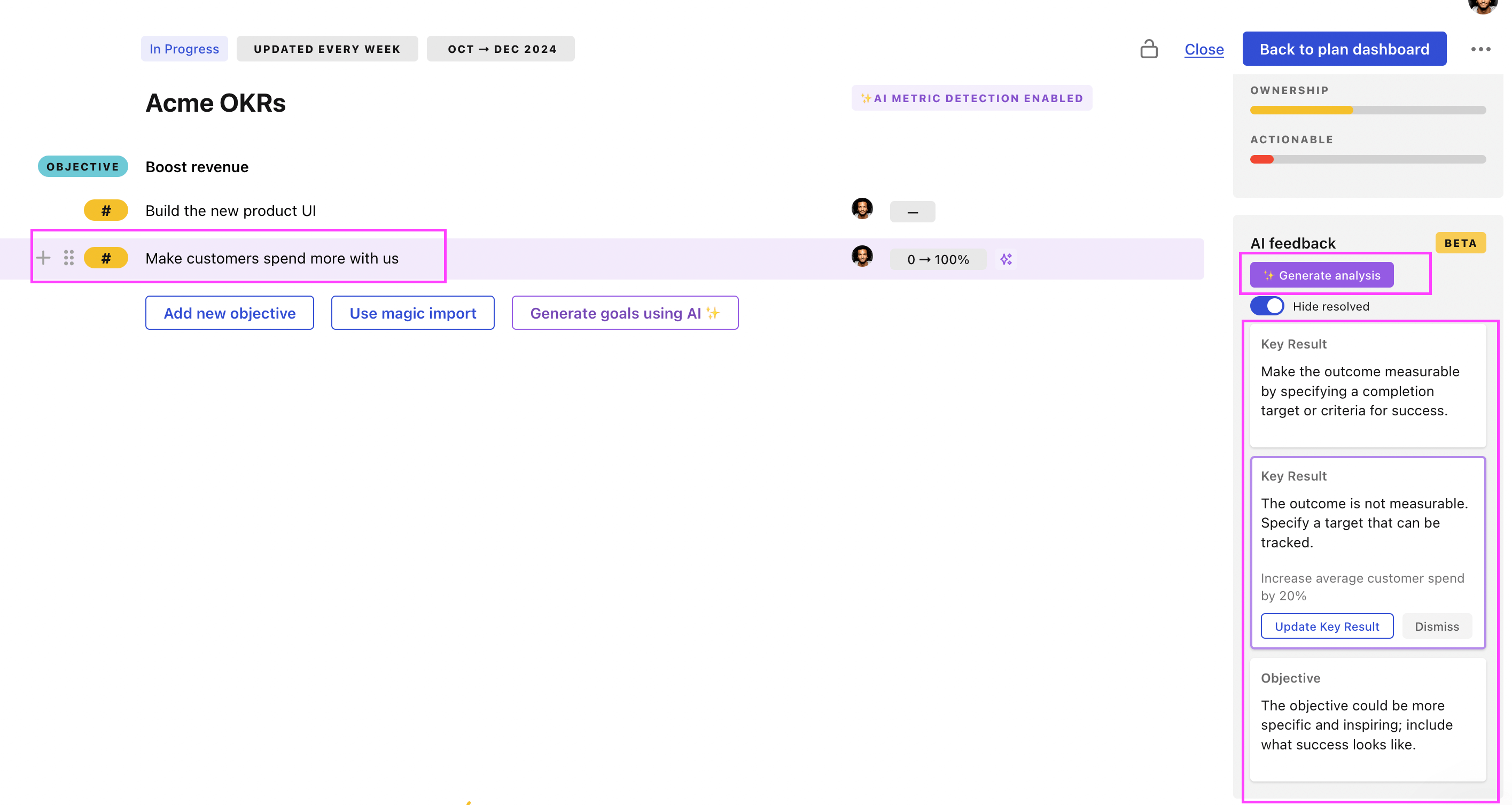
You can use Tability's AI feedback to improve your OKRs if you already have existing goals.
- 1. Create your Tability account
- 2. Add your existing OKRs (you can import them from a spreadsheet)
- 3. Click on Generate analysis
- 4. Review the suggestions and decide to accept or dismiss them
- 5. Publish to start tracking progress and get automated OKR dashboards

Tability will scan your OKRs and offer different suggestions to improve them. This can range from a small rewrite of a statement to make it clearer to a complete rewrite of the entire OKR.
Okr Manager OKRs examples
You'll find below a list of Objectives and Key Results templates for Okr Manager. We also included strategic projects for each template to make it easier to understand the difference between key results and projects.
Hope you'll find this helpful!
OKRs to strengthen the corporate-wide OKR management system
ObjectiveStrengthen the corporate-wide OKR management system
KRImplement feedback system for continual OKR improvements
Identify target areas through stakeholders' survey for OKR improvement
Develop a structured feedback collection system online
Monitor feedback and analyze for actionable OKR adjustments
KRAchieve 90% completion rate for all OKRs
Implement regular progress check-ins
Provide necessary resources and support
Review and adjust OKRs for feasible completion
KRIncrease the number of OKRs tracked by 25%
Utilize OKR tracking software
Implement weekly OKR update meetings
Train team in crafting and tracking OKRs
OKRs to improve team productivity via an enhanced OKR system
ObjectiveImprove team productivity via an enhanced OKR system
KRIncrease the number of successful projects by at least 25% compared to previous quarter
Encourage transparent communication within project teams
Implement regular training programs for project management skills
Review and refine project planning and execution strategies
KRImplement a new digital OKR tracking tool with 100% team adoption
Organize a mandatory training session on tool usage
Research and choose a suitable digital OKR tracking tool
Track and ensure every team member's activity on the tool
KRAchieve an average of 85% completion rate on all team OKRs
Set clear, measurable objectives for every team member
Schedule regular check-ins to discuss progress and obstacles
Provide resources and support for goal achievement
OKRs to enhance comprehension of OKRs utilization
ObjectiveEnhance comprehension of OKRs utilization
KRParticipate in two interactive workshops related to OKRs
Research and select two OKR-focused workshops to attend
Register for chosen workshops
Complete pre-workshop preparatory tasks
KRImplement an OKR strategy for a hypothetical project, tracking success and adjustments
Setup regular monitoring and tracking system
Define clear objectives and key results for the project
Make necessary adjustments based on evaluations
KRRead three relevant books about OKRs for in-depth knowledge
Highlight and note important concepts
Select three books focused on OKRs
Schedule uninterrupted reading periods
OKRs to implement effective OKR framework for document management
ObjectiveImplement effective OKR framework for document management
KRReduce document loss incidents by 40% operating under the new OKR framework
Implement document tracking systems across all departments
Train staff on proper document handling procedures
Conduct regular audits for document compliance
KRTrain 90% of staff on new OKR document management system in 8 weeks
Develop a detailed training schedule within one week
Monitor and report training progress regularly
Conduct weekly training sessions for staff
KRDecrease document retrieval time by 30% by developing a categorization system
Design a categorization system for file organization
Train staff on utilizing the new system
Implement new categorization system in document storage
OKRs to enhance CRM efficacy through implementation and tracking of OKR
ObjectiveEnhance CRM efficacy through implementation and tracking of OKR
KRBoost customer satisfaction scores by 10%
Provide regular training for customer-facing staff
Implement a regular customer feedback survey
Enhance customer support with a 24/7 helpline
KRIncrease CRM end-user adoption to 85%
Implement incentives for consistent CRM usage
Initiate personalized CRM training for all end users
Improve CRM user interface for easy navigation
KRImprove data integrity and error rate by 25%
Utilize data cleansing tools to improve accuracy
Implement robust data validation checks on all input fields
Enhance staff training on data input procedures
OKRs to successfully develop and implement team roadmap and OKR
ObjectiveSuccessfully develop and implement team roadmap and OKR
KRMeasure and improve team productivity by 20%
Provide adequate training to improve team skillset
Implement productivity tracking software for accurate measurement
Establish clear goals and track team progress
KRAchieve 90% completion of outlined tasks
Develop a daily task completion plan
Prioritize duties according to importance and deadline
Eliminate distractions to improve focus
KRDefine explicit roles and responsibilities for all team members
Identify individual skill sets and assign specific roles accordingly
Create clear job descriptions for each team member
Communicate responsibilities and expectations to all team members
OKRs to establish new, attractive OKR Consultancy firm for businesses
ObjectiveEstablish new, attractive OKR Consultancy firm for businesses
KRGenerate a minimum of $50,000 in revenue within the first quarter of operations
Secure partnerships with high-return clients
Implement effective marketing and sales strategies
Develop a comprehensive business plan highlighting revenue targets
KRIdentify and target 150 potential clients within the medium to large businesses sector
Research and compile a list of 150 medium to large businesses
Develop a custom pitch for each potential client
Initiate contact with these businesses via email
KRSecure 10 successful contracts with businesses seeking OKR consultancy services
Develop and present customized consultancy proposals to businesses
Identify potential businesses seeking OKR consultancy services
Conduct follow-ups to secure contracts
Okr Manager OKR best practices
Generally speaking, your objectives should be ambitious yet achievable, and your key results should be measurable and time-bound (using the SMART framework can be helpful). It is also recommended to list strategic initiatives under your key results, as it'll help you avoid the common mistake of listing projects in your KRs.
Here are a couple of best practices extracted from our OKR implementation guide 👇
Tip #1: Limit the number of key results
Having too many OKRs is the #1 mistake that teams make when adopting the framework. The problem with tracking too many competing goals is that it will be hard for your team to know what really matters.
We recommend having 3-4 objectives, and 3-4 key results per objective. A platform like Tability can run audits on your data to help you identify the plans that have too many goals.
Tip #2: Commit to weekly OKR check-ins
Setting good goals can be challenging, but without regular check-ins, your team will struggle to make progress. We recommend that you track your OKRs weekly to get the full benefits from the framework.
Being able to see trends for your key results will also keep yourself honest.
Tip #3: No more than 2 yellow statuses in a row
Yes, this is another tip for goal-tracking instead of goal-setting (but you'll get plenty of OKR examples above). But, once you have your goals defined, it will be your ability to keep the right sense of urgency that will make the difference.
As a rule of thumb, it's best to avoid having more than 2 yellow/at risk statuses in a row.
Make a call on the 3rd update. You should be either back on track, or off track. This sounds harsh but it's the best way to signal risks early enough to fix things.
Save hours with automated Okr Manager OKR dashboards

The rules of OKRs are simple. Quarterly OKRs should be tracked weekly, and yearly OKRs should be tracked monthly. Reviewing progress periodically has several advantages:
- It brings the goals back to the top of the mind
- It will highlight poorly set OKRs
- It will surface execution risks
- It improves transparency and accountability
Spreadsheets are enough to get started. Then, once you need to scale you can use Tability to save time with automated OKR dashboards, data connectors, and actionable insights.
How to get Tability dashboards:
- 1. Create a Tability account
- 2. Use the importers to add your OKRs (works with any spreadsheet or doc)
- 3. Publish your OKR plan
That's it! Tability will instantly get access to 10+ dashboards to monitor progress, visualise trends, and identify risks early.
More Okr Manager OKR templates
We have more templates to help you draft your team goals and OKRs.
OKRs to boost incremental revenue generation from CRM channels
OKRs to implement robust tracking of core Quality Assurance (QA) metrics
OKRs to enhance lead generation by delivering high-quality content
OKRs to ensure full compliance with health and safety regulations
OKRs to identify and assess AI tools available in the market
OKRs to increase school adoption of the 30% system