Tability is a cheatcode for goal-driven teams. Set perfect OKRs with AI, stay focused on the work that matters.
What are Okr Management OKRs?
The Objective and Key Results (OKR) framework is a simple goal-setting methodology that was introduced at Intel by Andy Grove in the 70s. It became popular after John Doerr introduced it to Google in the 90s, and it's now used by teams of all sizes to set and track ambitious goals at scale.
How you write your OKRs can make a huge difference on the impact that your team will have at the end of the quarter. But, it's not always easy to write a quarterly plan that focuses on outcomes instead of projects.
We have curated a selection of OKR examples specifically for Okr Management to assist you. Feel free to explore the templates below for inspiration in setting your own goals.
If you want to learn more about the framework, you can read our OKR guide online.
The best tools for writing perfect Okr Management OKRs
Here are 2 tools that can help you draft your OKRs in no time.
Tability AI: to generate OKRs based on a prompt
Tability AI allows you to describe your goals in a prompt, and generate a fully editable OKR template in seconds.
- 1. Create a Tability account
- 2. Click on the Generate goals using AI
- 3. Describe your goals in a prompt
- 4. Get your fully editable OKR template
- 5. Publish to start tracking progress and get automated OKR dashboards
Watch the video below to see it in action 👇
Tability Feedback: to improve existing OKRs
You can use Tability's AI feedback to improve your OKRs if you already have existing goals.
- 1. Create your Tability account
- 2. Add your existing OKRs (you can import them from a spreadsheet)
- 3. Click on Generate analysis
- 4. Review the suggestions and decide to accept or dismiss them
- 5. Publish to start tracking progress and get automated OKR dashboards
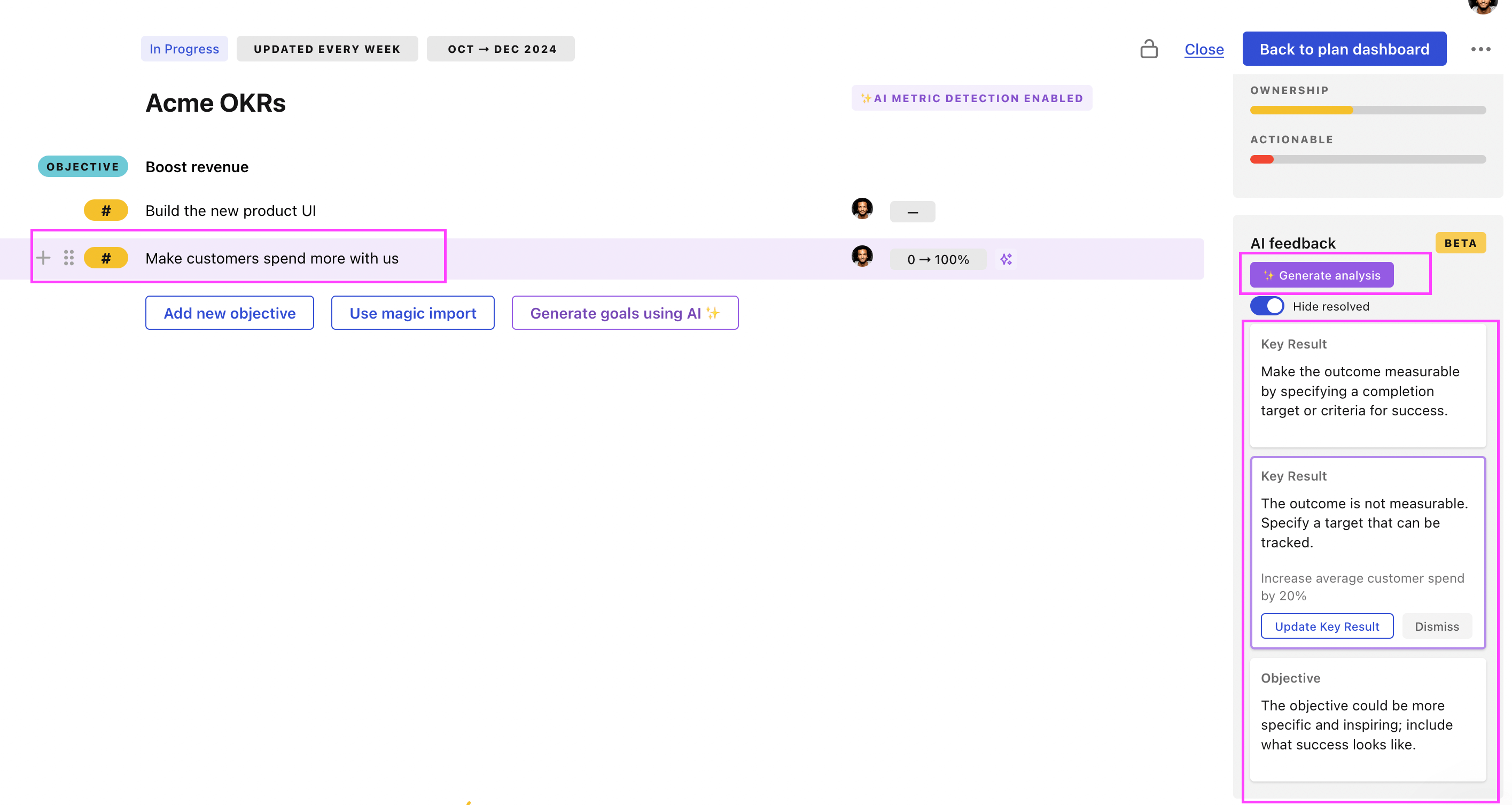
Tability will scan your OKRs and offer different suggestions to improve them. This can range from a small rewrite of a statement to make it clearer to a complete rewrite of the entire OKR.
Okr Management OKRs examples
You'll find below a list of Objectives and Key Results templates for Okr Management. We also included strategic projects for each template to make it easier to understand the difference between key results and projects.
Hope you'll find this helpful!
OKRs to strengthen the corporate-wide OKR management system
 ObjectiveStrengthen the corporate-wide OKR management system
 KRImplement feedback system for continual OKR improvements
 Identify target areas through stakeholders' survey for OKR improvement
- Develop a structured feedback collection system online
- Monitor feedback and analyze for actionable OKR adjustments
- KRAchieve 90% completion rate for all OKRs
- Implement regular progress check-ins
- Provide necessary resources and support
- Review and adjust OKRs for feasible completion
- KRIncrease the number of OKRs tracked by 25%
- Utilize OKR tracking software
- Implement weekly OKR update meetings
- Train team in crafting and tracking OKRs
OKRs to implement effective OKR framework for document management
- ObjectiveImplement effective OKR framework for document management
- KRReduce document loss incidents by 40% operating under the new OKR framework
- Implement document tracking systems across all departments
- Train staff on proper document handling procedures
- Conduct regular audits for document compliance
- KRTrain 90% of staff on new OKR document management system in 8 weeks
- Develop a detailed training schedule within one week
- Monitor and report training progress regularly
- Conduct weekly training sessions for staff
- KRDecrease document retrieval time by 30% by developing a categorization system
- Design a categorization system for file organization
- Train staff on utilizing the new system
- Implement new categorization system in document storage
OKRs to optimize Trello Board for effective team OKR management
- ObjectiveOptimize Trello Board for effective team OKR management
- KRConduct 5 training sessions on Trello usage to increase team efficiency by 20%
- Create a comprehensive Trello training curriculum
- Schedule and conduct five Trello training sessions
- Identify Trello features that boost team efficiency
- KREnsure 100% of team updates their respective OKRs on Trello weekly
- Issue weekly reminder emails to update OKRs on Trello
- Give a short training on updating OKRs on Trello
- Implement OKRs review during team meetings
- KRImprove Trello Board navigation efficiency by 30% through reorganization and streamlining
- Train team on navigation improvements to ensure smoother usage
- Implement an intuitive, uniform labeling system across all boards
- Review all current Trello boards for possible streamlining opportunities
OKRs to implement and optimize the OKR framework for effective tracking
- ObjectiveImplement and optimize the OKR framework for effective tracking
- KRIncrease adoption rate of OKR framework by minimum 75%
- Regularly review and provide feedback on OKR utilization
- Train staff on benefits and functionality of OKR framework
- Implement incentives for consistent usage of OKR
- KREnhance visibility of OKR tracking process to 100% staff awareness
- Initiate company-wide communication about OKR process
- Conduct regular OKR awareness training
- Create user-friendly OKR tracking software guide
- KRAchieve at least 80% satisfaction rate from teams using OKR framework
- Implement improvement plans based on team feedback
- Conduct regular check-ins to identify any issues with teams
- Provide ongoing training on the OKR framework
OKRs to enhance comprehension of OKRs utilization
- ObjectiveEnhance comprehension of OKRs utilization
- KRParticipate in two interactive workshops related to OKRs
- Research and select two OKR-focused workshops to attend
- Register for chosen workshops
- Complete pre-workshop preparatory tasks
- KRImplement an OKR strategy for a hypothetical project, tracking success and adjustments
- Setup regular monitoring and tracking system
- Define clear objectives and key results for the project
- Make necessary adjustments based on evaluations
- KRRead three relevant books about OKRs for in-depth knowledge
- Highlight and note important concepts
- Select three books focused on OKRs
- Schedule uninterrupted reading periods
OKRs to implement effective and smart goal-setting strategies
- ObjectiveImplement effective and smart goal-setting strategies
- KRReview and refine goal-setting process after completion of each goal
- Analyze the effectiveness of completed goal
- Identify improvements for future goal-setting process
- Implement identified improvements in next goal plan
- KRMonitor progress bi-weekly, ensuring 80% goal achievement rate
- Develop report formats for bi-weekly updates
- Schedule bi-weekly progress review meetings
- Create system to track 80% goal achievement rate
- KRFormulate 2 new, measurable and achievable goals each week
- Determine two realistic, quantifiable goals
- Create plan with steps to achieve each goal
- Brainstorm personal or professional objectives for the week
OKRs to implement a robust OKR tracking tool within the organization
- ObjectiveImplement a robust OKR tracking tool within the organization
- KRIdentify and evaluate five potential OKR tracking tools by quantified metrics
- Analyze each tool based on established metrics
- Research and list down five potential OKR tracking tools
- Define quantified metrics for evaluation
- KRAchieve 75% usage of the OKR tracking tool across all departments
- Implement periodical usage reports for each department
- Train all department heads in using the OKR tracking tool
- Incorporate OKR tracking tool in onboarding new employees
- KRTrain 90% of managers in utilizing the chosen tool effectively and efficiently
- Schedule training sessions for 90% of managers
- Monitor managers' progress and provide support
- Identify required training for chosen tool usage
OKRs to identify and implement the most effective OKR tool for productivity enhancement
- ObjectiveIdentify and implement the most effective OKR tool for productivity enhancement
- KRInvestigate and shortlist three potential OKR tools based on features and reviews
- Research different OKR tools on the market
- Compare features of each OKR tool
- Read and analyze customer reviews of the tools
- KRConduct a one-week trial for each selected OKR tool
- Assess the performance post-trial
- Set-up one-week trial for each tool
- Identify and select optimal OKR tools for trial
- KRFully integrate the chosen OKR tool into daily operations
- Include OKR tracking in daily operational checklists
- Train team members on how to use the chosen OKR tool effectively
- Review and update OKRs during regular team meetings
OKRs to master the fundamentals of OKR
- ObjectiveMaster the fundamentals of OKR
- KRComplete an online OKR course scoring at least 85%
- Aim for a minimum of 85% score in all tests and final exam
- Research and enroll in a reputable online OKR course
- Consistently study materials and complete course assignments
- KRImplement the OKR methodology in a pilot project successfully
- Train team members on the basics of OKR methodology
- Choose a suitable pilot project for the OKR implementation
- Monitor progress and adjust OKRs as needed
- KRRead two recommended books on OKR, noting down actionable insights
- Schedule time to read these books comprehensively
- Purchase or borrow two recommended books on OKR
- Note down actionable insights while reading
OKRs to implement robust OKR framework for enhancing organisational efficiency
- ObjectiveImplement robust OKR framework for enhancing organisational efficiency
- KRConducting two training sessions on new OKR framework by end of the quarter
- Develop comprehensive content for the OKR training sessions
- Conduct the two OKR training sessions
- Schedule and advertise two training events
- KRGet 80% of all departments to successfully adopt the new OKR framework
- Regularly monitor and evaluate departmental adoption progress
- Conduct training sessions for departments on the OKR framework usage
- Provide accessible support and resources for OKR implementation
- KRAchieve a 10% increase in overall operational efficiency post framework implementation
- Monitor productivity metrics to identify areas of inefficiency
- Implement efficiency improvement plans in the identified areas
- Collect and analyze post-implementation data to measure success
Okr Management OKR best practices
Generally speaking, your objectives should be ambitious yet achievable, and your key results should be measurable and time-bound (using the SMART framework can be helpful). It is also recommended to list strategic initiatives under your key results, as it'll help you avoid the common mistake of listing projects in your KRs.
Here are a couple of best practices extracted from our OKR implementation guide 👇
Tip #1: Limit the number of key results
Having too many OKRs is the #1 mistake that teams make when adopting the framework. The problem with tracking too many competing goals is that it will be hard for your team to know what really matters.
We recommend having 3-4 objectives, and 3-4 key results per objective. A platform like Tability can run audits on your data to help you identify the plans that have too many goals.
Tip #2: Commit to weekly OKR check-ins
Setting good goals can be challenging, but without regular check-ins, your team will struggle to make progress. We recommend that you track your OKRs weekly to get the full benefits from the framework.
Being able to see trends for your key results will also keep yourself honest.
Tip #3: No more than 2 yellow statuses in a row
Yes, this is another tip for goal-tracking instead of goal-setting (but you'll get plenty of OKR examples above). But, once you have your goals defined, it will be your ability to keep the right sense of urgency that will make the difference.
As a rule of thumb, it's best to avoid having more than 2 yellow/at risk statuses in a row.
Make a call on the 3rd update. You should be either back on track, or off track. This sounds harsh but it's the best way to signal risks early enough to fix things.
Save hours with automated Okr Management OKR dashboards
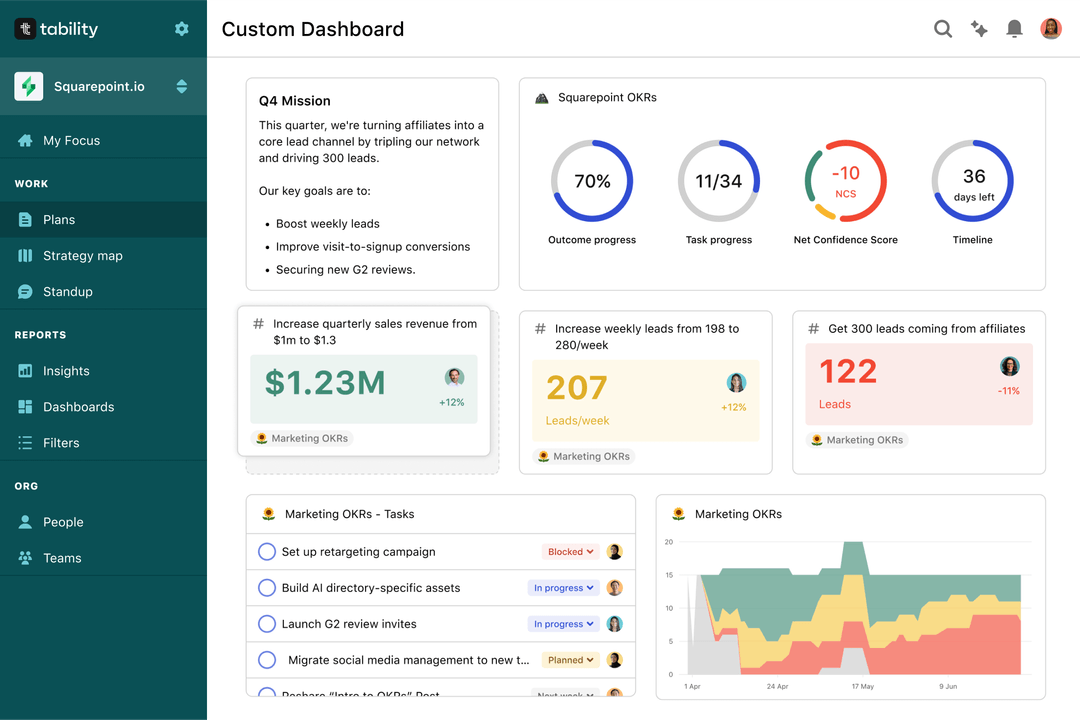
Your quarterly OKRs should be tracked weekly if you want to get all the benefits of the OKRs framework. Reviewing progress periodically has several advantages:
- It brings the goals back to the top of the mind
- It will highlight poorly set OKRs
- It will surface execution risks
- It improves transparency and accountability
We recommend using a spreadsheet for your first OKRs cycle. You'll need to get familiar with the scoring and tracking first. Then, you can scale your OKRs process by using Tability to save time with automated OKR dashboards, data connectors, and actionable insights.
How to get Tability dashboards:
- 1. Create a Tability account
- 2. Use the importers to add your OKRs (works with any spreadsheet or doc)
- 3. Publish your OKR plan
That's it! Tability will instantly get access to 10+ dashboards to monitor progress, visualise trends, and identify risks early.
More Okr Management OKR templates
We have more templates to help you draft your team goals and OKRs.
- OKRs to enhance discoverability of subject-level employability opportunities
- OKRs to earn an A grade in my English class
- OKRs to enhance software development efficiency and quality in the IT company
- OKRs to enhance analysis and implementations of Power BI Reports
- OKRs to boost engagement of inactive platform sign-ups
- OKRs to advance spoken communication skills and augment confidence in formal settings