In short
What is a good risk management officer OKR?
A good risk management officer OKR pairs one clear objective with two to four measurable key results the team can score every week. It describes an outcome rather than a list of activities, sets targets that are ambitious but scoreable, and is reviewed weekly so blockers surface before the quarter gets away from the team.
These Risk Management Officer OKR templates are meant to help teams move from ideas and projects to measurable business outcomes. Use them as a starting point, then tailor the metrics and initiatives to the reality of your company.
This page shows the top 9 of 9 templates for risk management officer, with internal links to related categories and guidance for adapting the examples to your team.
Last template update in this category: 2025-09-11What this category is for
- Teams that need a clearer operating rhythm for risk management officer work.
- Managers who want examples they can adapt into outcome-focused quarterly plans.
- Leaders comparing adjacent categories before choosing the best OKR direction.
Best outcomes to track
- Risk Management Officer priorities tied to measurable business outcomes.
- Weekly check-ins that surface blockers before they become delivery issues.
- Better alignment between initiatives and the metrics that matter.
Related categories
Use these linked categories to explore adjacent planning areas and strengthen the internal topic cluster around risk management officer.
Risk Management Officer OKR examples and templates
Start with these top 9 examples from 9 total templates in this category, then adapt the metrics and initiatives to fit your team's constraints and operating cadence.
OKRs to improve efficiency in IR and CCMA risk management
 ObjectiveImprove efficiency in IR and CCMA risk management
 KRReduce CCMA risk-related incidents by 20%
 Regularly review and update risk management protocol
- Implement preemptive compliance checks
- Train staff on CCMA risk-associated procedures
- KRImplement 2 new risk mitigation strategies in IR and CCMA
- Identify potential risks in IR and CCMA practices
- Implement and monitor these strategies
- Develop two new mitigation strategies
- KRIncrease successful IR cases by 15%
- Train IR team on latest best practices
- Review and revise current IR strategies
- Implement robust case tracking software
OKRs to enhance payment screening for sanction compliance efficiency
- ObjectiveEnhance payment screening for sanction compliance efficiency
- KRReduce false positives in sanctions checks by 25%
- Regularly update sanctions lists and references
- Implement rigorous system and data testing procedures
- Improve accuracy and precision of data matching algorithms
- KRAchieve 95% precision in identifying sanction-related payment risks
- Train staff on recognizing potential risks
- Regularly update regulatory and sanctions lists
- Implement comprehensive sanction screening software
- KRConduct quality checks for 100% of the reviewed payments for sanction compliance
- Address and rectify any identified compliance issues
- Verify and record results of each compliance check
- Review all payments for adherence to sanction compliance laws
OKRs to enhance company-wide risk management capabilities
- ObjectiveEnhance company-wide risk management capabilities
- KRTrain 90% of team members on new risk identification and mitigation strategies
- Monitor and record training participation rates
- Schedule mandatory training sessions for team
- Identify suitable training program on risk identification and mitigation
- KRImplement a comprehensive risk management framework in 75% of business units
- Develop a detailed risk management plan for selected units
- Train staff in these units on risk management practices
- Identify crucial business units requiring a risk management framework
- KRDecrease identified risks by 30% through proactive risk assessment processes
- Enhance staff training on risk identification and management
- Implement regular risk assessment reviews across all departments
- Integrate proactive risk assessment software in workflow
OKRs to achieve full contract coverage
- ObjectiveAchieve full contract coverage
- KRDevelop and implement strategies to cover 50% of uncovered contracts by week 6
- KRObtain full coverage for all identified contracts by week 12
- Finalize and obtain coverage for all contracts by week 12
- Review and identify all existing contracts by week 9
- Start requesting full coverage quotes by week 10
- KRIdentify and list all contracts lacking coverage by week 2
OKRs to enable smooth first country's rollout through comprehensive hypercare
- ObjectiveEnable smooth first country's rollout through comprehensive hypercare
- KRReduce hypercare-related issues by at least 30% through vigilant risk management
- Monitor and evaluate ongoing hypercare issues for risk reduction
- Implement robust risk assessment protocols for hypercare activities
- Regularly train staff in hypercare risk management techniques
- KRCreate a detailed hypercare plan for every rollout process by the first week
- Develop detailed schedules, responsibilities, and procedures
- Review, refine, and finalize each hypercare plan
- Identify and list key elements for each rollout process hypercare plan
- KRConduct two intensive training sessions for all involved teams to optimize rollout efficiency
- Define specific objectives for the training sessions
- Schedule the two extensive training sessions
- Send invites to all involved teams
OKRs to enhance and streamline our risk management processes
- ObjectiveEnhance and streamline our risk management processes
- KRIdentify and document at least 30 potential risks impacting our business operations
- Document all identified risks in a risk register
- Categorize each risk and its potential impact
- Conduct a comprehensive risk identification process
- KRImplement risk mitigation strategies for 100% of identified top-priority risks
- Identify and prioritize all potential risks within the operation
- Develop appropriate countermeasures for top-priority risks
- Implement and monitor these mitigation strategies consistently
- KRAchieve a 20% decrease in operational disruptions due to better risk management
- Implement risk management training for all operational employees
- Introduce proactive maintenance system to avoid disruptions
- Regularly review and update risk management strategies
OKRs to enhance enterprise-wide governance, risk, and compliance
- ObjectiveEnhance enterprise-wide governance, risk, and compliance
- KRImplement a robust governance framework across 70% of the company departments
- Train department heads on governance procedures
- Identify key departments needing governance framework implementation
- Develop a tailored governance framework
- KRDecrease non-compliance incidents by 30% through improved risk management procedures
- Implement mandatory risk management training for all employees
- Improve surveillance audits to detect non-compliance
- Update compliance policies to reflect current legislation
- KRTrain 100% of the staff on compliance regulations and company policies
- Schedule training sessions for all staff members
- Monitor and document staff's training progress
- Develop a comprehensive compliance and policy training program
OKRs to enhance risk management in the finance department
- ObjectiveEnhance risk management in the finance department
- KRDecrease risk-related financial losses by 15%
- Strengthen internal audit procedures
- Provide staff training on risk management
- Implement regular financial risk assessment strategies
- KRDevelop and train staff on 3 new risk mitigation strategies
- Identify and outline 3 new risk mitigation strategies
- Prepare a comprehensive training program around these strategies
- Schedule and conduct training sessions for staff
- KRImplement risk assessment tools to identify 20% more financial risks
- Choose appropriate risk assessment tools
- Train staff on proper tool usage
- Monitor and measure effectiveness regularly
OKRs to strengthen operational self-sufficiency and resiliency within the business
- ObjectiveStrengthen operational self-sufficiency and resiliency within the business
- KRImplement two new business continuity plans
- Test and refine the proposed business continuity plans
- Develop two separate strategies that address these risks
- Identify potential risks that could disrupt business operations
- KRIncrease emergency fund savings by 25%
- Set up automated monthly transfers to emergency fund
- Analyze current budget and identify unnecessary expenses
- Generate additional income through side jobs
- KRTrain 90% of the team on new operational procedures for better autonomy
- Implement follow-up assessments to ensure competency
- Organize comprehensive training sessions for team members
- Develop simplified documentation of new operational procedures
How to use Risk Management Officer OKRs well
Strong OKRs keep the team focused on measurable outcomes instead of a long task list. That means picking a clear objective, limiting the number of competing priorities, and reviewing progress every week.
Use Risk Management Officer OKRs to define what success looks like this quarter, then track them weekly so the team can quickly spot blockers, learn, and adjust execution.
Choosing software to run Risk Management Officer OKRs?
Move from risk management officer examples to execution with sourced comparisons from The OKR Software Benchmark.
- Best OKR software rankingSee the overall verdict and the criteria behind each platform score.
- OKR software pricing comparisonCompare verified prices, minimum commitments, and costs at different team sizes.
- Benchmark methodologyReview the published scoring model, source standards, and conflict-of-interest policy.
Related OKR template categories
If you are building a broader plan, these related categories can help you connect risk management officer work to adjacent company priorities.
- risk management OKR templates
- operations team OKR templates
- compliance OKR templates
- leadership OKR templates
- strategic planning OKR templates
- operations OKR templates
More OKR templates to explore
- OKRs to enhance marketing effectiveness and reach
- OKRs to build a comprehensive new customer CRM database
- OKRs to enhance effectiveness and engagement in meetings
- OKRs to enhance capabilities of tech leadership
- OKRs to enhance my leadership capabilities
- OKRs to enhance personal communication proficiency
Not seeing what you need?
Use Tability AI to generate OKRs based on a prompt
Tability allows you to describe your goals in a prompt, and generate a fully editable OKR template in seconds.
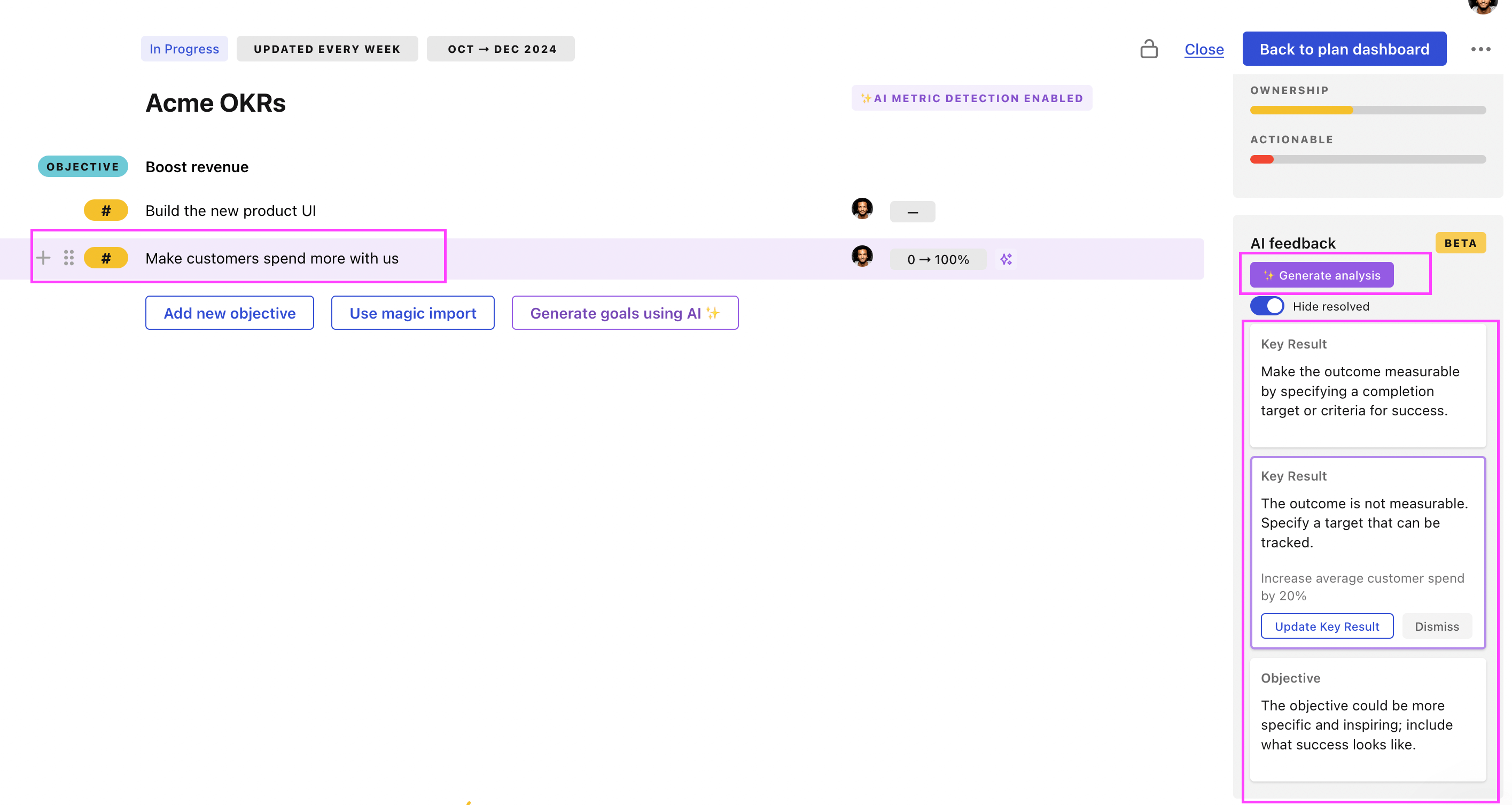
Use Tability feedback to improve existing OKRs
You can also use Tability's AI feedback to improve your OKRs if you already have existing goals. Just import them to the platform and click on the Generate analysis button.
Tability will scan your OKRs and offer different suggestions to improve them. This can range from a small rewrite of a statement to make it clearer to a complete rewrite of the entire OKR.