Tability is a cheatcode for goal-driven teams. Set perfect OKRs with AI, stay focused on the work that matters.
What are Sales Support OKRs?
The Objective and Key Results (OKR) framework is a simple goal-setting methodology that was introduced at Intel by Andy Grove in the 70s. It became popular after John Doerr introduced it to Google in the 90s, and it's now used by teams of all sizes to set and track ambitious goals at scale.
How you write your OKRs can make a huge difference on the impact that your team will have at the end of the quarter. But, it's not always easy to write a quarterly plan that focuses on outcomes instead of projects.
That's why we have created a list of OKRs examples for Sales Support to help. You can use any of the templates below as a starting point to write your own goals.
If you want to learn more about the framework, you can read our OKR guide online.
The best tools for writing perfect Sales Support OKRs
Here are 2 tools that can help you draft your OKRs in no time.
Tability AI: to generate OKRs based on a prompt
Tability AI allows you to describe your goals in a prompt, and generate a fully editable OKR template in seconds.
- 1. Create a Tability account
- 2. Click on the Generate goals using AI
- 3. Describe your goals in a prompt
- 4. Get your fully editable OKR template
- 5. Publish to start tracking progress and get automated OKR dashboards
Watch the video below to see it in action 👇
Tability Feedback: to improve existing OKRs
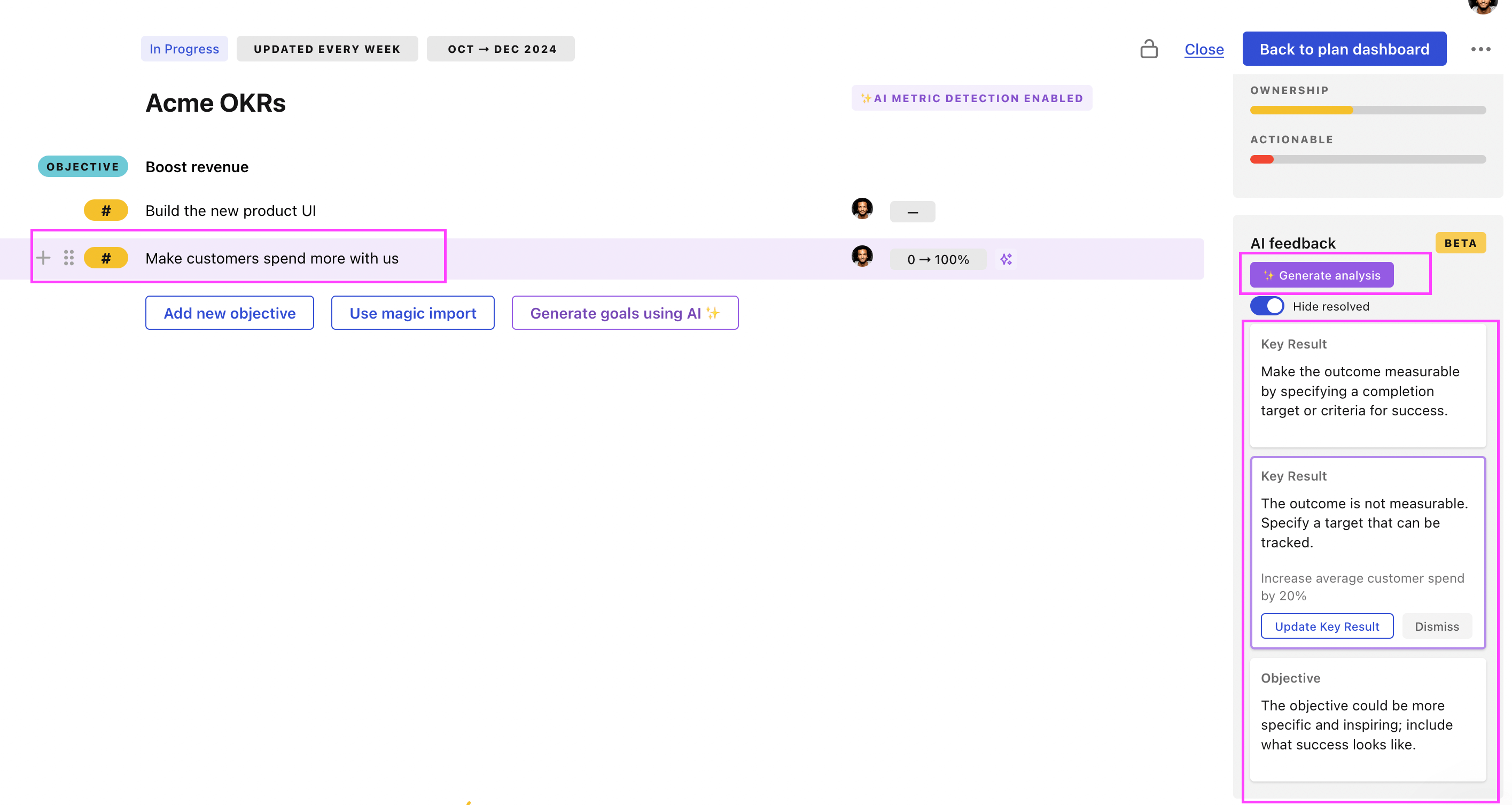
You can use Tability's AI feedback to improve your OKRs if you already have existing goals.
- 1. Create your Tability account
- 2. Add your existing OKRs (you can import them from a spreadsheet)
- 3. Click on Generate analysis
- 4. Review the suggestions and decide to accept or dismiss them
- 5. Publish to start tracking progress and get automated OKR dashboards

Tability will scan your OKRs and offer different suggestions to improve them. This can range from a small rewrite of a statement to make it clearer to a complete rewrite of the entire OKR.
Sales Support OKRs examples
You'll find below a list of Objectives and Key Results templates for Sales Support. We also included strategic projects for each template to make it easier to understand the difference between key results and projects.
Hope you'll find this helpful!
OKRs to improve sales support operations for increased revenues
ObjectiveImprove sales support operations for increased revenues
KRIncrease upselling rate by 15% with enhanced support-guided recommendations
Develop tailored recommendation scripts for support staff to use
Train support team in advanced selling techniques and product knowledge
Implement tracking metrics to monitor progress and effectiveness regularly
KRIncrease customer engagement by 30% through revamped sales support systems
Introduce incentive programs to reward loyal customers
Implement a user-friendly interface for seamless customer interaction
Train sales personnel on customer connectivity and relationship building
KRReduce sales cycle duration by 20% through sales support optimizations
Train team on effective closing techniques
Streamline sales proposal approval process
Implement more efficient sales tracking software
OKRs to enhance team collaboration and support sales
ObjectiveEnhance team collaboration and support sales
KRDecrease team conflict incidents by 40% via conflict management training
Monitor and track the conflict incidents post-training
Identify and organize a conflict management training program
Encourage all team members to participate in the training
KRImprove team communication efficiency by 30% through collaboration tool implementation
Identify suitable collaboration tools for team needs
Arrange training sessions on tool usage
Monitor and evaluate tool effectiveness
KRIncrease sales support activities by 25% to boost sales outcomes
Identify key areas in need of increased sales support
Upgrade technology to expedite sales support processes
Train staff to enhance their sales-support capabilities
OKRs to improve sales performance across all product lines
ObjectiveImprove sales performance across all product lines
KRRaise customer retention rate by 15%
Improve customer support and response time
Implement loyalty programs and reward frequent customers
Collect feedback to understand and solve customer problems
KRAchieve a 25% increase in overall unit sales
Enhance distribution channels to broaden product accessibility
Implement a marketing campaign to raise product awareness and demand
Offer customer incentives like discounts or loyalty programs
KRBoost the average purchase value by 10% per customer
Introduce premium versions or add-ons of popular products
Implement strategic up-selling and cross-selling techniques
Offer discounts or incentives for bulk purchases
OKRs to increase usage of D365 Sales Hub in our organization
ObjectiveIncrease usage of D365 Sales Hub in our organization
KRAchieve a 20% increase in daily active users within the next quarter
Implement a user referral incentive program
Optimize product features to improve user retention
Launch an engaging marketing campaign to attract new users
KRConduct 3 interactive workshops on the benefits and features of D365 Sales Hub
Identify key benefits and features of D365 Sales Hub for workshop content
Promote and schedule D365 Sales Hub workshops to target audiences
Plan structure and activities for three interactive workshops
KRDecrease D365 Sales Hub related support queries by 30%
Develop a user guide to resolve common issues independently
Introduce a self-help portal with FAQ
Implement comprehensive staff training on D365 Sales Hub usage
OKRs to increase business customer onboarding in customer support
ObjectiveIncrease business customer onboarding in customer support
KRBoost direct outreach campaigns to 20 potential business customers a week
Identify 20 potential business customers per week
Execute weekly outreach through phone calls or emails
Develop personalized outreach materials for each target
KRTrain customer support team to upsell services, increasing sales by 15%
Implement specialized upselling training for customer support team
Monitor, evaluate, and give feedback on performance regularly
Introduce incentives for successful upsells
KRConvert 30% of potential business customer inquiries into sales
Implement a thorough and personalized follow-up system
Develop a compelling sales pitch tailored to their specific business needs
Provide potential customers with successful case studies and testimonials
OKRs to improve efficiency and success rate of the technical sales support team
ObjectiveImprove efficiency and success rate of the technical sales support team
KRIncrease customer satisfaction rate by 20%
Implement a comprehensive customer service training program
Regularly update product or service based on customer feedback
Launch a customer loyalty and rewards program
KRAchieve a 15% reduction in response and resolution times
Implement automated responses for commonly raised issues
Assign urgent cases to seasoned team members
Conduct regular team performance evaluations and feedback
KRBoost upselling success rate by 10%
Monitor and reward sales team members who successfully upsell products
Identify top-selling products and strategically promote them
Implement training programs focusing on upselling techniques for sales staff
OKRs to improve customer satisfaction and loyalty for Sales and Marketing
ObjectiveImprove customer satisfaction and loyalty for Sales and Marketing
KRAchieve a 10% reduction in customer complaints over the quarter
Provide additional training for customer service staff
Update and clarify product usage instructions
Implement customer satisfaction surveys after service interactions
KRBoost overall customer satisfaction score by 20% on our survey
Enhance product or service quality based on feedback
Implement regular staff training on customer service skills
Follow up on customer complaints efficiently
KRIncrease repeat sales volume by 15%
Launch a loyalty rewards program to incentivize repeat purchases
Implement targeted follow-up emails with personalized deals
Enhance customer service quality to boost customer satisfaction
OKRs to improve efficiency and profitability of lab supply store
ObjectiveImprove efficiency and profitability of lab supply store
KRIncrease sales revenue by 10% via targeted marketing campaigns
KRReduce inventory carrying costs by 15% through improved demand forecasting
Regularly monitor and adjust forecasting parameters
Implement a more accurate demand forecasting software
Train staff on new demand forecasting methods
KRImprove customer satisfaction rate to 90% through enhanced after-sales support
Implement a 24/7 customer help desk for addressing after-sales queries
Launch feedback system to evaluate customer's after-sales experience
Train customer support staff in proactive solution-focused service
OKRs to boost sales performance significantly
ObjectiveBoost sales performance significantly
KRImprove product demonstration conversions by 10%
Train staff on persuasive presentation and selling techniques
Research audience needs for personalized product demonstrations
Incorporate a compelling call-to-action in all demos
KRDrive repeat business higher by improving client retention by 20%
Personalize client communications to enhance engagement
Implement a loyalty program to reward frequent customers
Improve customer service response times by 15%
KRIncrease the number of customer contacts by 15%
Enhance social media engagement strategies
Implement a new customer outreach campaign
Offer incentives for customer referrals
OKRs to boost invoice value for slurry pumps and spares to $800,000
ObjectiveBoost invoice value for slurry pumps and spares to $800,000
KRImprove sales closure rate by 20% through targeted sales initiatives
Develop specific proposals tailored for each potential customer's needs
Utilize data analytics to identify and target high conversion rate customers
Implement a continuous training program to sharpen sales team's closing skills
KRIncrease average order value to $4,000 by upselling related products
Train sales team on effective upselling techniques
Develop recommendations for related, higher-priced products
Implement upselling strategies during post-sale follow-up
KRAchieve 200 customer orders for slurry pumps and spare parts
Develop a detailed marketing plan targeting potential customers
Boost online presence via SEO and social media advertising
Initiate contact with relevant industry influencers for partnerships
Sales Support OKR best practices
Generally speaking, your objectives should be ambitious yet achievable, and your key results should be measurable and time-bound (using the SMART framework can be helpful). It is also recommended to list strategic initiatives under your key results, as it'll help you avoid the common mistake of listing projects in your KRs.
Here are a couple of best practices extracted from our OKR implementation guide 👇
Tip #1: Limit the number of key results
Focus can only be achieve by limiting the number of competing priorities. It is crucial that you take the time to identify where you need to move the needle, and avoid adding business-as-usual activities to your OKRs.
We recommend having 3-4 objectives, and 3-4 key results per objective. A platform like Tability can run audits on your data to help you identify the plans that have too many goals.
Tip #2: Commit to weekly OKR check-ins
Having good goals is only half the effort. You'll get significant more value from your OKRs if you commit to a weekly check-in process.
Being able to see trends for your key results will also keep yourself honest.
Tip #3: No more than 2 yellow statuses in a row
Yes, this is another tip for goal-tracking instead of goal-setting (but you'll get plenty of OKR examples above). But, once you have your goals defined, it will be your ability to keep the right sense of urgency that will make the difference.
As a rule of thumb, it's best to avoid having more than 2 yellow/at risk statuses in a row.
Make a call on the 3rd update. You should be either back on track, or off track. This sounds harsh but it's the best way to signal risks early enough to fix things.
Save hours with automated Sales Support OKR dashboards

The rules of OKRs are simple. Quarterly OKRs should be tracked weekly, and yearly OKRs should be tracked monthly. Reviewing progress periodically has several advantages:
- It brings the goals back to the top of the mind
- It will highlight poorly set OKRs
- It will surface execution risks
- It improves transparency and accountability
Spreadsheets are enough to get started. Then, once you need to scale you can use Tability to save time with automated OKR dashboards, data connectors, and actionable insights.
How to get Tability dashboards:
- 1. Create a Tability account
- 2. Use the importers to add your OKRs (works with any spreadsheet or doc)
- 3. Publish your OKR plan
That's it! Tability will instantly get access to 10+ dashboards to monitor progress, visualise trends, and identify risks early.
More Sales Support OKR templates
We have more templates to help you draft your team goals and OKRs.
OKRs to boost the billability rate of employees to 95%
OKRs to become a proficient Front End technical lead
OKRs to design and operationalize robust measurement system
OKRs to boost social media content shares by refining our content strategy
OKRs to enhance productivity and expertise of our Linux Admin team
OKRs to enroll in relevant courses for proficient website development