In short
What is a good developer OKR?
A good developer OKR pairs one clear objective with two to four measurable key results the team can score every week. It describes an outcome rather than a list of activities, sets targets that are ambitious but scoreable, and is reviewed weekly so blockers surface before the quarter gets away from the team.
These Developer OKR templates are meant to help teams move from ideas and projects to measurable business outcomes. Use them as a starting point, then tailor the metrics and initiatives to the reality of your company.
This page shows the top 6 of 6 templates for developer, with internal links to related categories and guidance for adapting the examples to your team.
Last template update in this category: 2025-09-07What this category is for
- Teams that need a clearer operating rhythm for developer work.
- Managers who want examples they can adapt into outcome-focused quarterly plans.
- Leaders comparing adjacent categories before choosing the best OKR direction.
Best outcomes to track
- Developer priorities tied to measurable business outcomes.
- Weekly check-ins that surface blockers before they become delivery issues.
- Better alignment between initiatives and the metrics that matter.
Related categories
Use these linked categories to explore adjacent planning areas and strengthen the internal topic cluster around developer.
Developer OKR examples and templates
Start with these top 6 examples from 6 total templates in this category, then adapt the metrics and initiatives to fit your team's constraints and operating cadence.
OKRs to develop and implement a user-friendly process inventory application
 ObjectiveDevelop and implement a user-friendly process inventory application
 KRDesign a fully functional prototype of the application by end of week 6
 Begin coding the functional elements
- Construct a basic design layout
- Outline essential features for the application
- KREstablish a governance model that 95% of end users find easy to understand
- Implement comprehensive user education
- Survey end users to understand governance comprehension
- Develop a simplified governance model
- KRTest the application with a select group of users, achieving 80% user satisfaction
- Analyze data to confirm 80% user satisfaction
- Implement testing phase with chosen users
- Identify a select group of users for testing
OKRs to certify in development using JTA, Blueprint, Item writing & peer reviews
- ObjectiveCertify in development using JTA, Blueprint, Item writing & peer reviews
- KRScore above 85% in 3 JTA application-related mock tests to ensure understanding
- Complete practice mock tests for review and correction
- Study all relevant JTA application-related materials
- Achieve 85% or higher in 3 official JTA mock tests
- KRDevelop and review 10 unique development items using Blueprint per week
- Create and structure these items using Blueprint
- List potential topics for 10 unique development items
- Review and edit each item weekly
- KRParticipate in 2 peer reviews per month to enhance Blueprint, item writing proficiency
- Constructively critique and edit peers' blueprints
- Volunteer for two peer review sessions
- Attend all scheduled blueprint item writing workshops
OKRs to improve AI security requirements operationalization for developers’ comprehension
- ObjectiveImprove AI security requirements operationalization for developers’ comprehension
- KRDevelop and deploy a standardized AI security guideline by 25%
- Draft a comprehensive AI security guideline
- Reduce guideline by 25% focusing on core elements
- Implement the streamlined AI security guideline across all systems
- KRReduce misunderstandings in AI security requirements by 30% through improved documentation
- Conduct regular staff trainings highlighting documentation procedures
- Establish clear, concise writing guidelines for technical content
- Implement a standardized format for all AI security requirement documents
- KRConduct bi-weekly developer trainings on new AI security protocols resulting in 80% adherence
OKRs to gain comprehensive understanding of Behavior Driven Development (BDD)
- ObjectiveGain comprehensive understanding of Behavior Driven Development (BDD)
- KRPrepare and deliver a presentation on BDD to validate acquired knowledge
- Rehearse the presentation to ensure clear delivery
- Craft an informative and engaging presentation on BDD
- Study in-depth about Behavior Driven Development (BDD)
- KRComplete two online courses related to BDD principles and implementation
- Research and identify two online courses about BDD principles
- Actively participate and complete the two online courses
- Enroll in chosen BDD-related online courses
- KRImplement a small project using BDD techniques to reinforce learning
- Select a project suitable for Behavior-Driven Development (BDD)
- Implement code and perform BDD testing
- Identify and note down expected behaviors
OKRs to amplify developer involvement in epic definition and prioritization
- ObjectiveAmplify developer involvement in epic definition and prioritization
- KRObtain 90% positive feedback from developers on their influence in defining epics
- Implement a regular feedback mechanism from developers
- Conduct training on defining epics for developers
- Involve developers in epic creation process
- KRTrain 80% of developers in advanced epic creation and prioritization techniques
- Identify suitable training programs on epic creation and prioritization
- Monitor and track developer training progress
- Enroll developers in identified training programs
- KRAchieve 30% increase in developer-led epic prioritization based on weekly reports
- Establish incentives for achieving prioritization targets
- Implement training sessions to improve developer's prioritization skills
- Enhance weekly reporting system to track progress
OKRs to improve code quality through effective code reviews
- ObjectiveImprove code quality through effective code reviews
- KRReduce average time taken to complete code reviews
- Set clear expectations and guidelines for code reviews
- Use automated tools for code analysis and review to enhance efficiency
- Implement a peer review process to streamline code reviews
- Provide regular code review training sessions for team members
- KRImplement and track improvements in code review feedback incorporation rate
- Conduct a survey to collect feedback from developers on barriers to incorporating code review feedback
- Analyze the survey results to identify the common barriers to incorporating code review feedback
- Implement a tracking system to monitor and measure the improvements in code review feedback incorporation rate
- Develop a training program to address the identified barriers and improve feedback incorporation rate
- KRIncrease team members' satisfaction with code review process
- KRIncrease average number of bugs caught through code review per week
How to use Developer OKRs well
Strong OKRs keep the team focused on measurable outcomes instead of a long task list. That means picking a clear objective, limiting the number of competing priorities, and reviewing progress every week.
Use Developer OKRs to define what success looks like this quarter, then track them weekly so the team can quickly spot blockers, learn, and adjust execution.
Choosing software to run Developer OKRs?
Move from developer examples to execution with sourced comparisons from The OKR Software Benchmark.
- Best OKR software rankingSee the overall verdict and the criteria behind each platform score.
- OKR software pricing comparisonCompare verified prices, minimum commitments, and costs at different team sizes.
- Benchmark methodologyReview the published scoring model, source standards, and conflict-of-interest policy.
Related OKR template categories
If you are building a broader plan, these related categories can help you connect developer work to adjacent company priorities.
- project manager OKR templates
- security analyst OKR templates
- security team OKR templates
- leadership OKR templates
- strategic planning OKR templates
- operations OKR templates
More OKR templates to explore
- OKRs to implement single account just-in-time access system
- OKRs to significantly reduce reported risks
- OKRs to enhance proactive investigation through expanded log analysis
- OKRs to implement automation to streamline existing processes
- OKRs to initiate transition from old privilege access management tools
- OKRs to implement replacement of privilege access management tools
Not seeing what you need?
Use Tability AI to generate OKRs based on a prompt
Tability allows you to describe your goals in a prompt, and generate a fully editable OKR template in seconds.
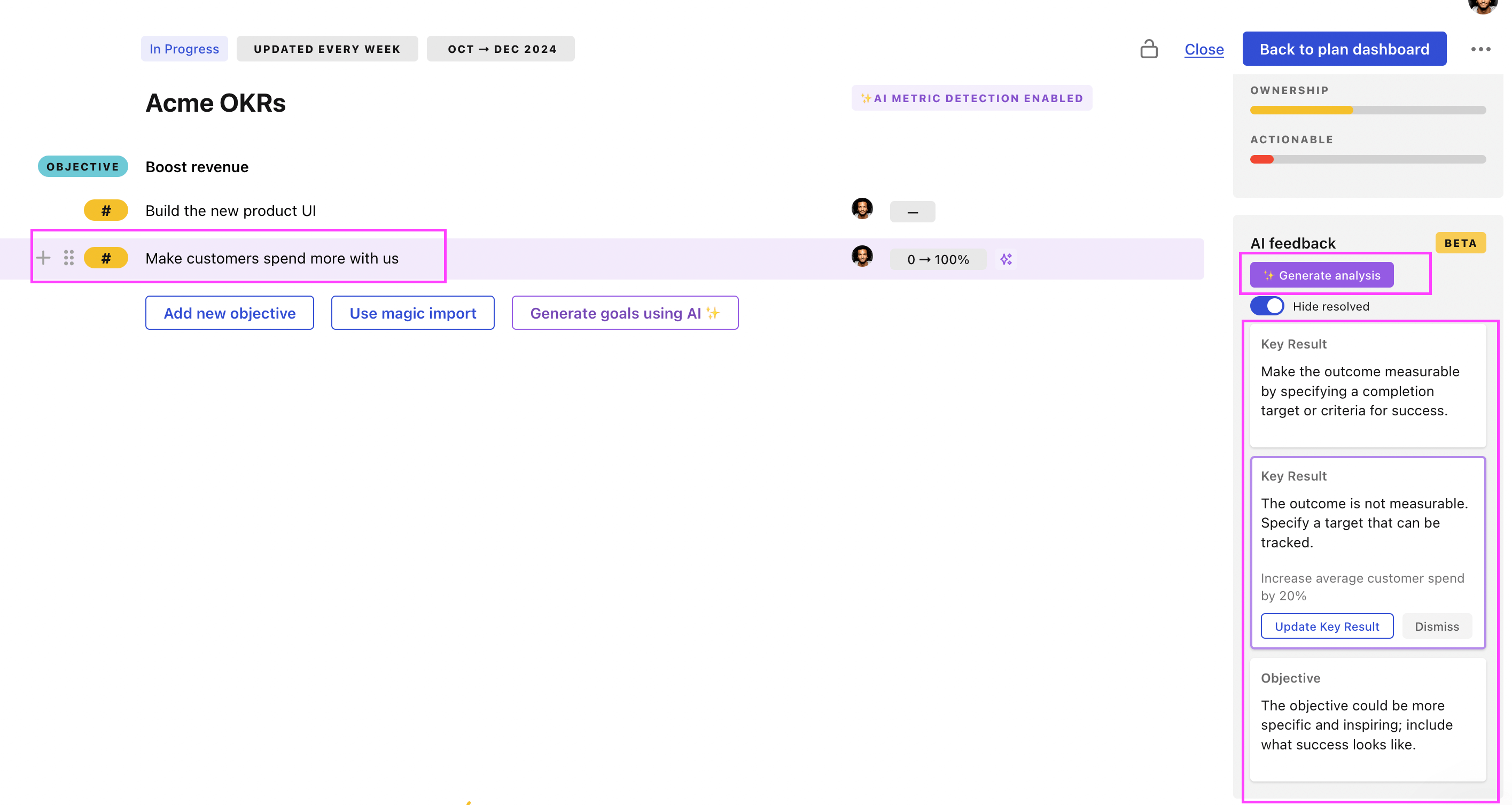
Use Tability feedback to improve existing OKRs
You can also use Tability's AI feedback to improve your OKRs if you already have existing goals. Just import them to the platform and click on the Generate analysis button.
Tability will scan your OKRs and offer different suggestions to improve them. This can range from a small rewrite of a statement to make it clearer to a complete rewrite of the entire OKR.