Tability is a cheatcode for goal-driven teams. Set perfect OKRs with AI, stay focused on the work that matters.
What are Team Organization OKRs?
The OKR acronym stands for Objectives and Key Results. It's a goal-setting framework that was introduced at Intel by Andy Grove in the 70s, and it became popular after John Doerr introduced it to Google in the 90s. OKRs helps teams has a shared language to set ambitious goals and track progress towards them.
OKRs are quickly gaining popularity as a goal-setting framework. But, it's not always easy to know how to write your goals, especially if it's your first time using OKRs.
To aid you in setting your goals, we have compiled a collection of OKR examples customized for Team Organization. Take a look at the templates below for inspiration and guidance.
If you want to learn more about the framework, you can read our OKR guide online.
The best tools for writing perfect Team Organization OKRs
Here are 2 tools that can help you draft your OKRs in no time.
Tability AI: to generate OKRs based on a prompt
Tability AI allows you to describe your goals in a prompt, and generate a fully editable OKR template in seconds.
- 1. Create a Tability account
- 2. Click on the Generate goals using AI
- 3. Describe your goals in a prompt
- 4. Get your fully editable OKR template
- 5. Publish to start tracking progress and get automated OKR dashboards
Watch the video below to see it in action 👇
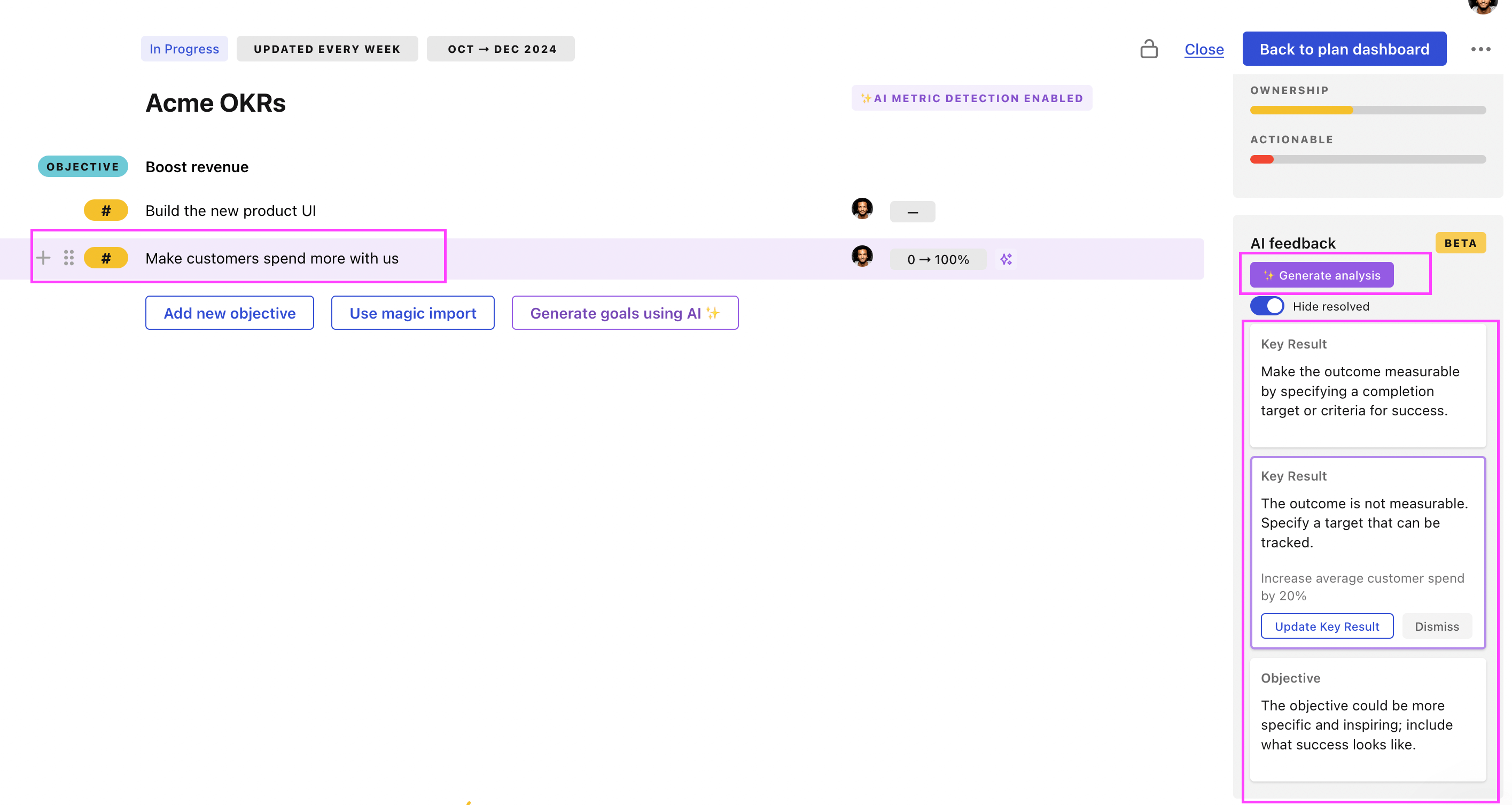
Tability Feedback: to improve existing OKRs
You can use Tability's AI feedback to improve your OKRs if you already have existing goals.
- 1. Create your Tability account
- 2. Add your existing OKRs (you can import them from a spreadsheet)
- 3. Click on Generate analysis
- 4. Review the suggestions and decide to accept or dismiss them
- 5. Publish to start tracking progress and get automated OKR dashboards

Tability will scan your OKRs and offer different suggestions to improve them. This can range from a small rewrite of a statement to make it clearer to a complete rewrite of the entire OKR.
Team Organization OKRs examples
You will find in the next section many different Team Organization Objectives and Key Results. We've included strategic initiatives in our templates to give you a better idea of the different between the key results (how we measure progress), and the initiatives (what we do to achieve the results).
Hope you'll find this helpful!
OKRs to boost developer productivity and team organization
ObjectiveBoost developer productivity and team organization
KRImplement new coding tool reducing bug discovery time by 20%
Purchase and integrate the selected coding tool into existing systems
Research top-rated coding tools aimed at reducing bug discovery time
Train team members on the proper use of the new tool
KRConduct training sessions increasing developer skills by 25%
Identify areas where developers require skill enhancement
Develop effective training modules for identified areas
Implement training and measure skill increase
KREstablish weekly peer code reviews improving solution efficiency by 15%
Initiate scheduling of weekly peer code reviews
Develop efficiency measurement criteria for solutions
Implement feedback loop for continuous improvement
OKRs to achieve deep understanding of each team's business and improve team organization
ObjectiveAchieve deep understanding of each team's business and improve team organization
KRDevelop and implement a customized organization system for each team, noting a 15% increase in efficiency
Analyze each team's current organization system
Create a tailored organization system per team
Monitor and measure efficiency improvement
KRAttend 5 meetings per team to gain in-depth knowledge about their business processes
Review and summarize meeting notes for information
Schedule to join 5 meetings per team
Take detailed notes during each meeting
KRInterview 3 team members from each team to gather detailed insights by Week 6
Schedule interviews with selected team members by Week 3
Conduct and document interviews by Week 6
Prepare detailed interview questions by Week 4
OKRs to enhance professional growth through lunch and learn sessions
ObjectiveEnhance professional growth through lunch and learn sessions
KRWrite and share a summary of key learnings from each session with the team
Distribute summary to team via email
Jot down main points learned during each session
Structure these points into a succinct summary
KRAttend a minimum of 10 lunch and learn sessions by various professionals
Research and list upcoming lunch and learn sessions that interest you
Plan out your schedule to include at least 10 sessions
Regularly attend, engage, and take notes at these events
KRUse the knowledge gained to contribute to at least 2 team projects/tasks
Use acquired understanding to help resolve project challenges
Incorporate new knowledge in planning future team initiatives
Apply learned skills in assisting team members with major project milestones
OKRs to enhance leadership organization skills
ObjectiveEnhance leadership organization skills
KRDe-clutter and streamline the current documentation system to ensure easy access
Digitize paperwork and establish a virtual filing system
Review and categorize all existing documents systematically
Implement an effective search functionality for easier access
KRUndertake a weekly organizational management course for professional growth
Research and select appropriate management course for your career path
Assess weekly learned new skills and apply at work
Reserve designated weekly time for course participation and study
KRImplement a new digital task management system to track team's progress
Train team members on using the new system
Research and select suitable digital task management system
Monitor and assess system efficacy regularly
OKRs to strengthen strategic alignment across all business units
ObjectiveStrengthen strategic alignment across all business units
KRAchieve 80% positive feedback on strategy understanding in anonymous post-workshop surveys
Develop clear, engaging workshop content to encourage comprehension
Follow-up with explanatory resources post-workshop
Implement interactive sessions promoting feedback and discussion
KRConduct 3 alignment workshops achieving 90% attendance from all departments
Determine workshop times that don't conflict with departmental schedules
Send out clear, concise workshop invites to each department
Follow up with non-respondents to ensure maximum attendance
KRDevelop a cross-functional team from all departments by end of month 1
Set team expectations and goal guidelines
Plan and organize initial team-building activities
Identify potential team members from each department
OKRs to strengthen the organizational foundation
ObjectiveStrengthen the organizational foundation
KRIncrease core team productivity metrics by 15%
Use project management tools to track progress
Implement weekly productivity training for the team
Foster a positive, distraction-free working environment
KRInvest 20% of revenue in research and development to innovate foundational processes
Prioritize R&D projects targeting foundational processes
Identify 20% revenue allocation for R&D activities
Recruit experienced R&D professionals and invest in pro-tools
KRDecrease operational cost by 10% through process optimization
Identify inefficient processes in current operational structure
Implement training for staff on optimized processes
Monitor and adjust optimizations regularly for continual improvement
OKRs to drive climate change legislation adoption in Colorado
ObjectiveDrive climate change legislation adoption in Colorado
KRSecure 10 meetings with legislative members to discuss proposed Climate Change Bill
Research contact information for targeted legislative members
Schedule and confirm meeting times with lawmakers
Draft persuasive emails advocating for meeting appointments
KRCollaborate with 5 local environmental organizations for a shared advocacy campaign
Set dates for collaboration meetings to discuss strategies
Identify and reach out to five local environmental organizations
Propose a shared advocacy campaign to each organization
KRIncrease public support by 20% through targeted social media awareness campaigns
Develop relevant and engaging content for social media posts
Implement targeted social media advertising campaigns
Monitor and adjust campaigns based on public response
OKRs to enhance strategic alignment across the organization towards business goals
ObjectiveEnhance strategic alignment across the organization towards business goals
KRIncrease strategic goal awareness by conducting 3 cross-departmental workshops
Communicate workshop details to all departments
Identify appropriate workshop topics that align with strategic goals
Plan and schedule cross-departmental workshops
KRImplement a responsive tracking system for goal assessment and adjustment
Test implementation and adjust accordingly
Develop framework based on research findings
Research various existing goal tracking systems
KRAchieve 20% improvement in goal alignment as assessed by year-end staff survey
Initiate feedback sessions after each project completion
Implement regular alignment check-ins between teams and management
Conduct workshops on effective goal setting and alignment strategies
OKRs to enhance personal organization
ObjectiveEnhance personal organization
KRMaster a productivity app, increasing task completion rate by 25%
Utilize the app regularly to manage tasks
Research and select a high-rated productivity app
Spend daily time learning the app's features
KRMinimize clutter: clean and organize workspace, achieving a 50% reduction
Remove unnecessary items from workspace
Implement regular cleaning schedule
Install organizing tools like shelves, drawers
KRImplement a daily scheduling routine to track all activities by week 1
Monitor and adjust the schedule daily
Purchase a daily planner or download a scheduling app
Allocate time slots for all daily activities
OKRs to implement a sustainable system for organizational growth
ObjectiveImplement a sustainable system for organizational growth
KRDecrease operational inefficiencies by 20% through sustainable strategies
Train staff on environmentally-friendly waste disposal practices
Establish paperless document management system for streamlined operations
Implement energy-efficient equipment across all operational lines
KRSave 15% of business expenses by adopting sustainable practices and policies
Promote recycling or composting to lower waste management costs
Decrease paper usage by promoting digital solutions
Implement energy-efficient equipment to reduce power bills
KRTrain 80% of the team on sustainability best practices by end of quarter
Schedule and conduct training sessions for the team
Identify relevant sustainability best practices for training
Develop a comprehensive sustainability training program
Team Organization OKR best practices
Generally speaking, your objectives should be ambitious yet achievable, and your key results should be measurable and time-bound (using the SMART framework can be helpful). It is also recommended to list strategic initiatives under your key results, as it'll help you avoid the common mistake of listing projects in your KRs.
Here are a couple of best practices extracted from our OKR implementation guide 👇
Tip #1: Limit the number of key results
Focus can only be achieve by limiting the number of competing priorities. It is crucial that you take the time to identify where you need to move the needle, and avoid adding business-as-usual activities to your OKRs.
We recommend having 3-4 objectives, and 3-4 key results per objective. A platform like Tability can run audits on your data to help you identify the plans that have too many goals.
Tip #2: Commit to weekly OKR check-ins
Having good goals is only half the effort. You'll get significant more value from your OKRs if you commit to a weekly check-in process.
Being able to see trends for your key results will also keep yourself honest.
Tip #3: No more than 2 yellow statuses in a row
Yes, this is another tip for goal-tracking instead of goal-setting (but you'll get plenty of OKR examples above). But, once you have your goals defined, it will be your ability to keep the right sense of urgency that will make the difference.
As a rule of thumb, it's best to avoid having more than 2 yellow/at risk statuses in a row.
Make a call on the 3rd update. You should be either back on track, or off track. This sounds harsh but it's the best way to signal risks early enough to fix things.
Save hours with automated Team Organization OKR dashboards

Your quarterly OKRs should be tracked weekly if you want to get all the benefits of the OKRs framework. Reviewing progress periodically has several advantages:
- It brings the goals back to the top of the mind
- It will highlight poorly set OKRs
- It will surface execution risks
- It improves transparency and accountability
Spreadsheets are enough to get started. Then, once you need to scale you can use Tability to save time with automated OKR dashboards, data connectors, and actionable insights.
How to get Tability dashboards:
- 1. Create a Tability account
- 2. Use the importers to add your OKRs (works with any spreadsheet or doc)
- 3. Publish your OKR plan
That's it! Tability will instantly get access to 10+ dashboards to monitor progress, visualise trends, and identify risks early.
More Team Organization OKR templates
We have more templates to help you draft your team goals and OKRs.
OKRs to enhance performance in the top two targeted areas for improvement
OKRs to ensure precision in financial statement generation
OKRs to establish and publicize a Health & Safety Newsletter for awareness
OKRs to improve SOC service level agreement performance by the resolver team
OKRs to implement unbiased performance evaluations system
OKRs to ensure punctual and high-quality project delivery