Tability is a cheatcode for goal-driven teams. Set perfect OKRs with AI, stay focused on the work that matters.
What are Departmental Manager OKRs?
The Objective and Key Results (OKR) framework is a simple goal-setting methodology that was introduced at Intel by Andy Grove in the 70s. It became popular after John Doerr introduced it to Google in the 90s, and it's now used by teams of all sizes to set and track ambitious goals at scale.
Crafting effective OKRs can be challenging, particularly for beginners. Emphasizing outcomes rather than projects should be the core of your planning.
We have a collection of OKRs examples for Departmental Manager to give you some inspiration. You can use any of the templates below as a starting point for your OKRs.
If you want to learn more about the framework, you can read our OKR guide online.
The best tools for writing perfect Departmental Manager OKRs
Here are 2 tools that can help you draft your OKRs in no time.
Tability AI: to generate OKRs based on a prompt
Tability AI allows you to describe your goals in a prompt, and generate a fully editable OKR template in seconds.
- 1. Create a Tability account
- 2. Click on the Generate goals using AI
- 3. Describe your goals in a prompt
- 4. Get your fully editable OKR template
- 5. Publish to start tracking progress and get automated OKR dashboards
Watch the video below to see it in action 👇
Tability Feedback: to improve existing OKRs
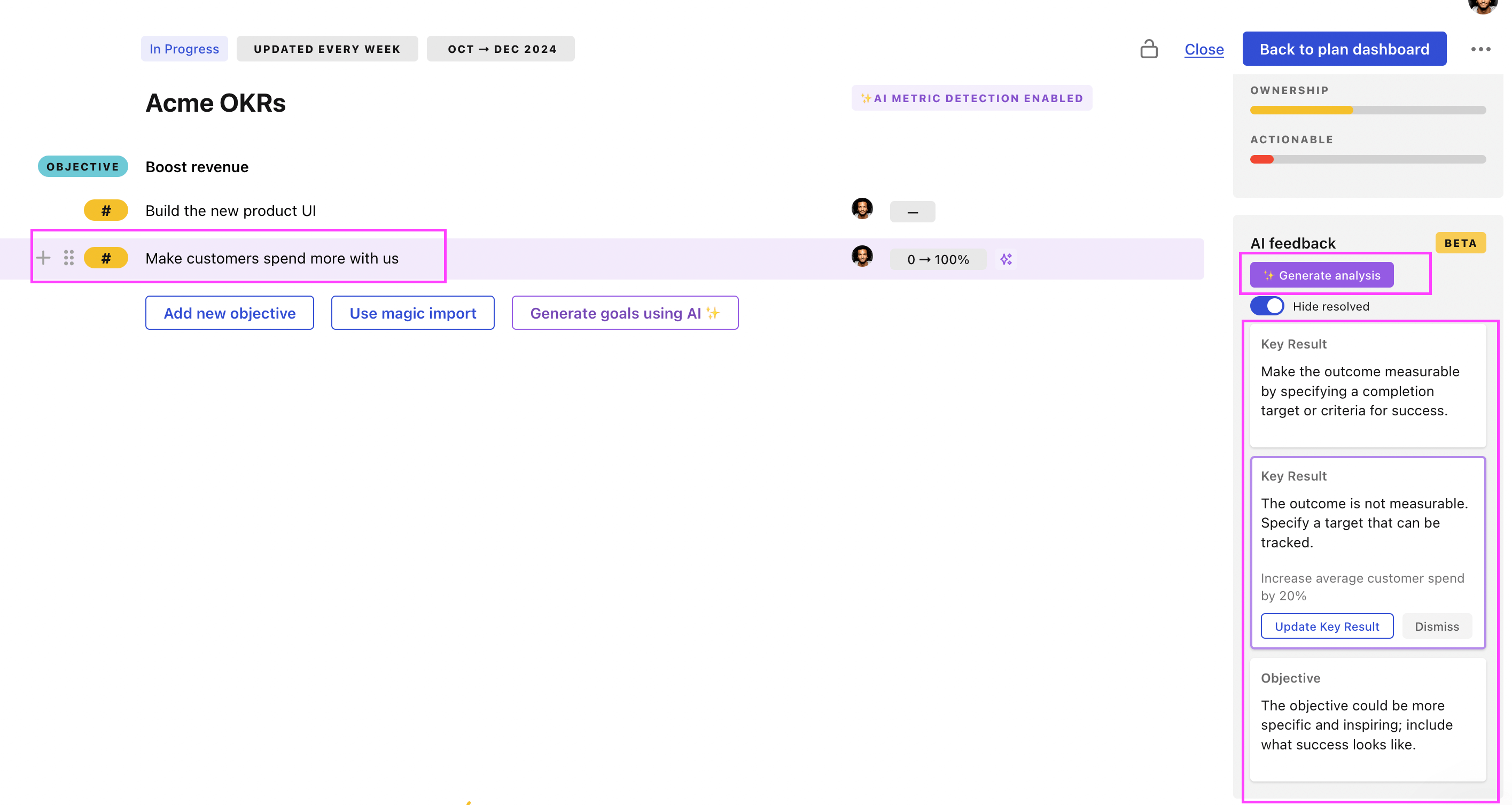
You can use Tability's AI feedback to improve your OKRs if you already have existing goals.
- 1. Create your Tability account
- 2. Add your existing OKRs (you can import them from a spreadsheet)
- 3. Click on Generate analysis
- 4. Review the suggestions and decide to accept or dismiss them
- 5. Publish to start tracking progress and get automated OKR dashboards

Tability will scan your OKRs and offer different suggestions to improve them. This can range from a small rewrite of a statement to make it clearer to a complete rewrite of the entire OKR.
Departmental Manager OKRs examples
We've added many examples of Departmental Manager Objectives and Key Results, but we did not stop there. Understanding the difference between OKRs and projects is important, so we also added examples of strategic initiatives that relate to the OKRs.
Hope you'll find this helpful!
OKRs to enhance productivity and cooperation within the workplace
ObjectiveEnhance productivity and cooperation within the workplace
KRAchieve a 20% decrease in internal misunderstanding or conflict reports
Provide regular conflict resolution training for staff
Establish a transparent method for handling internal reports
Implement a clear, comprehensive internal communication protocol
KRImplement two efficiency-boosting initiatives per department
Implement second initiative in all departments
Roll out one initiative per department
Identify potential efficiency-boosting initiatives
KRIncrease participation in team-building activities by 75%
Implement attractive rewards for active participation
Schedule regular, optional team-building activities
Promote benefits of team-building via internal communications
OKRs to streamline the onboarding process for rapid integration of new hires
ObjectiveStreamline the onboarding process for rapid integration of new hires
KRIncrease new hire proficiency score by 30% within first 60 days
Monitor and evaluate individual job performance
Establish mentorship system within departments
Implement comprehensive orientation program for new hires
KRDecrease average onboarding duration by 25% from current baseline
Improve training materials for quicker learning
Streamline hiring procedures for faster employee integration
Automate administrative tasks to save time
KRAchieve 90% new hire satisfaction rate regarding onboarding process
Address concerns and issues promptly and effectively
Implement a comprehensive and clear onboarding program
Regularly survey new hires for constructive feedback
OKRs to streamline the company's recruitment process
ObjectiveStreamline the company's recruitment process
KRIncrease new hire retention rate by 10% through improved onboarding processes
Develop a comprehensive and engaging employee onboarding program
Provide mentorship opportunities for new employees
Implement regular check-ins with new hires
KRReduce hiring process time by 30% while maintaining quality of hires
Implement an efficient applicant tracking system
Streamline the interview and selection process
Conduct timely background and reference checks
KRImplement a standardized interviewing system across all departments
Develop a standard interview protocol for all departments
Train hiring managers on the new interview system
Monitor and adjust the system based on feedback
OKRs to establish a comprehensive Career Development Program
ObjectiveEstablish a comprehensive Career Development Program
KREnroll 50% employees in career development courses or workshops
KRMeasure and achieve a 25% increase in internal promotions or role advancements
Regularly review individual performance and potential for advancement
Implement robust employee development programs
Define clear career progression pathways within the organization
KRDesign a robust career development framework for all department employees
Research successful career development frameworks in similar industries
Survey employees to identify desired career progression and development areas
Draft a tailorable framework focusing on development, progression, and mentorship
OKRs to enhance inter-departmental collaboration for effective social media operations
ObjectiveEnhance inter-departmental collaboration for effective social media operations
KRPioneer a shared, online document housing all social media initiatives and updates
Create structure for social media initiatives document
Identify suitable online platform for shared document storage
Update document regularly with initiatives and updates
KRImplement weekly cross-departmental meetings focused on social media strategy by month-end
Create a recurring weekly meeting schedule
Outline the meeting agenda focusing on social media
Identify key representatives from each department
KRIncrease shared social media projects between departments by 20%
Implement regular shared social media project progress reports across departments
Develop a centralized social media project management tool for all departments
Initiate weekly interdepartmental brainstorming sessions on social media projects
OKRs to enhance productivity and efficiency of Shared Services Department
ObjectiveEnhance productivity and efficiency of Shared Services Department
KRReduce departmental overheads by 10% through resource optimization efforts
Streamline processes to minimize wastage of materials
Downsize underperforming resources or projects
Implement energy-saving measures to reduce utilities expenses
KRTrain 90% of department staff on new systems and productivity tools
Monitor and document staff members' completion of training
Identify a suitable training program for new systems and productivity tools
Schedule training sessions for all department staff members
KRImplement a unified HR, IT, Legal, and Admin ticketing system to streamline requests
Train staff in using the new ticketing system
Deploy the unified ticketing system across all departments
Identify a unified ticketing system to meet all department needs
OKRs to enhance efficiency and accuracy using AutoML in our data analysis process
ObjectiveEnhance efficiency and accuracy using AutoML in our data analysis process
KRReduce data processing time by 20%
Reduce duplicate/unwanted data through cleaning
Implement streamlined data processing algorithms
Upgrade hardware to increase processing capacity
KRImplement AutoML in 3 different department projects
Compile necessary data for AutoML testing
Identify possible department projects for AutoML application
Train staff on AutoML basics
KRIncrease model prediction accuracy by 15%
Use ensemble methods for model improvement
Implement feature engineering to enhance predictive signals
Optimize hyperparameters using rigorous validation
OKRs to enhance understanding of business requirements
ObjectiveEnhance understanding of business requirements
KRComplete 3 online courses about business requirements analysis and documentation
Diligently complete all course materials and assessments
Identify suitable online courses in business requirements analysis
Register for three chosen online courses
KRConduct 5 cross-departmental informational interviews per month
Conduct and document the informational interviews
Identify five potential interviewees across various departments
Schedule and plan the interviews
KRCreate checklist for comprehensive business requirement gathering in 2 weeks
Design draft of business requirement checklist
Identify key stakeholders for business requirement gathering
Establish critical business needs and objectives
OKRs to establish comprehensive SOPs in five distinct areas
ObjectiveEstablish comprehensive SOPs in five distinct areas
KRFinalize and implement all SOPs, achieving 90% adherence in first month
Review and finalize all Standard Operating Procedures (SOPs)
Monitor and assess adherence to SOPs
Distribute the finalized SOPs to all relevant parties
KRIdentify requisite processes for SOP creation in each area by week two
Schedule deadlines within week two
Define all areas requiring SOP creation
List all requisite processes for each area
KRDraft initial SOPs for all areas, extracting feedback and improvements
Send SOPs to teams for feedback
Create first drafts of SOPs for all departments
Incorporate team feedback for SOP improvements
OKRs to enhance employees' alignment with the organization's objectives and culture
ObjectiveEnhance employees' alignment with the organization's objectives and culture
KRIncrease the average score from employee engagement survey by 20%
Establish an open feedback culture promoting transparency and honesty
Implement training programs focused on communication and team-building skills
Enhance employee recognition and reward strategies
KRConduct 5 company-culture training sessions to all departments
Identify key elements of the company culture for training
Schedule department-wide sessions to communicate timelines
Plan, outline, and prepare the 5 training sessions
KRAchieve 90% successful completion of individual performance targets connected to organisation's objective
Regularly review personal KPIs aligned with organizational objectives
Develop execution strategies for each performance target
Continuously analyze and improve current performance methods
Departmental Manager OKR best practices
Generally speaking, your objectives should be ambitious yet achievable, and your key results should be measurable and time-bound (using the SMART framework can be helpful). It is also recommended to list strategic initiatives under your key results, as it'll help you avoid the common mistake of listing projects in your KRs.
Here are a couple of best practices extracted from our OKR implementation guide 👇
Tip #1: Limit the number of key results
The #1 role of OKRs is to help you and your team focus on what really matters. Business-as-usual activities will still be happening, but you do not need to track your entire roadmap in the OKRs.
We recommend having 3-4 objectives, and 3-4 key results per objective. A platform like Tability can run audits on your data to help you identify the plans that have too many goals.
Tip #2: Commit to weekly OKR check-ins
Don't fall into the set-and-forget trap. It is important to adopt a weekly check-in process to get the full value of your OKRs and make your strategy agile – otherwise this is nothing more than a reporting exercise.
Being able to see trends for your key results will also keep yourself honest.
Tip #3: No more than 2 yellow statuses in a row
Yes, this is another tip for goal-tracking instead of goal-setting (but you'll get plenty of OKR examples above). But, once you have your goals defined, it will be your ability to keep the right sense of urgency that will make the difference.
As a rule of thumb, it's best to avoid having more than 2 yellow/at risk statuses in a row.
Make a call on the 3rd update. You should be either back on track, or off track. This sounds harsh but it's the best way to signal risks early enough to fix things.
Save hours with automated Departmental Manager OKR dashboards

The rules of OKRs are simple. Quarterly OKRs should be tracked weekly, and yearly OKRs should be tracked monthly. Reviewing progress periodically has several advantages:
- It brings the goals back to the top of the mind
- It will highlight poorly set OKRs
- It will surface execution risks
- It improves transparency and accountability
Spreadsheets are enough to get started. Then, once you need to scale you can use Tability to save time with automated OKR dashboards, data connectors, and actionable insights.
How to get Tability dashboards:
- 1. Create a Tability account
- 2. Use the importers to add your OKRs (works with any spreadsheet or doc)
- 3. Publish your OKR plan
That's it! Tability will instantly get access to 10+ dashboards to monitor progress, visualise trends, and identify risks early.
More Departmental Manager OKR templates
We have more templates to help you draft your team goals and OKRs.
OKRs to improve development team productivity
OKRs to implement tech solutions to optimize consulting business
OKRs to enhance the quality of the weekly catalogue
OKRs to minimize expenditure on application hosting
OKRs to identify and address all existing compliance gaps
OKRs to maximize perceived value across all customer profiles