Tability is a cheatcode for goal-driven teams. Set perfect OKRs with AI, stay focused on the work that matters.
What are Back Testing OKRs?
The Objective and Key Results (OKR) framework is a simple goal-setting methodology that was introduced at Intel by Andy Grove in the 70s. It became popular after John Doerr introduced it to Google in the 90s, and it's now used by teams of all sizes to set and track ambitious goals at scale.
Crafting effective OKRs can be challenging, particularly for beginners. Emphasizing outcomes rather than projects should be the core of your planning.
We have a collection of OKRs examples for Back Testing to give you some inspiration. You can use any of the templates below as a starting point for your OKRs.
If you want to learn more about the framework, you can read our OKR guide online.
The best tools for writing perfect Back Testing OKRs
Here are 2 tools that can help you draft your OKRs in no time.
Tability AI: to generate OKRs based on a prompt
Tability AI allows you to describe your goals in a prompt, and generate a fully editable OKR template in seconds.
- 1. Create a Tability account
- 2. Click on the Generate goals using AI
- 3. Describe your goals in a prompt
- 4. Get your fully editable OKR template
- 5. Publish to start tracking progress and get automated OKR dashboards
Watch the video below to see it in action 👇
Tability Feedback: to improve existing OKRs
You can use Tability's AI feedback to improve your OKRs if you already have existing goals.
- 1. Create your Tability account
- 2. Add your existing OKRs (you can import them from a spreadsheet)
- 3. Click on Generate analysis
- 4. Review the suggestions and decide to accept or dismiss them
- 5. Publish to start tracking progress and get automated OKR dashboards
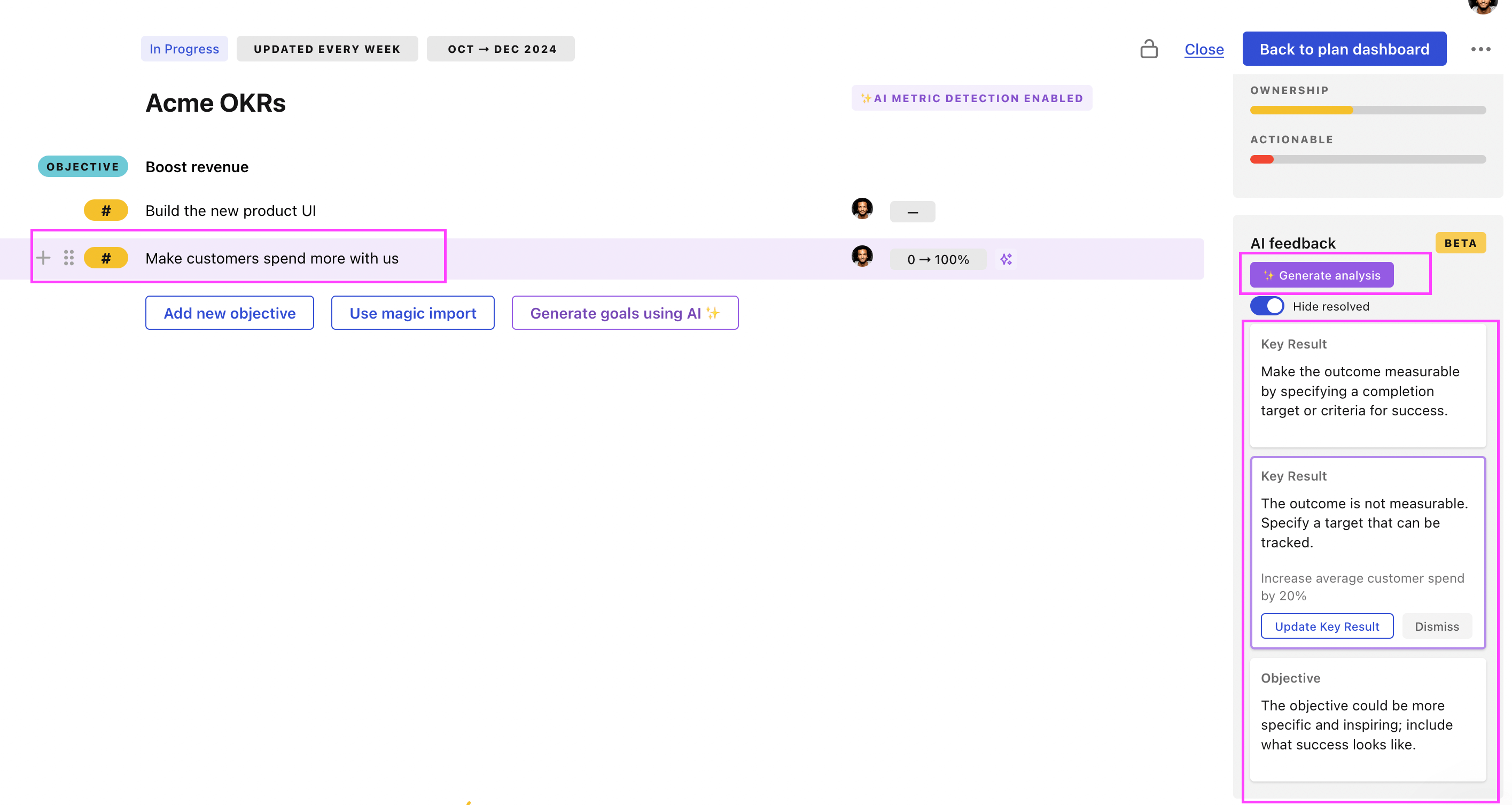
Tability will scan your OKRs and offer different suggestions to improve them. This can range from a small rewrite of a statement to make it clearer to a complete rewrite of the entire OKR.
Back Testing OKRs examples
We've added many examples of Back Testing Objectives and Key Results, but we did not stop there. Understanding the difference between OKRs and projects is important, so we also added examples of strategic initiatives that relate to the OKRs.
Hope you'll find this helpful!
OKRs to develop a cloud-based SAAS loyalty product
 ObjectiveDevelop a cloud-based SAAS loyalty product
 KRComplete backend development process meeting 95% of the defined specifications
 Develop and test backend according to specifications
- Finalize defined specifications for backend development process
- Conduct reviews and adjust code to meet 95% specification accuracy
- KRSuccessfully launch a beta version with less than 3% defects reported
- Prioritize and swiftly address reported defects
- Develop comprehensive testing procedures for beta version
- Provide effective channels for reporting software defects
- KRFinalize system specifications and required features by interviewing 20 potential users
- Identify and contact 20 potential system users for interviews
- Conduct interviews to finalize system specifications
- Finalize required features based on user feedback
OKRs to improve analysis and back-testing of VIX 75 trading
- ObjectiveImprove analysis and back-testing of VIX 75 trading
- KRImprove trading strategy effectiveness by 15% based on back-test results
- Analyze previous trades to identify successful strategies
- Implement and monitor adjusted strategies regularly
- Adjust current strategies based on analysis
- KRImplement a new back-testing strategy for VIX 75 trading
- Design a new enhanced back-testing model
- Test the new strategy, making necessary adjustments
- Research existing back-testing strategies for VIX 75
- KRIncrease accuracy of trading analysis by 25%
- Invest in top-notch analytics software for better data management
- Implement strict quality checks on analysis outputs
- Train team members on advanced trading analysis methods
Back Testing OKR best practices
Generally speaking, your objectives should be ambitious yet achievable, and your key results should be measurable and time-bound (using the SMART framework can be helpful). It is also recommended to list strategic initiatives under your key results, as it'll help you avoid the common mistake of listing projects in your KRs.
Here are a couple of best practices extracted from our OKR implementation guide 👇
Tip #1: Limit the number of key results
The #1 role of OKRs is to help you and your team focus on what really matters. Business-as-usual activities will still be happening, but you do not need to track your entire roadmap in the OKRs.
We recommend having 3-4 objectives, and 3-4 key results per objective. A platform like Tability can run audits on your data to help you identify the plans that have too many goals.
Tip #2: Commit to weekly OKR check-ins
Don't fall into the set-and-forget trap. It is important to adopt a weekly check-in process to get the full value of your OKRs and make your strategy agile – otherwise this is nothing more than a reporting exercise.
Being able to see trends for your key results will also keep yourself honest.
Tip #3: No more than 2 yellow statuses in a row
Yes, this is another tip for goal-tracking instead of goal-setting (but you'll get plenty of OKR examples above). But, once you have your goals defined, it will be your ability to keep the right sense of urgency that will make the difference.
As a rule of thumb, it's best to avoid having more than 2 yellow/at risk statuses in a row.
Make a call on the 3rd update. You should be either back on track, or off track. This sounds harsh but it's the best way to signal risks early enough to fix things.
Save hours with automated Back Testing OKR dashboards
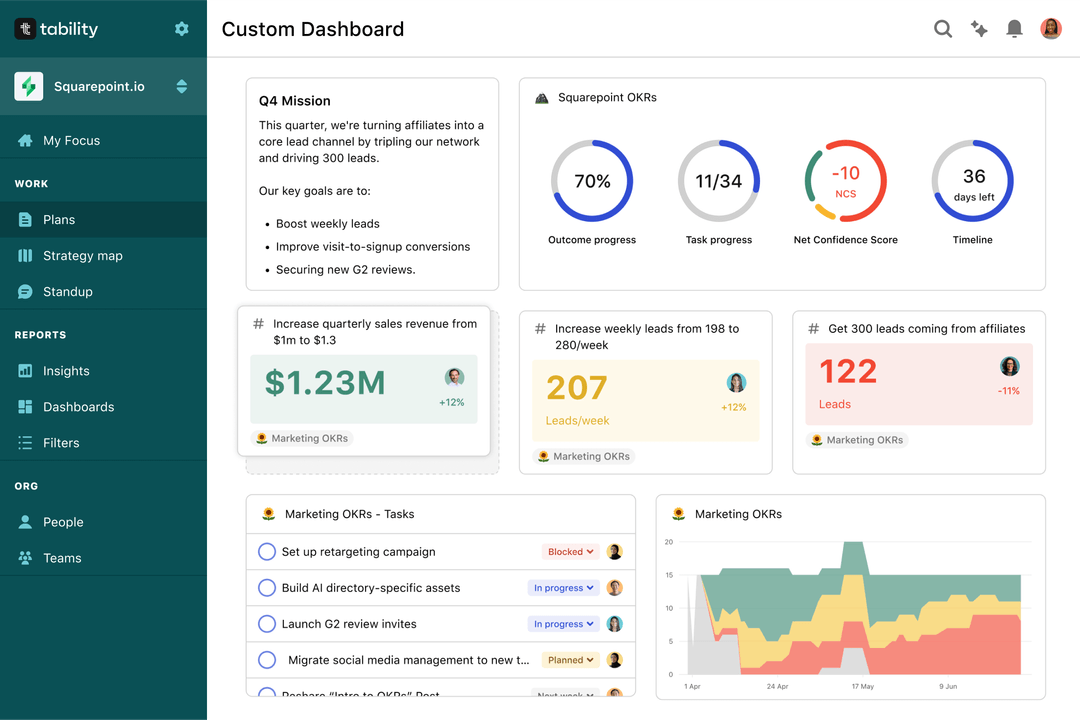
Quarterly OKRs should have weekly updates to get all the benefits from the framework. Reviewing progress periodically has several advantages:
- It brings the goals back to the top of the mind
- It will highlight poorly set OKRs
- It will surface execution risks
- It improves transparency and accountability
Most teams should start with a spreadsheet if they're using OKRs for the first time. Then, you can move to Tability to save time with automated OKR dashboards, data connectors, and actionable insights.
How to get Tability dashboards:
- 1. Create a Tability account
- 2. Use the importers to add your OKRs (works with any spreadsheet or doc)
- 3. Publish your OKR plan
That's it! Tability will instantly get access to 10+ dashboards to monitor progress, visualise trends, and identify risks early.
More Back Testing OKR templates
We have more templates to help you draft your team goals and OKRs.
- OKRs to enhance pre-clinical efficiency and productivity in pharma R&D
- OKRs to reduce IT support response time by 20%
- OKRs to achieve a stable weight of 25 KG less and a BMI of 24.5
- OKRs to successfully establish a progress-tracking Notion template
- OKRs to boost Iranian childhood cancer charity's brand recognition
- OKRs to streamline resource management and patient tracking systems