Get Tability: OKRs that don't suck | Learn more →

10 OKR examples for It Security Officer

Turn your spreadsheets into OKR dashboards with Tability

Tability is a cheatcode for goal-driven teams. Set perfect OKRs with AI, stay focused on the work that matters.

What are It Security Officer OKRs?

The OKR acronym stands for Objectives and Key Results. It's a goal-setting framework that was introduced at Intel by Andy Grove in the 70s, and it became popular after John Doerr introduced it to Google in the 90s. OKRs helps teams has a shared language to set ambitious goals and track progress towards them.

Formulating strong OKRs can be a complex endeavor, particularly for first-timers. Prioritizing outcomes over projects is crucial when developing your plans.

We've tailored a list of OKRs examples for It Security Officer to help you. You can look at any of the templates below to get some inspiration for your own goals.

If you want to learn more about the framework, you can read our OKR guide online.

The best tools for writing perfect It Security Officer OKRs

Here are 2 tools that can help you draft your OKRs in no time.

Tability AI: to generate OKRs based on a prompt

Tability AI allows you to describe your goals in a prompt, and generate a fully editable OKR template in seconds.

Watch the video below to see it in action 👇

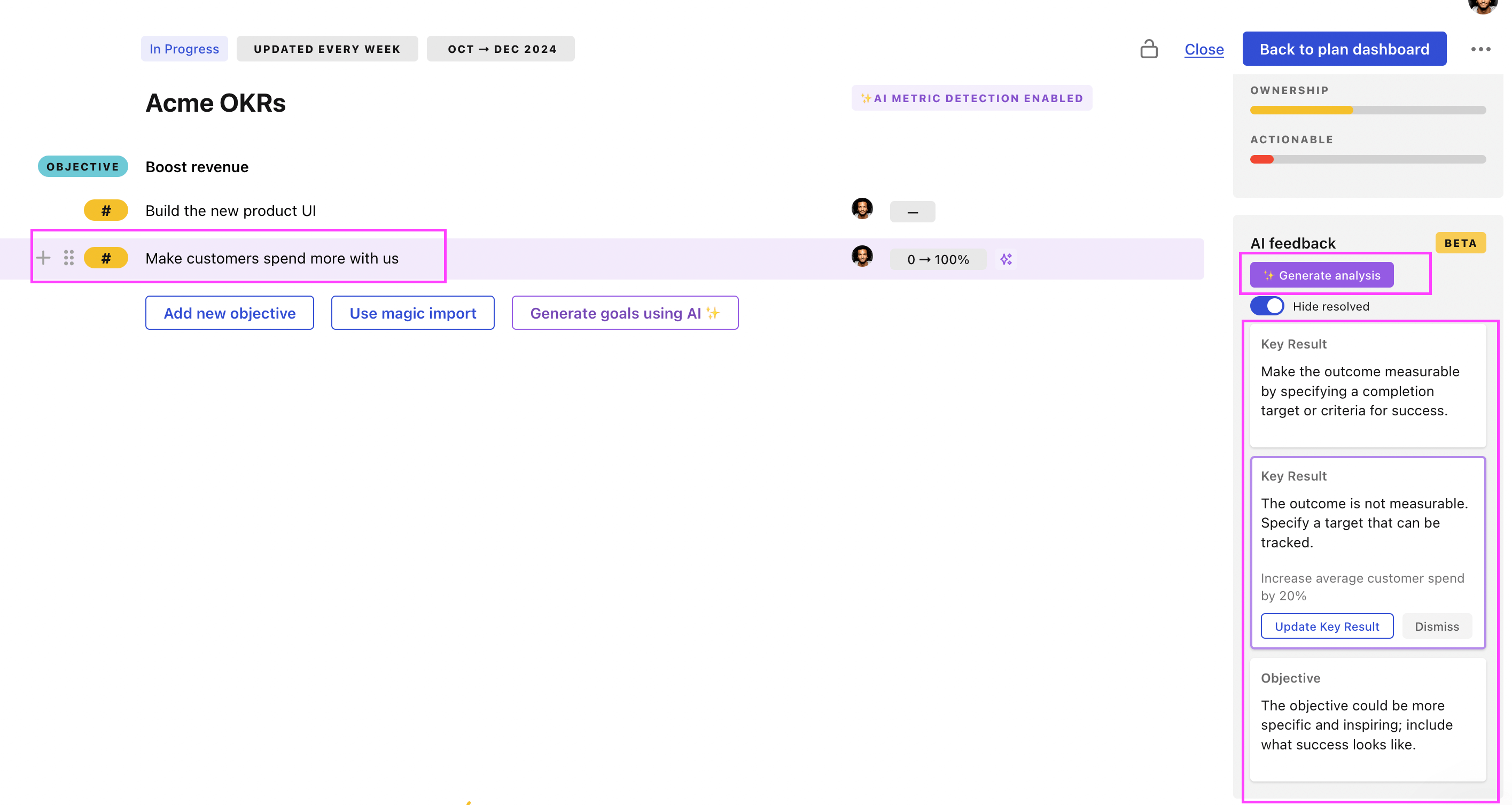
Tability Feedback: to improve existing OKRs

You can use Tability's AI feedback to improve your OKRs if you already have existing goals.

AI feedback for OKRs in Tability

Tability will scan your OKRs and offer different suggestions to improve them. This can range from a small rewrite of a statement to make it clearer to a complete rewrite of the entire OKR.

It Security Officer OKRs examples

You'll find below a list of Objectives and Key Results templates for It Security Officer. We also included strategic projects for each template to make it easier to understand the difference between key results and projects.

Hope you'll find this helpful!

OKRs to strengthen the company's network security defenses

  • ObjectiveStrengthen the company's network security defenses
  • KRTrain 90% of employees on new network security protocols within the next quarter
  • TaskAssess current understanding of network security protocols among employees
  • TaskImplement training, ensuring participation of at least 90% of employees
  • TaskDevelop comprehensive training program on new security protocols
  • KRImplement two-factor authentication for all user accounts by the end of next quarter
  • TaskPurchase and set up chosen authentication system
  • TaskTrain users on new authentication system
  • TaskResearch best two-factor authentication systems for our needs
  • KRReduce the number of detected security breaches by 80% compared to last quarter
  • TaskImplement an updated, top-quality cybersecurity system
  • TaskProvide comprehensive cybersecurity training for all staff
  • TaskConduct regular, intensive IT security audits

OKRs to implement and maintain SOCII compliance measures

  • ObjectiveEnsure ongoing SOCII compliance
  • KRConduct regular testing and auditing to assess SOCII compliance status
  • KRTrain and educate all relevant teams on SOCII compliance regulations and best practices
  • KRMonitor and promptly address any SOCII compliance gaps or violations identified
  • TaskEstablish a dedicated team to promptly address and resolve any identified SOCII compliance issues
  • TaskImplement corrective measures to address identified SOCII compliance gaps promptly
  • TaskConduct regular audits to identify any SOCII compliance gaps or violations
  • TaskMaintain a vigilant monitoring system to detect any new SOCII compliance violations
  • KRImplement and maintain necessary controls and processes to meet SOCII requirements
  • TaskConduct initial assessment of current controls and processes to identify gaps
  • TaskDevelop and document new controls and processes to fulfill SOCII requirements
  • TaskRegularly monitor and evaluate controls and processes to ensure ongoing compliance
  • TaskTrain and educate employees on the importance and execution of SOCII controls

OKRs to minimize exposure to compliance and cybersecurity threats

  • ObjectiveMinimize exposure to compliance and cybersecurity threats
  • KREnhance cybersecurity measures to decrease cyber breaches by 30%
  • TaskImplement strict password policies and two-factor authentication system
  • TaskPerform regular cyber security audits and fix identified vulnerabilities
  • TaskIncrease employee training on phishing scams and other cyber threats
  • KRReduce compliance violations by 20% through implementation of stricter internal processes
  • TaskConduct regular audit checks to identify potential violations
  • TaskIncrease frequency of internal process assessments
  • TaskImplement comprehensive employee training on stricter internal processes
  • KRTrain 90% of employees on updated compliance rules and cyberthreat awareness
  • TaskDevelop an updated compliance and cyberthreat training program
  • TaskEnroll all employees in the training program
  • TaskMonitor employee participation rates to reach 90% completion

OKRs to enhance SIEM visibility via diversified log monitoring

  • ObjectiveEnhance SIEM visibility via diversified log monitoring
  • KRIncrease log correlation effectiveness by 20% to improve threat detection
  • TaskTrain team on efficient threat detection methods
  • TaskRegularly monitor and adjust correlation rules
  • TaskImplement advanced log correlation strategies
  • KRDetect and add logs from 100% of currently unmonitored network devices
  • TaskIdentify all currently unmonitored network devices
  • TaskImplement logging mechanism on each unmonitored device
  • TaskVerify logs are correctly setup and functioning
  • KRIncorporate 30% more diverse log sources into the SIEM system

OKRs to implement and maintain a comprehensive data protection program

  • ObjectiveStrengthen data protection program
  • KREnsure compliance with relevant data protection laws and regulations
  • TaskRegularly review and update data protection practices
  • TaskDevelop and implement policies and procedures for compliance
  • TaskIdentify all applicable data protection regulations
  • TaskTrain employees on data protection laws and regulations
  • KRConduct a thorough risk assessment and mitigation plan
  • Taskcreate contingency plan
  • Taskdevelop mitigation strategies
  • Taskassess likelihood and impact
  • Taskidentify potential risks
  • KRImplement regular employee training and awareness programs
  • TaskSchedule regular training sessions
  • TaskIdentify training needs and design a program
  • TaskEvaluate program effectiveness and make necessary improvements
  • TaskEncourage employee participation and reward progress
  • KRRegularly review and update data protection policies and procedures
  • TaskTrain employees on updated policies and procedures
  • TaskDocument all data protection policies and procedures
  • TaskRegularly audit adherence to policies and procedures
  • TaskAssign responsibility for policy and procedure review and updates

OKRs to establish robust security controls for DHS/ATO and NATO contracts

  • ObjectiveEstablish robust security controls for DHS/ATO and NATO contracts
  • KRConduct quarterly maintenance on all the security controls and document findings
  • TaskDocument observations and any maintenance executed
  • TaskReview all security control systems thoroughly
  • TaskPerform necessary maintenance on security controls
  • KRImplement 5 new security measures aligned with DHS/ATO requirements by a 100%
  • TaskIdentify potential security measures that align with DHS/ATO requirements
  • TaskImplement and test the newly identified security measures
  • TaskReview existing security measures for any DHS/ATO non-compliance
  • KRAchieve zero security breaches related to the NATO contracts information
  • TaskImplement strong encryption on all NATO-related digital communication
  • TaskTrain staff in counter-intelligence and data protection practices
  • TaskRegularly perform rigorous security audits and fix vulnerabilities

OKRs to enhance MFA capabilities and user access review process

  • ObjectiveEnhance MFA capabilities and user access review process
  • KRConduct user access reviews for 100% of active accounts
  • TaskResolve any inappropriate access findings
  • TaskIdentify all active accounts in the system
  • TaskReview access privileges for each account
  • KRImplement an advanced MFA system with at least 95% successful user authentication rate
  • TaskMonitor and improve authentication success rate post-implementation
  • TaskIdentify a reliable advanced MFA system to install
  • TaskPlan and execute staff training on the MFA system
  • KRTrain all employees on new MFA capabilities and access review processes to boost compliance by 90%
  • TaskPlan a comprehensive training on new MFA capabilities for all employees
  • TaskMonitor and track compliance rates, aiming to achieve a 90% increase
  • TaskConduct the training, focusing on access review processes

OKRs to ensure shadow IT alignment with corporate policy

  • ObjectiveEnsure shadow IT alignment with corporate policy
  • KRAnalyze and document compliance gaps in 70% of identified shadow IT initiatives
  • TaskIdentify 70% of existing shadow IT initiatives
  • TaskEvaluate these initiatives for compliance gaps
  • TaskDocument all identified compliance gaps
  • KRImplement policy-compliant changes in 50% of non-compliant shadow IT projects
  • TaskImplement changes in identified projects
  • TaskDraft policy-compliant changes for identified projects
  • TaskIdentify 50% of non-compliant shadow IT projects
  • KRIdentify all shadow IT initiatives by end of week 2
  • TaskCompile a report of all discoveries
  • TaskAnalyze network traffic for unknown applications
  • TaskSurvey employees about unapproved software or systems they're using

OKRs to achieve full cybersecurity compliance across all systems

  • ObjectiveAchieve full cybersecurity compliance across all systems
  • KRImplement rigorous password protocol on all employee devices by providing secure training
  • TaskRegularly update and enforce password protocol
  • TaskDevelop comprehensive password security training program
  • TaskImplement mandatory training for all employees
  • KRAssess and mitigate 100% of identified vulnerabilities in our software infrastructure
  • TaskPrioritize identified vulnerabilities based on potential impact
  • TaskConduct comprehensive vulnerability assessment on entire software infrastructure
  • TaskDevelop and implement mitigation strategies for each vulnerability
  • KRSuccessfully pass an external cybersecurity audit with zero major infringement notices
  • TaskImplement robust cybersecurity policies and procedures
  • TaskPerform frequent internal cybersecurity audits
  • TaskRegularly update and patch all software systems

OKRs to drive cybersecurity awareness across the organization

  • ObjectiveDrive cybersecurity awareness across the organization
  • KRImplement a cybersecurity newsletter reaching all staff members
  • TaskDistribute the newsletter to all staff members
  • TaskCreate engaging content for the newsletter
  • TaskIdentify relevant cybersecurity topics for the newsletter
  • KRAchieve a 25% reduction in reported phishing attempts
  • TaskConduct regular staff cyber security training
  • TaskRegularly update and patch all systems
  • TaskImplement advanced email filtering software
  • KRHave 90% of employees complete a cybersecurity training course
  • TaskMonitor and track course completion
  • TaskIdentify available cybersecurity training courses
  • TaskEnroll employees in selected cybersecurity course

It Security Officer OKR best practices

Generally speaking, your objectives should be ambitious yet achievable, and your key results should be measurable and time-bound (using the SMART framework can be helpful). It is also recommended to list strategic initiatives under your key results, as it'll help you avoid the common mistake of listing projects in your KRs.

Here are a couple of best practices extracted from our OKR implementation guide 👇

Tip #1: Limit the number of key results

Focus can only be achieve by limiting the number of competing priorities. It is crucial that you take the time to identify where you need to move the needle, and avoid adding business-as-usual activities to your OKRs.

We recommend having 3-4 objectives, and 3-4 key results per objective. A platform like Tability can run audits on your data to help you identify the plans that have too many goals.

Tip #2: Commit to weekly OKR check-ins

Having good goals is only half the effort. You'll get significant more value from your OKRs if you commit to a weekly check-in process.

Being able to see trends for your key results will also keep yourself honest.

Tip #3: No more than 2 yellow statuses in a row

Yes, this is another tip for goal-tracking instead of goal-setting (but you'll get plenty of OKR examples above). But, once you have your goals defined, it will be your ability to keep the right sense of urgency that will make the difference.

As a rule of thumb, it's best to avoid having more than 2 yellow/at risk statuses in a row.

Make a call on the 3rd update. You should be either back on track, or off track. This sounds harsh but it's the best way to signal risks early enough to fix things.

Save hours with automated It Security Officer OKR dashboards

AI feedback for OKRs in Tability

Your quarterly OKRs should be tracked weekly if you want to get all the benefits of the OKRs framework. Reviewing progress periodically has several advantages:

Spreadsheets are enough to get started. Then, once you need to scale you can use Tability to save time with automated OKR dashboards, data connectors, and actionable insights.

How to get Tability dashboards:

That's it! Tability will instantly get access to 10+ dashboards to monitor progress, visualise trends, and identify risks early.

More It Security Officer OKR templates

We have more templates to help you draft your team goals and OKRs.

Table of contents