The plan focuses on enhancing the accuracy and effectiveness of a trading robot by measuring several critical metrics. For instance, the "Accuracy Rate" indicates the robot's proficiency in predicting correct trades and is imperative for performance optimization, often benchmarked at 70%. Meanwhile, "Trade Volume" highlights the robot's activity, vital for evaluating algorithm efficiency, with a typical range of 50-100 trades per day.
Additionally, achieving a favorable "Return on Investment (ROI)" is crucial, ensuring that profits outweigh initial costs. The "Win Rate," aiming for above 60%, provides insight into overall trading success. Preventing significant losses is monitored through "Max Drawdown," where the goal is to keep it under 20%.
Each of these metrics plays a pivotal role in forming and adjusting trading strategies. Implementing improvement suggestions like optimizing algorithms, automating processes, and integrating risk management contributes to overall success.
Top 5 metrics for Trading Robot Accuracy
1. Accuracy Rate
The percentage of trades where the robot correctly predicts digit matches out of the total trades.
What good looks like for this metric: Typical benchmark is around 70%
How to improve this metric:- Optimise the prediction algorithm using machine learning
- Regularly backtest with historical data
- Implement risk management strategies
- Enhance data quality and integration
- Continuously monitor and adjust strategy
2. Trade Volume
The total number of trades executed within a given period.
What good looks like for this metric: Varies depending on strategy, typically 50-100 trades per day
How to improve this metric:- Increase trading frequency while maintaining accuracy
- Automate signal identification
- Optimise order execution speed
- Simplify decision-making processes
- Utilise high-performance computing resources
3. Return on Investment (ROI)
The percentage of profit or loss relative to the initial investment in trading.
What good looks like for this metric: Typical ROI for trading strategies can range from 10% to 20% annually
How to improve this metric:- Improve decision-making algorithms
- Implement a stop-loss strategy
- Reduce transaction costs
- Identify and capitalise on market inefficiencies
- Diversify trading instruments
4. Win Rate
The ratio of successful trades to total trades executed.
What good looks like for this metric: Aim for a win rate above 60%
How to improve this metric:- Refine predictive models
- Use technical indicators more effectively
- Conduct post-trade analysis for insights
- Tweak trade entry and exit points
- Test alternative strategies and algorithms
5. Max Drawdown
The maximum percentage loss from the peak to the trough during a trading period.
What good looks like for this metric: Aim for a max drawdown under 20%
How to improve this metric:- Implement stringent risk control measures
- Regularly update risk-reward ratios
- Incorporate stop-loss and take-profit levels
- Reduce position sizes during volatile periods
- Enhance market condition analysis
How to track Trading Robot Accuracy metrics
It's one thing to have a plan, it's another to stick to it. We hope that the examples above will help you get started with your own strategy, but we also know that it's easy to get lost in the day-to-day effort.
That's why we built Tability: to help you track your progress, keep your team aligned, and make sure you're always moving in the right direction.
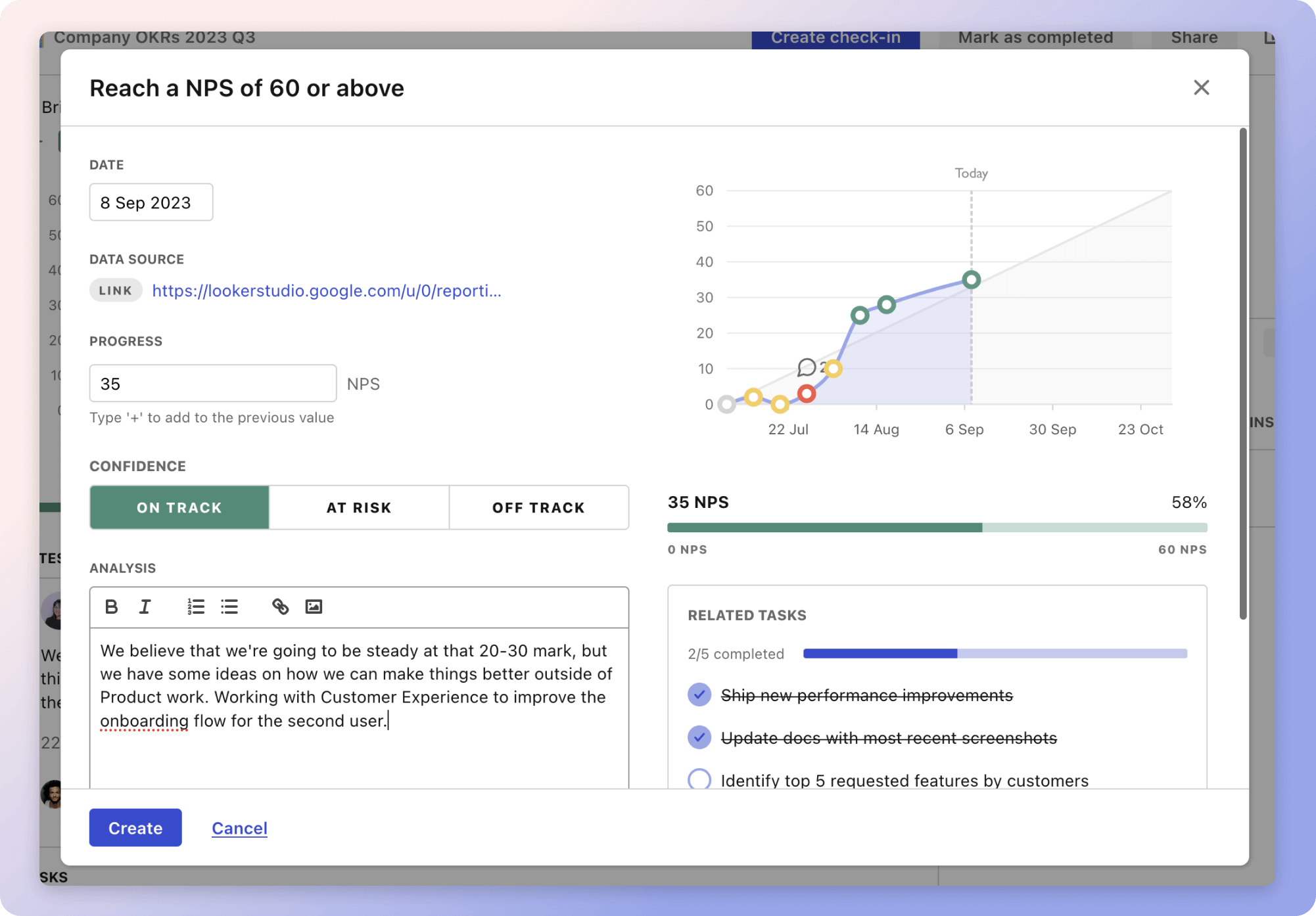
Give it a try and see how it can help you bring accountability to your metrics.
