In short
What is a good minimum viable product OKR?
A good minimum viable product OKR pairs one clear objective with two to four measurable key results the team can score every week. It describes an outcome rather than a list of activities, sets targets that are ambitious but scoreable, and is reviewed weekly so blockers surface before the quarter gets away from the team.
These Minimum Viable Product OKR templates are meant to help teams move from ideas and projects to measurable business outcomes. Use them as a starting point, then tailor the metrics and initiatives to the reality of your company.
This page shows the top 6 of 6 templates for minimum viable product, with internal links to related categories and guidance for adapting the examples to your team.
Last template update in this category: 2024-06-17What this category is for
- Teams that need a clearer operating rhythm for minimum viable product work.
- Managers who want examples they can adapt into outcome-focused quarterly plans.
- Leaders comparing adjacent categories before choosing the best OKR direction.
Best outcomes to track
- Minimum Viable Product priorities tied to measurable business outcomes.
- Weekly check-ins that surface blockers before they become delivery issues.
- Better alignment between initiatives and the metrics that matter.
Related categories
Use these linked categories to explore adjacent planning areas and strengthen the internal topic cluster around minimum viable product.
Minimum Viable Product OKR examples and templates
Start with these top 6 examples from 6 total templates in this category, then adapt the metrics and initiatives to fit your team's constraints and operating cadence.
OKRs to build and launch our minimum viable product (MVP)
 ObjectiveBuild and launch our minimum viable product (MVP)
 KRSecure MVP launch with 100% of targeted early adopters signed up
 Implement sign-up mechanism and secure all early adopter registrations
- Develop a marketing strategy focused on targeted early adopters for the MVP
- Finalize MVP, ensuring it meets the needs of the targeted early adopters
- KRComplete MVP development by achieving 100% of assigned programming tasks
- Prioritize and organize assigned programming tasks by their complexity
- Devote dedicated daily hours to working on these assigned tasks
- Regularly review and test code to ensure quality and functionality
- KRConduct 3 iterative tests for MVP targeting 100% bug resolution
- Execute three iterative tests of MVP
- Analyze testing data, identify and resolve all bugs
- Develop test plan for MVP with goals of identifying bugs
OKRs to launch a viable, user-friendly SaaS product
- ObjectiveLaunch a viable, user-friendly SaaS product
- KRAchieve a customer satisfaction score of above 85%
- Develop a proactive customer communication strategy for problem resolution
- Implement a customer feedback system to identify improvement areas
- Train staff in customer service protocols and problem-solving
- KRDevelop MVP with essential features by involving 10 beta testers
- Gather and integrate feedback to refine MVP features
- Identify the essential features needed for MVP development
- Recruit 10 beta testers for product evaluation
- KRObtain initial sign ups exceeding 50 customers
- Develop enticing advertising campaign targeting potential customers
- Launch sign-up incentive program or promotional offers
- Maximize reach through social media marketing strategies
OKRs to successfully launch the Minimum Viable Product for Product Information Management
- ObjectiveSuccessfully launch the Minimum Viable Product for Product Information Management
- KRRelease the PIM MVP to at least 100 initial users for beta testing
- Finalize MVP of the PIM software for release
- Identify and invite 100 initial beta testers
- Deploy MVP to the selected beta testers
- KRObtain a 75% positive response rate from initial user testing and feedback
- Develop user-friendly, engaging testing protocols
- Incentivize participants to promote response rates
- Follow-up consistently with participants for feedback
- KRComplete development of core features for the MVP by 60% progress on the project timeline
- Allocate tasks to the development team
- Review and monitor team's progress regularly
- Define required core features for the MVP
OKRs to successfully launch challenge MVP (Minimum Viable Product)
- ObjectiveSuccessfully launch challenge MVP (Minimum Viable Product)
- KRDevelop functional prototype of the MVP by engaging tech team
- Assign tasks to tech team for prototype development
- Define MVP specifications and requirements with relevant teams
- Regularly supervise and adjust prototype progress
- KRValidate MVP through feedback from 100 beta users
- Distribute MVP to these users and gather the feedback
- Identify and recruit 100 potential beta users for testing
- Analyze and implement suggestions from user feedback
- KRAchieve 70% user satisfaction rate post MVP launch
- Continuously improve product based on user feedback
- Enhance user support and engagement systems
- Implement customer feedback surveys post-launch
OKRs to successfully launch the tech startup
- ObjectiveSuccessfully launch the tech startup
- KRSecure funding from at least three investors by increasing company visibility
- Enhance online presence through social media and optimized website
- Participate in industry networking events
- Develop a compelling investor presentation
- KRDevelop, test and launch the MVP (minimum viable product) targeting user validation
- Design and develop the minimum viable product
- Carry out rigorous testing and fixing of the MVP
- Launch MVP and collect user validation data
- KRHire and onboard five skilled developers to establish the product team
- Create a detailed job description for developer positions
- Promote vacancies on targeted recruitment platforms
- Develop a comprehensive onboarding program
OKRs to develop a functional and user-friendly MVP
- ObjectiveDevelop a functional and user-friendly MVP
- KRRelease MVP to a test group and achieve more than 85% satisfaction rate
- Identify and organize a comprehensive, relevant test group
- Develop a fully functional MVP for the specified product
- Implement feedback collection and satisfaction measurement tools
- KRIdentify and prioritize the top 3 key features by interviewing 20 potential users
- Conduct interviews with 20 potential users
- Prepare interview questions targeting potential key features
- Analyze responses to determine top 3 features
- KRSecure commitment from a technical developer or agency for MVP development
- Finalize and sign official commitment agreement
- Present project details and expectations to potential developer
- Identify potential technical developers or agencies
How to use Minimum Viable Product OKRs well
Strong OKRs keep the team focused on measurable outcomes instead of a long task list. That means picking a clear objective, limiting the number of competing priorities, and reviewing progress every week.
Use Minimum Viable Product OKRs to define what success looks like this quarter, then track them weekly so the team can quickly spot blockers, learn, and adjust execution.
Choosing software to run Minimum Viable Product OKRs?
Move from minimum viable product examples to execution with sourced comparisons from The OKR Software Benchmark.
- Best OKR software rankingSee the overall verdict and the criteria behind each platform score.
- OKR software pricing comparisonCompare verified prices, minimum commitments, and costs at different team sizes.
- Benchmark methodologyReview the published scoring model, source standards, and conflict-of-interest policy.
Related OKR template categories
If you are building a broader plan, these related categories can help you connect minimum viable product work to adjacent company priorities.
- marketing team OKR templates
- product manager OKR templates
- project manager OKR templates
- leadership OKR templates
- strategic planning OKR templates
- operations OKR templates
More OKR templates to explore
- OKRs to enhance team productivity with collaborative efforts
- OKRs to enhance teamwork across different departments
- OKRs to successfully migrate virtual machines from Linux 7 to Linux 8
- OKRs to become thin and improve physical appearance
- OKRs to increase number of signups through referral program
- OKRs to enhance leadership inclusivity across all teams
Not seeing what you need?
Use Tability AI to generate OKRs based on a prompt
Tability allows you to describe your goals in a prompt, and generate a fully editable OKR template in seconds.
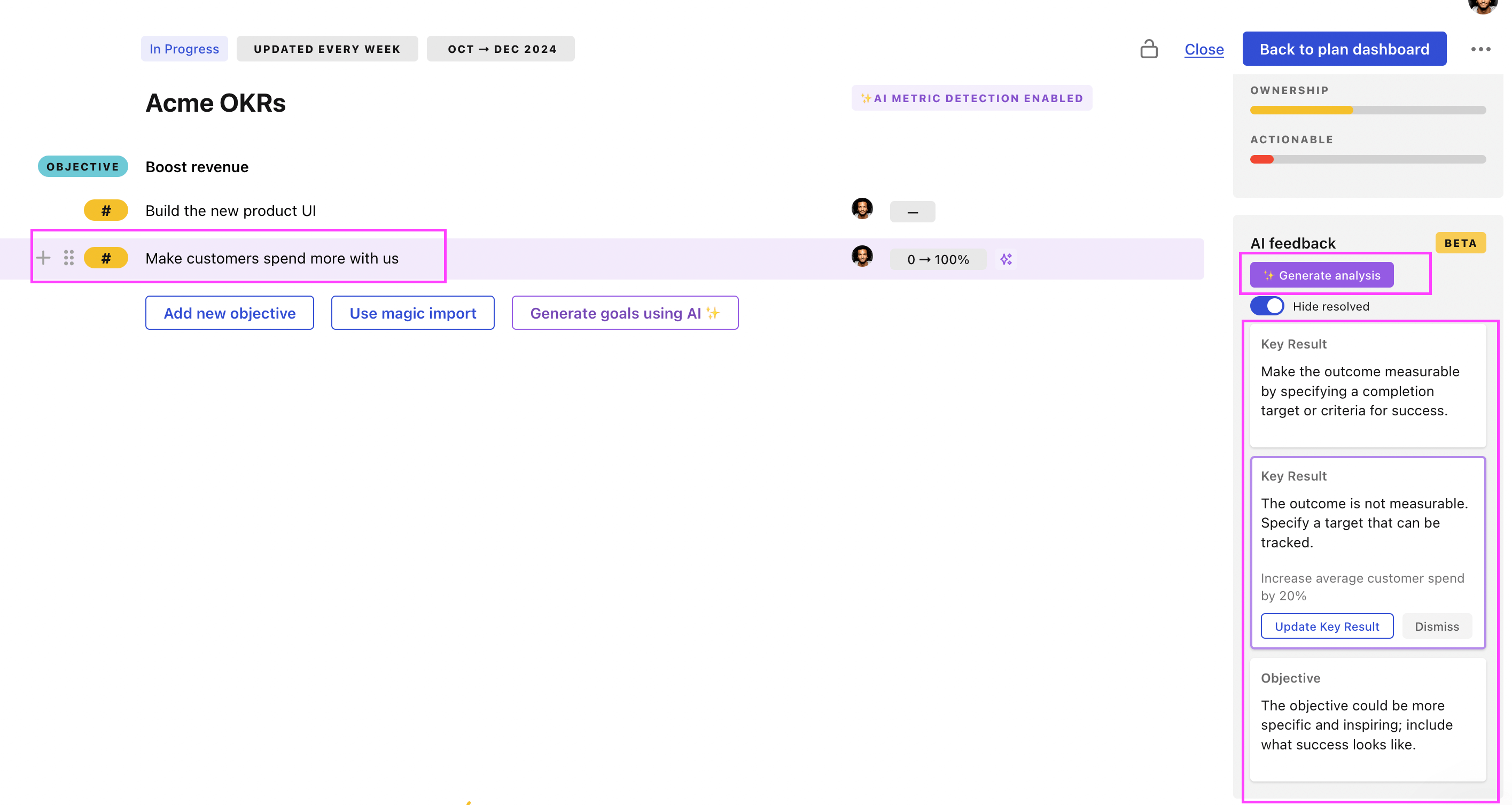
Use Tability feedback to improve existing OKRs
You can also use Tability's AI feedback to improve your OKRs if you already have existing goals. Just import them to the platform and click on the Generate analysis button.
Tability will scan your OKRs and offer different suggestions to improve them. This can range from a small rewrite of a statement to make it clearer to a complete rewrite of the entire OKR.