In short
What is a good cloud migration team OKR?
A good cloud migration team OKR pairs one clear objective with two to four measurable key results the team can score every week. It describes an outcome rather than a list of activities, sets targets that are ambitious but scoreable, and is reviewed weekly so blockers surface before the quarter gets away from the team.
These Cloud Migration Team OKR templates are meant to help teams move from ideas and projects to measurable business outcomes. Use them as a starting point, then tailor the metrics and initiatives to the reality of your company.
This page shows the top 4 of 4 templates for cloud migration team, with internal links to related categories and guidance for adapting the examples to your team.
Last template update in this category: 2024-05-30What this category is for
- Teams that need a clearer operating rhythm for cloud migration team work.
- Managers who want examples they can adapt into outcome-focused quarterly plans.
- Leaders comparing adjacent categories before choosing the best OKR direction.
Best outcomes to track
- Cloud Migration Team priorities tied to measurable business outcomes.
- Weekly check-ins that surface blockers before they become delivery issues.
- Better alignment between initiatives and the metrics that matter.
Related categories
Use these linked categories to explore adjacent planning areas and strengthen the internal topic cluster around cloud migration team.
Priority hubs
Cloud Migration Team OKR examples and templates
Start with these top 4 examples from 4 total templates in this category, then adapt the metrics and initiatives to fit your team's constraints and operating cadence.
OKRs to optimize cloud transition expenses
 ObjectiveOptimize cloud transition expenses
 KRImplement a cost-monitoring dashboard to track cloud expenses
 Train team on using the new dashboard
- Choose a suitable cost-monitoring dashboard software
- Identify key metrics to monitor for cloud expenses
- KRReduce current on-premises infrastructure costs by 20%
- Consolidate redundant hardware and systems to streamline operations
- Negotiate better pricing contracts with vendors
- Implement energy-saving measures for physical infrastructure
- KRAchieve 30% cost savings from the cloud transition
- Identify redundant applications prior to cloud migration
- Optimize cloud storage usage to reduce wastage
- Utilize automated scaling for cloud resources
OKRs to develop and implement an efficient cloud strategy
- ObjectiveDevelop and implement an efficient cloud strategy
- KRIdentify and analyze potential cloud service providers by the end of month 2
- Research potential cloud service providers
- Prepare a comparative analytical report of all providers
- Evaluate providers based on features, cost-effectiveness and reliability
- KRDefine key requirements and desired outcomes of the cloud strategy by month 1
- Outline desired outcomes from implementing the cloud solution
- Identify critical objectives for adopting the cloud strategy
- Determine primary requirements for the cloud strategy
- KRDesign, test, and execute cloud migration strategy achieving 90% transition by quarter end
- Develop comprehensive cloud migration plan, including cost and risk analysis
- Execute the cloud migration, closely monitoring process and resolving issues promptly
- Conduct exhaustive testing on pre-migration process and continuity plans
OKRs to successfully migrate on-prem applications to cloud setup
- ObjectiveSuccessfully migrate on-prem applications to cloud setup
- KRPerform successful trial migration for at least 2 applications without compromising functionality
- Identify two applications suitable for migration testing
- Perform incremental migration while ensuring functionality
- Verify the successful migration and performance
- KRIdentify and prioritize 70% of on-prem applications for migration by comparing impact and feasibility
- Evaluate each application's migration impact and feasibility
- List existing on-prem applications for review
- Prioritize 70% of applications based on evaluation results
- KRAchieve full migration with zero downtime for the prioritized list of applications
- Test and implement the migration plan effectively
- Ensure proper setup for seamless transition without downtime
- Create a detailed migration plan for priority applications
OKRs to efficiently migrate services and databases to Google Cloud
- ObjectiveEfficiently migrate services and databases to Google Cloud
- KRAchieve minimal downtime during the migration process
- Conduct regular communication regarding the migration process with all relevant stakeholders
- Perform a thorough assessment of the existing infrastructure and identify potential issues
- Develop a detailed migration plan with clear timelines and allocated resources
- Implement redundancy measures and backup systems to minimize the impact of any disruptions
- KROptimize costs by analyzing and implementing cost-effective solutions in Google Cloud
- Identify and eliminate any unnecessary services or resources to reduce expenses
- Regularly monitor and review cost reports and adjust strategies accordingly
- Research and implement more cost-effective alternatives or optimized configurations for existing services
- Conduct a thorough analysis of current Google Cloud services and associated costs
- KREnsure seamless data migration from existing databases to Google Cloud
- Perform necessary data cleansing and transformation to ensure compatibility with Google Cloud
- Assess current database structure and data volume for smooth migration planning
- Create a detailed data migration strategy outlining steps, tools, and timelines
- Execute step-by-step migration process, verifying data integrity and minimizing downtime
- KRSuccessfully migrate all services from current platform to Google Cloud
How to use Cloud Migration Team OKRs well
Strong OKRs keep the team focused on measurable outcomes instead of a long task list. That means picking a clear objective, limiting the number of competing priorities, and reviewing progress every week.
Use Cloud Migration Team OKRs to define what success looks like this quarter, then track them weekly so the team can quickly spot blockers, learn, and adjust execution.
Choosing software to run Cloud Migration Team OKRs?
Move from cloud migration team examples to execution with sourced comparisons from The OKR Software Benchmark.
- Best OKR software rankingSee the overall verdict and the criteria behind each platform score.
- OKR software pricing comparisonCompare verified prices, minimum commitments, and costs at different team sizes.
- Benchmark methodologyReview the published scoring model, source standards, and conflict-of-interest policy.
Related OKR template categories
If you are building a broader plan, these related categories can help you connect cloud migration team work to adjacent company priorities.
- finance team OKR templates
- leadership OKR templates
- strategic planning OKR templates
- operations OKR templates
- operations team OKR templates
- sales OKR templates
More OKR templates to explore
- OKRs to implement transparency in project allocation for balanced workload per person
- OKRs to achieve 100% productivity in financial statement preparation
- OKRs to achieve full real-time transaction posting in the system
- OKRs to to Increase productivity in financial statement preparation process
- OKRs to achieve full productivity in general accounting role
- OKRs to implement a laboratory procedure mentorship program
Not seeing what you need?
Use Tability AI to generate OKRs based on a prompt
Tability allows you to describe your goals in a prompt, and generate a fully editable OKR template in seconds.
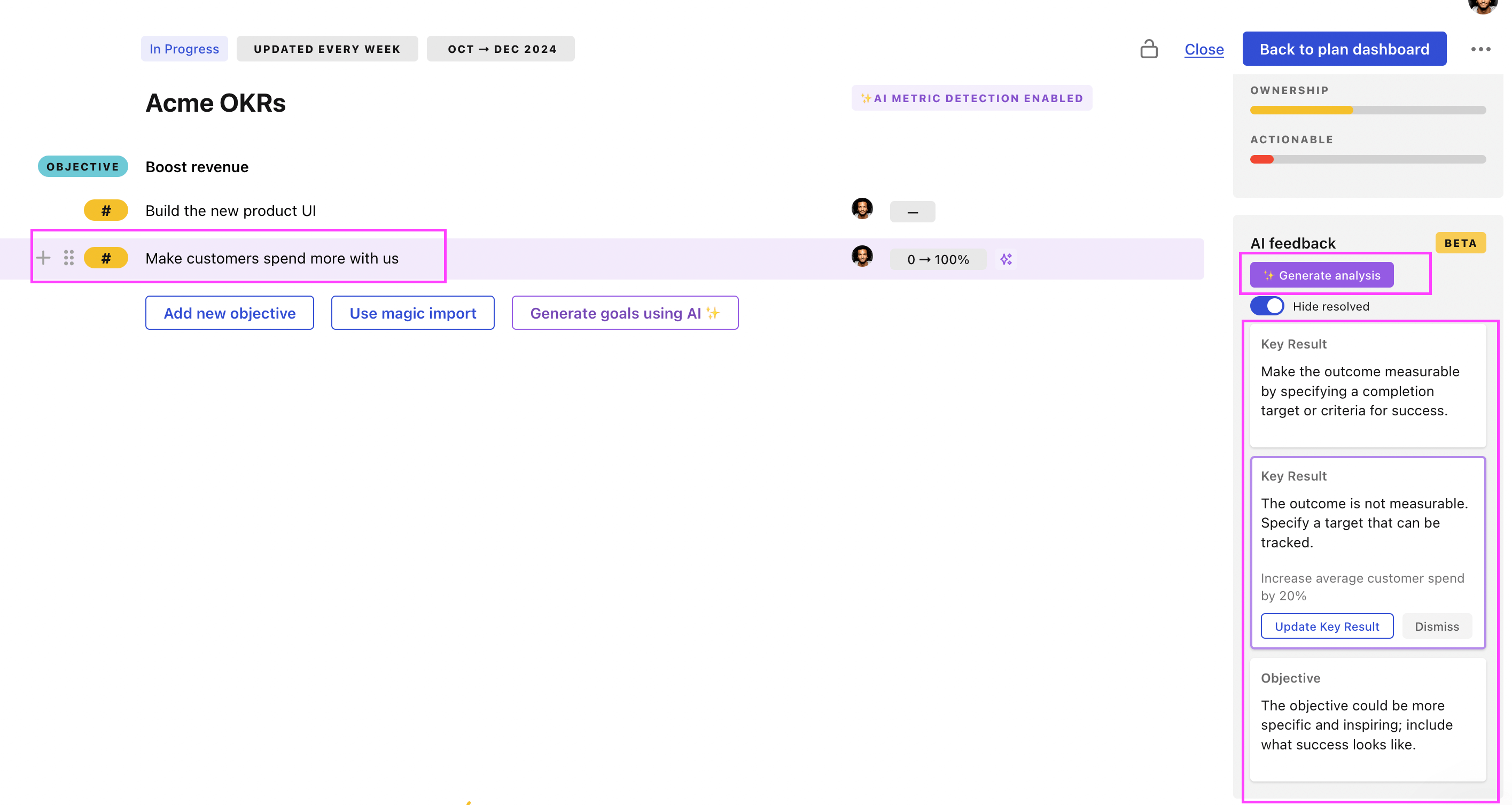
Use Tability feedback to improve existing OKRs
You can also use Tability's AI feedback to improve your OKRs if you already have existing goals. Just import them to the platform and click on the Generate analysis button.
Tability will scan your OKRs and offer different suggestions to improve them. This can range from a small rewrite of a statement to make it clearer to a complete rewrite of the entire OKR.