In short
What is a good research team OKR?
A good research team OKR pairs one clear objective with two to four measurable key results the team can score every week. It describes an outcome rather than a list of activities, sets targets that are ambitious but scoreable, and is reviewed weekly so blockers surface before the quarter gets away from the team.
These Research Team OKR templates are meant to help teams move from ideas and projects to measurable business outcomes. Use them as a starting point, then tailor the metrics and initiatives to the reality of your company.
This page shows the top 10 of 16 templates for research team, with internal links to related categories and guidance for adapting the examples to your team.
Last template update in this category: 2025-08-20What this category is for
- Teams that need a clearer operating rhythm for research team work.
- Managers who want examples they can adapt into outcome-focused quarterly plans.
- Leaders comparing adjacent categories before choosing the best OKR direction.
Best outcomes to track
- Research Team priorities tied to measurable business outcomes.
- Weekly check-ins that surface blockers before they become delivery issues.
- Better alignment between initiatives and the metrics that matter.
Related categories
Use these linked categories to explore adjacent planning areas and strengthen the internal topic cluster around research team.
Research Team OKR examples and templates
Start with these top 10 examples from 16 total templates in this category, then adapt the metrics and initiatives to fit your team's constraints and operating cadence.
OKRs to deliver quality psychological report on time
 ObjectiveDeliver quality psychological report on time
 KRComplete baseline research and case study analysis in first two weeks
 Outline the research and analysis goals and objectives
- Gather relevant case studies for analysis
- Review and summarize gathered data
- KRFinalize and proofread the report, ready for submission in the last week
- Perform thorough proofreading of the report
- Review the report for content accuracy
- Ensure report is ready for final submission
- KRDevelop first draft of report within three weeks of initiating project
- Allocate time daily for focused writing
- Review and refine initial draft
- Identify key points for the report's structure
OKRs to deliver an impactful and engaging informative speech
- ObjectiveDeliver an impactful and engaging informative speech
- KRPractice delivery to ensure speech duration is within the allocated time (+-5%)
- Track and adjust speech duration during practice runs
- Write and rehearse the speech in a real-time setting
- Utilize a timer while practicing to time accuracy
- KRDraft and revise speech content to achieve 95% audience comprehension rate
- Draft speech focusing on clarity and simplicity
- Rehearse and revise speech based on feedback
- Research audience demographics for topic relevancy
- KRCompile comprehensive research on the speech topic by week 2
- Organize findings into a detailed report
- Extract relevant information from sources
- Identify credible sources related to speech topic
OKRs to deliver a compelling speech on "My Experience with AI"
- ObjectiveDeliver a compelling speech on "My Experience with AI"
- KRPractice the speech to receive a peer feedback score above 90%
- Rehearse the speech regularly for fluency and improvement
- Arrange practice sessions for peers to give feedback
- Write a clear, concise and engaging speech
- KRCreate an engaging speech draft with real-life AI applications
- Research current, compelling real-life AI applications
- Outline key points for the speech draft
- Write draft incorporating AI examples
- KRDevelop a deep understanding of AI through industry articles and journals
- Take notes on articles to track and remember key information
- Commit to reading and analyzing one AI-related article daily
- Subscribe to reputable AI-focused industry journals and newsletters
OKRs to understand elite processes in sports
- ObjectiveUnderstand elite processes in sports
- KRInterview 10 professional athletes from diverse sports within one quarter
- Identify and list 10 athletes from diverse sports for interviews
- Prepare relevant questions and conduct interviews
- Reach out to athletes or their managers to schedule interviews
- KRRead and summarise 5 published studies or books on elite sporting processes
- Create a comprehensive summary of each selected study or book
- Select and obtain five reputable studies or books on elite sporting processes
- Carefully read each study or book, making notes of key points
- KRDevelop a 10-point elitism framework derived from athlete interviews and literature analysis
OKRs to understand the elite process comprehensively
- ObjectiveUnderstand the elite process comprehensively
- KRConduct in-depth interviews with 10 top industry professionals about elite process
- Identify and shortlist 10 top industry professionals for interviews
- Schedule and conduct the interviews
- Design and prepare insightful in-depth interview questions
- KRDevelop and present a full report on elite process functioning and applications
- Compile findings into a comprehensive, engaging report
- Research in-depth on the topic of elite process functioning and applications
- Organize a presentation to discuss this report
- KRRead and summarize 5 books on high performance operation strategies
- Read and thoroughly comprehend each book
- Select and procure 5 books on high-performance operation strategies
- Write concise summaries for each book
OKRs to thorough understanding of all interrelated applications for improved initiative research
- ObjectiveThorough understanding of all interrelated applications for improved initiative research
- KRDevelop a process strategy to improve a new initiative's research based on the application interaction findings
- Develop a process strategy based on observed data trends
- Analyze existing application interaction data for key patterns and insights
- Implement process changes, measure results, and iterate as needed
- KREvaluate and document key functionalities of 15 applications by end of Quarter
- Evaluate and note key features of each application
- Compile and finalize documentation of findings
- Identify 15 applications for functionality evaluation
- KRLead four cross-functional meetings to discuss application interactions and understand dependencies
- Schedule four cross-functional team meetings
- Prepare agendas focusing on application interactions
- Identify and list potential dependency issues
OKRs to determine the business benefits of SAP S4
- ObjectiveDetermine the business benefits of SAP S4
- KRIdentify and document 20 potential SAP S4 features beneficial to businesses
- Identify 20 SAP S4 features useful to business operations
- Document each feature's benefits in a comprehensive report
- Research the functionalities and benefits of various SAP S4 features
- KRCreate a detailed report highlighting the identified SAP S4 business benefits
- Gather relevant data and statistics to substantiate each benefit
- Identify the benefits associated with implementing SAP S4 in the business
- Draft a detailed report highlighting these benefits
- KRInterview 10 companies currently using SAP S4 for concrete advantages
- Identify 10 companies currently utilizing SAP S4
- Conduct interviews focusing on SAP S4 advantages
- Arrange interviews with the identified companies
OKRs to expand understanding of commissioned projects
- ObjectiveExpand understanding of commissioned projects
- KRAttend 3 industry seminars on project commissioning by quarter end
- Register for three suitable seminars
- Research upcoming industry seminars on project commissioning
- Schedule and attend the selected seminars
- KRRead and analyze 10 case studies on successful commissioned projects
- Write a brief summary and insight from each case study
- Select and download 10 successful commissioned project case studies
- Thoroughly read each case study for analysis
- KRConduct 5 insightful interviews with project commissioning experts
- Identify and list 5 project commissioning experts for interviews
- Schedule and conduct the interviews, recording responses
- Prepare relevant, insight-provoking questions before interviews
OKRs to expanding understanding of commission-based models
- ObjectiveExpanding understanding of commission-based models
- KRConduct interviews with 5 professionals working on commission in diverse industries
- Schedule and conduct the interviews
- Prepare relevant industry-specific questions for each interview
- Identify and contact five professionals in diverse commission-based sectors
- KRComplete three commission-related online courses with a score of at least 85%
- Achieve at least 85% score in each course
- Enroll in and study for selected courses
- Research and select three commission-related online courses
- KRRead and summarize 10 books on sales commissions within the period
- Thoroughly read and annotate these 10 books
- Draft a summary report for each book
- Select and procure 10 books related to sales commissions
OKRs to explore doctors' insights in prescribing COVID-19 antivirals
- ObjectiveExplore doctors' insights in prescribing COVID-19 antivirals
- KRSchedule and conduct 30 semi-structured interviews with physicians by the end of the period
- Plan the semi-structured interview guidelines
- Identify and list 30 physicians for the interviews
- Arrange and perform the set interviews
- KRAnalyze interview reports to identify three recurring themes within physician responses
- KRDevelop and share a comprehensive report outlining physicians’ prescribing perspectives
- Conduct surveys to gather physicians' prescribing perspectives
- Analyze survey data to develop a comprehensive report
- Distribute the report among relevant stakeholders
How to use Research Team OKRs well
Strong OKRs keep the team focused on measurable outcomes instead of a long task list. That means picking a clear objective, limiting the number of competing priorities, and reviewing progress every week.
Use Research Team OKRs to define what success looks like this quarter, then track them weekly so the team can quickly spot blockers, learn, and adjust execution.
Choosing software to run Research Team OKRs?
Move from research team examples to execution with sourced comparisons from The OKR Software Benchmark.
- Best OKR software rankingSee the overall verdict and the criteria behind each platform score.
- OKR software pricing comparisonCompare verified prices, minimum commitments, and costs at different team sizes.
- Benchmark methodologyReview the published scoring model, source standards, and conflict-of-interest policy.
Related OKR template categories
If you are building a broader plan, these related categories can help you connect research team work to adjacent company priorities.
- operations team OKR templates
- project manager OKR templates
- leadership OKR templates
- strategic planning OKR templates
- operations OKR templates
- sales OKR templates
More OKR templates to explore
- OKRs to enhance effectiveness of AD and email administration
- OKRs to enhance drayage gross margin via cost optimization
- OKRs to establish a thriving Community of Practice to enhance collaborative learning
- OKRs to boost overall employee satisfaction levels
- OKRs to expand user acquisition significantly
- OKRs to improve mobile user experience for our ecommerce website
Not seeing what you need?
Use Tability AI to generate OKRs based on a prompt
Tability allows you to describe your goals in a prompt, and generate a fully editable OKR template in seconds.
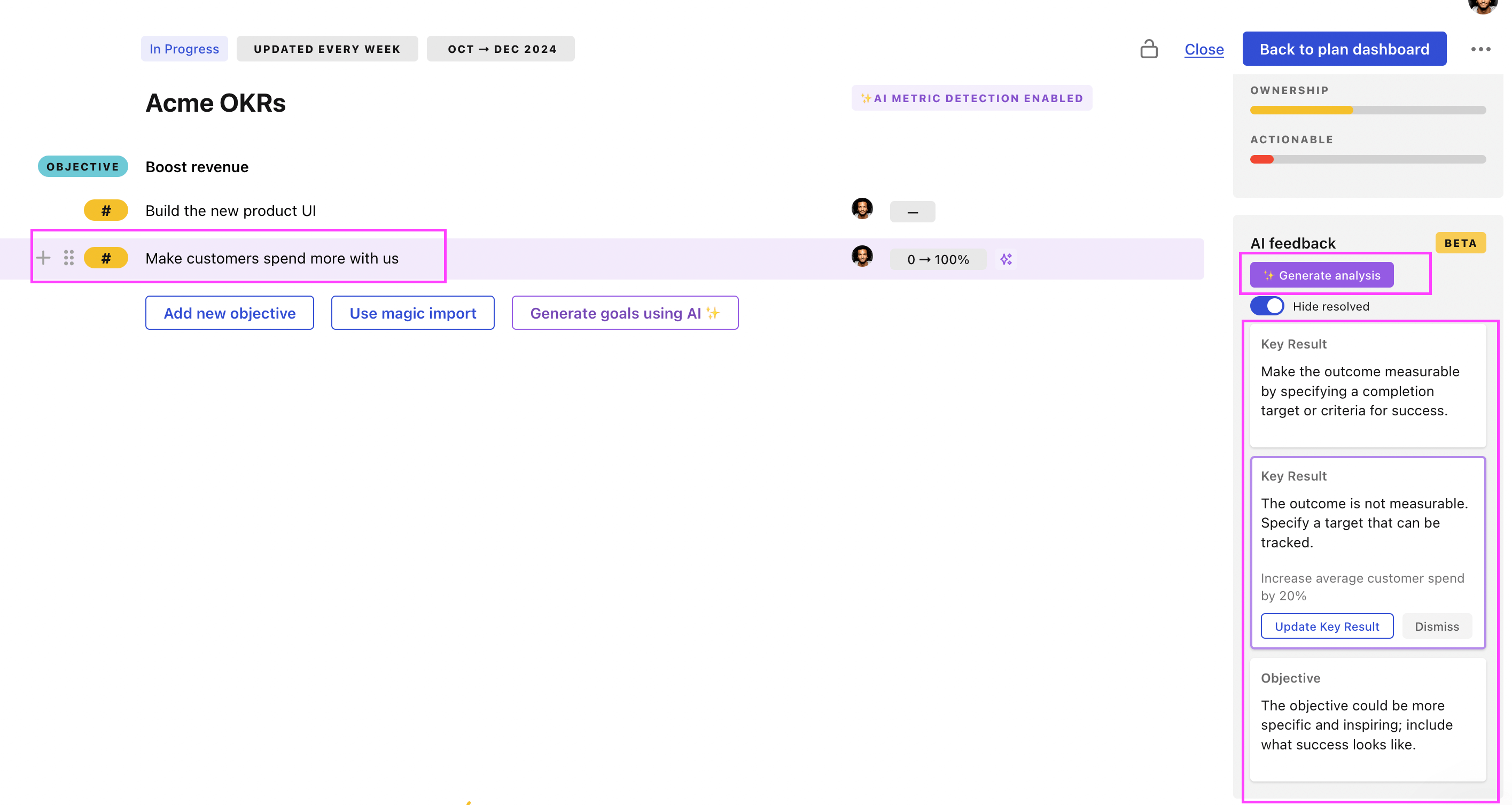
Use Tability feedback to improve existing OKRs
You can also use Tability's AI feedback to improve your OKRs if you already have existing goals. Just import them to the platform and click on the Generate analysis button.
Tability will scan your OKRs and offer different suggestions to improve them. This can range from a small rewrite of a statement to make it clearer to a complete rewrite of the entire OKR.