Tability is a cheatcode for goal-driven teams. Set perfect OKRs with AI, stay focused on the work that matters.
What are Ai Product Development OKRs?
The Objective and Key Results (OKR) framework is a simple goal-setting methodology that was introduced at Intel by Andy Grove in the 70s. It became popular after John Doerr introduced it to Google in the 90s, and it's now used by teams of all sizes to set and track ambitious goals at scale.
Creating impactful OKRs can be a daunting task, especially for newcomers. Shifting your focus from projects to outcomes is key to successful planning.
We have curated a selection of OKR examples specifically for Ai Product Development to assist you. Feel free to explore the templates below for inspiration in setting your own goals.
If you want to learn more about the framework, you can read our OKR guide online.
The best tools for writing perfect Ai Product Development OKRs
Here are 2 tools that can help you draft your OKRs in no time.
Tability AI: to generate OKRs based on a prompt
Tability AI allows you to describe your goals in a prompt, and generate a fully editable OKR template in seconds.
- 1. Create a Tability account
- 2. Click on the Generate goals using AI
- 3. Describe your goals in a prompt
- 4. Get your fully editable OKR template
- 5. Publish to start tracking progress and get automated OKR dashboards
Watch the video below to see it in action 👇
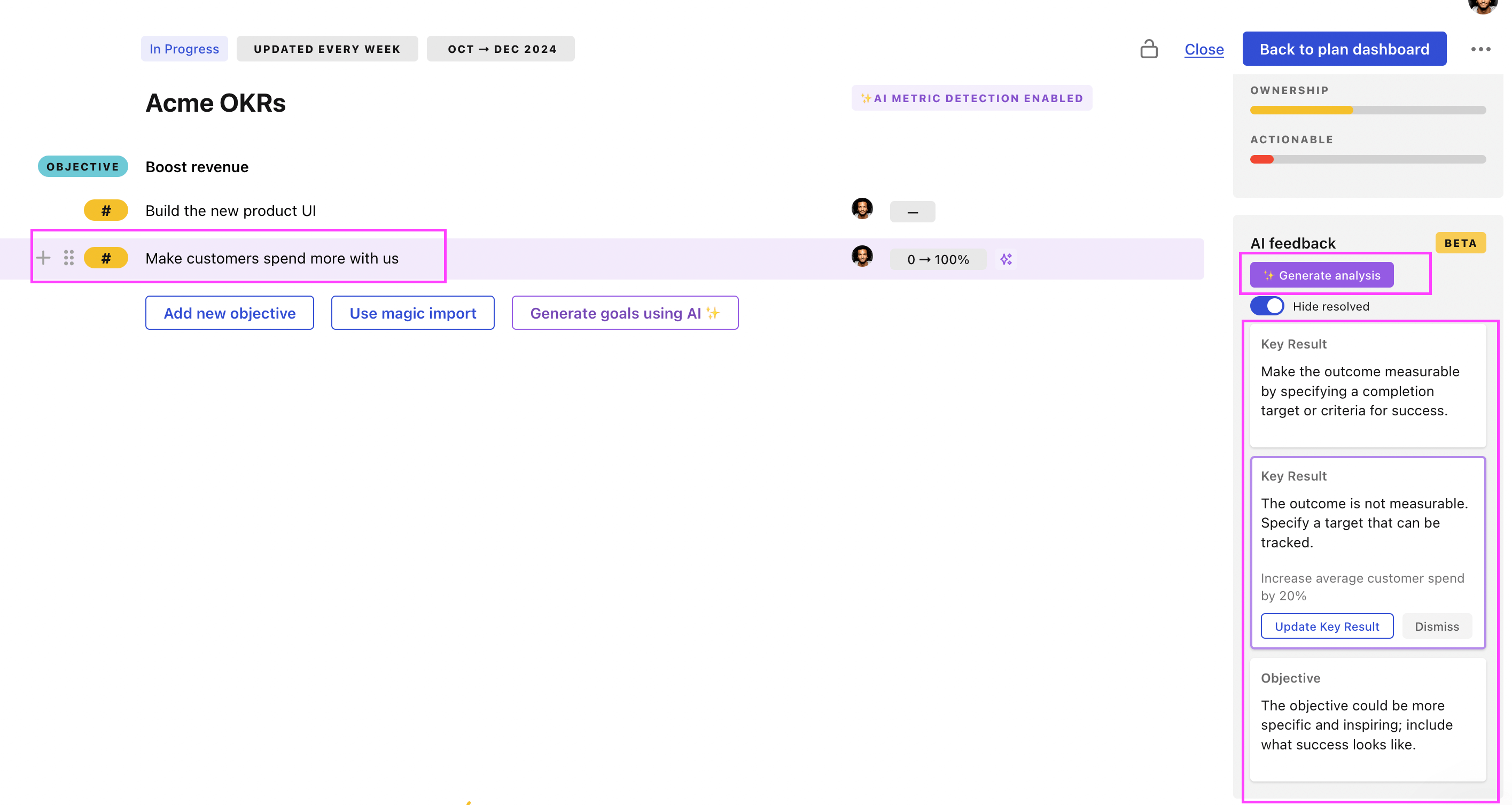
Tability Feedback: to improve existing OKRs
You can use Tability's AI feedback to improve your OKRs if you already have existing goals.
- 1. Create your Tability account
- 2. Add your existing OKRs (you can import them from a spreadsheet)
- 3. Click on Generate analysis
- 4. Review the suggestions and decide to accept or dismiss them
- 5. Publish to start tracking progress and get automated OKR dashboards

Tability will scan your OKRs and offer different suggestions to improve them. This can range from a small rewrite of a statement to make it clearer to a complete rewrite of the entire OKR.
Ai Product Development OKRs examples
We've added many examples of Ai Product Development Objectives and Key Results, but we did not stop there. Understanding the difference between OKRs and projects is important, so we also added examples of strategic initiatives that relate to the OKRs.
Hope you'll find this helpful!
OKRs to drive innovation in healthcare through AI implementation
ObjectiveDrive innovation in healthcare through AI implementation
KRLaunch 2 AI-enabled health products to improve patient care
Identify potential AI technologies for health product development
Conduct user tests and gather feedback for improvements
Assemble a dedicated project team for AI product integration
KRIncrease AI-basedplatform user engagement by 15%
Incorporate personalized recommendations using AI
Revamp UI design to improve user experience
Enhance AI-based interactive features
KRReduce AI system diagnosis errors by 10%
Train AI on more diverse datasets
Implement continuous performance assessment
Update algorithms to enhance diagnostic accuracy
OKRs to integrate Generative AI across the entire product lineup
ObjectiveIntegrate Generative AI across the entire product lineup
KRTrain and launch generative AI models in 50% of product functionalities
Develop and train generative AI models for selected functionalities
Implement and test AI models within each selected product functionality
Identify product functionalities suitable for generative AI
KRAchieve 70% user satisfaction with AI-generated content or predictions
Develop user feedback mechanisms for AI-generated content
Continually update AI algorithms for accuracy
Initiate improvements based on collected user feedback
KRReduce manual intervention by 40% in selected processes through AI automation
Analyze and adjust AI efficiency
Identify processes that require repetitive manual intervention
Implement AI automation in identified processes
OKRs to implement AI tools for refining film production processes
ObjectiveImplement AI tools for refining film production processes
KRSuccessfully incorporate NLP into script-development systems, improving efficiency by 40%
Identify NLP tools suitable for script-development systems
Monitor and measure efficiency improvements regularly
Incorporate selected NLP tools into our script-development process
KRTrain staff members on AI usage, achieving 80% employee proficiency by quarter-end
Provide continuous support for AI-related queries
Develop a comprehensive AI training program for staff
Implement regular proficiency tests on AI usage
KRComplete prototyping of an AI-based imaging system, increasing image quality by 50%
Evaluate and refine prototype to achieve 50% image quality improvement
Draft design specifications for an AI-based imaging system
Develop prototype incorporating AI technologies
OKRs to establish a proficient AI team with skilled ML engineers and product manager
ObjectiveEstablish a proficient AI team with skilled ML engineers and product manager
KRRecruit an experienced AI product manager with a proven track record
Reach out to AI professionals on LinkedIn
Post the job ad on AI and tech-focused job boards
Draft a compelling job description for the AI product manager role
KRConduct an effective onboarding program to integrate new hires into the team
Arrange team building activities to promote camaraderie
Develop a comprehensive orientation package for new hires
Assign mentors to guide newcomers in their roles
KRInterview and hire 5 qualified Machine Learning engineers
Conduct interviews and evaluate candidates based on benchmarks
Promote job vacancies on recruitment platforms and LinkedIn
Develop detailed job descriptions for Machine Learning engineer positions
OKRs to enhance authenticity of our AI product
ObjectiveEnhance authenticity of our AI product
KRIncrease AI response variation by 25% to simulate human conversation
Identify patterns and redundancy in current AI responses
Develop new conversational algorithms and responses
Implement and test changes within the AI system
KRImplement regular user feedback loops to measure and improve authenticity by 20%
Analyze feedback and implement authenticity improvements
Deploy regular user feedback surveys
Develop a consistent survey focused on authenticity measurement
KRReduce AI response time by 15% to achieve realistic interaction
Implement system checks and balances to reduce lag time
Optimize AI algorithms to increase efficiency
Upgrade hardware to improve processing speed of the AI
OKRs to develop AI-assisted cosmetics prototype with Korean OEM factories
ObjectiveDevelop AI-assisted cosmetics prototype with Korean OEM factories
KRLaunch a successful prototype showcase with a minimum 30% influencer approval rate
Develop an engaging prototype based on market trends and user requirements
Establish connections with key influencers within the relevant industry
Organize a compelling showcase event, inviting these influential figures
KRSecure partnerships with at least 3 Korean OEM factories for product collaboration
Finalize and formalize partnership agreements
Initiate partnership discussions and negotiations
Identify potential Korean OEM factories for collaboration
KRHave at least 5 influencers create unique cosmetics concepts via AI dialogue
Facilitate the influencers in creating unique cosmetics concepts
Provide influencers with training on AI dialogue tools
Identify and contact 5 influencers interested in cosmetics
OKRs to increase programmer productivity, quality, and happiness through the use of AI Tools
ObjectiveIncrease programmer productivity, quality, and happiness through the use of AI Tools
KRImprove programmer productivity by decreasing the time spent on repetitive tasks by 15%
Develop standardized templates and guidelines to ensure consistency and eliminate redundant work
Provide training to enhance programmers' skills and efficiency in relevant areas
Implement task automation tools to eliminate repetitive manual tasks
Streamline code review process for quicker feedback and reduced rework time
KRIncrease the adoption rate of AI Tools among programmers by 25%
KRIncrease code quality by reducing the number of bugs found in production by 20%
Implement code reviews and pair programming to catch bugs earlier
Provide comprehensive documentation and clear comments throughout the codebase
Invest in automated testing tools to identify and prevent bugs more efficiently
Conduct thorough testing and debugging before deploying code to production
KRBoost programmer happiness by increasing their satisfaction score in the quarterly survey by 10%
Ai Product Development OKR best practices
Generally speaking, your objectives should be ambitious yet achievable, and your key results should be measurable and time-bound (using the SMART framework can be helpful). It is also recommended to list strategic initiatives under your key results, as it'll help you avoid the common mistake of listing projects in your KRs.
Here are a couple of best practices extracted from our OKR implementation guide 👇
Tip #1: Limit the number of key results
Having too many OKRs is the #1 mistake that teams make when adopting the framework. The problem with tracking too many competing goals is that it will be hard for your team to know what really matters.
We recommend having 3-4 objectives, and 3-4 key results per objective. A platform like Tability can run audits on your data to help you identify the plans that have too many goals.
Tip #2: Commit to weekly OKR check-ins
Setting good goals can be challenging, but without regular check-ins, your team will struggle to make progress. We recommend that you track your OKRs weekly to get the full benefits from the framework.
Being able to see trends for your key results will also keep yourself honest.
Tip #3: No more than 2 yellow statuses in a row
Yes, this is another tip for goal-tracking instead of goal-setting (but you'll get plenty of OKR examples above). But, once you have your goals defined, it will be your ability to keep the right sense of urgency that will make the difference.
As a rule of thumb, it's best to avoid having more than 2 yellow/at risk statuses in a row.
Make a call on the 3rd update. You should be either back on track, or off track. This sounds harsh but it's the best way to signal risks early enough to fix things.
Save hours with automated Ai Product Development OKR dashboards

OKRs without regular progress updates are just KPIs. You'll need to update progress on your OKRs every week to get the full benefits from the framework. Reviewing progress periodically has several advantages:
- It brings the goals back to the top of the mind
- It will highlight poorly set OKRs
- It will surface execution risks
- It improves transparency and accountability
We recommend using a spreadsheet for your first OKRs cycle. You'll need to get familiar with the scoring and tracking first. Then, you can scale your OKRs process by using Tability to save time with automated OKR dashboards, data connectors, and actionable insights.
How to get Tability dashboards:
- 1. Create a Tability account
- 2. Use the importers to add your OKRs (works with any spreadsheet or doc)
- 3. Publish your OKR plan
That's it! Tability will instantly get access to 10+ dashboards to monitor progress, visualise trends, and identify risks early.
More Ai Product Development OKR templates
We have more templates to help you draft your team goals and OKRs.
OKRs to enhance management of billable target and team's learning needs
OKRs to to effectively elevate my leadership abilities
OKRs to enhance technical performance and usability of the website
OKRs to strengthen and streamline third-party relationships
OKRs to implement a performance-based pay system for field technicians
OKRs to enhancement of CSR initiatives' financial efficiency and impact