Tability is a cheatcode for goal-driven teams. Set perfect OKRs with AI, stay focused on the work that matters.
What are Warehouse Team OKRs?
The Objective and Key Results (OKR) framework is a simple goal-setting methodology that was introduced at Intel by Andy Grove in the 70s. It became popular after John Doerr introduced it to Google in the 90s, and it's now used by teams of all sizes to set and track ambitious goals at scale.
Writing good OKRs can be hard, especially if it's your first time doing it. You'll need to center the focus of your plans around outcomes instead of projects.
We understand that setting OKRs can be challenging, so we have prepared a set of examples tailored for Warehouse Team. Take a peek at the templates below to find inspiration and kickstart your goal-setting process.
If you want to learn more about the framework, you can read our OKR guide online.
The best tools for writing perfect Warehouse Team OKRs
Here are 2 tools that can help you draft your OKRs in no time.
Tability AI: to generate OKRs based on a prompt
Tability AI allows you to describe your goals in a prompt, and generate a fully editable OKR template in seconds.
- 1. Create a Tability account
- 2. Click on the Generate goals using AI
- 3. Describe your goals in a prompt
- 4. Get your fully editable OKR template
- 5. Publish to start tracking progress and get automated OKR dashboards
Watch the video below to see it in action 👇
Tability Feedback: to improve existing OKRs
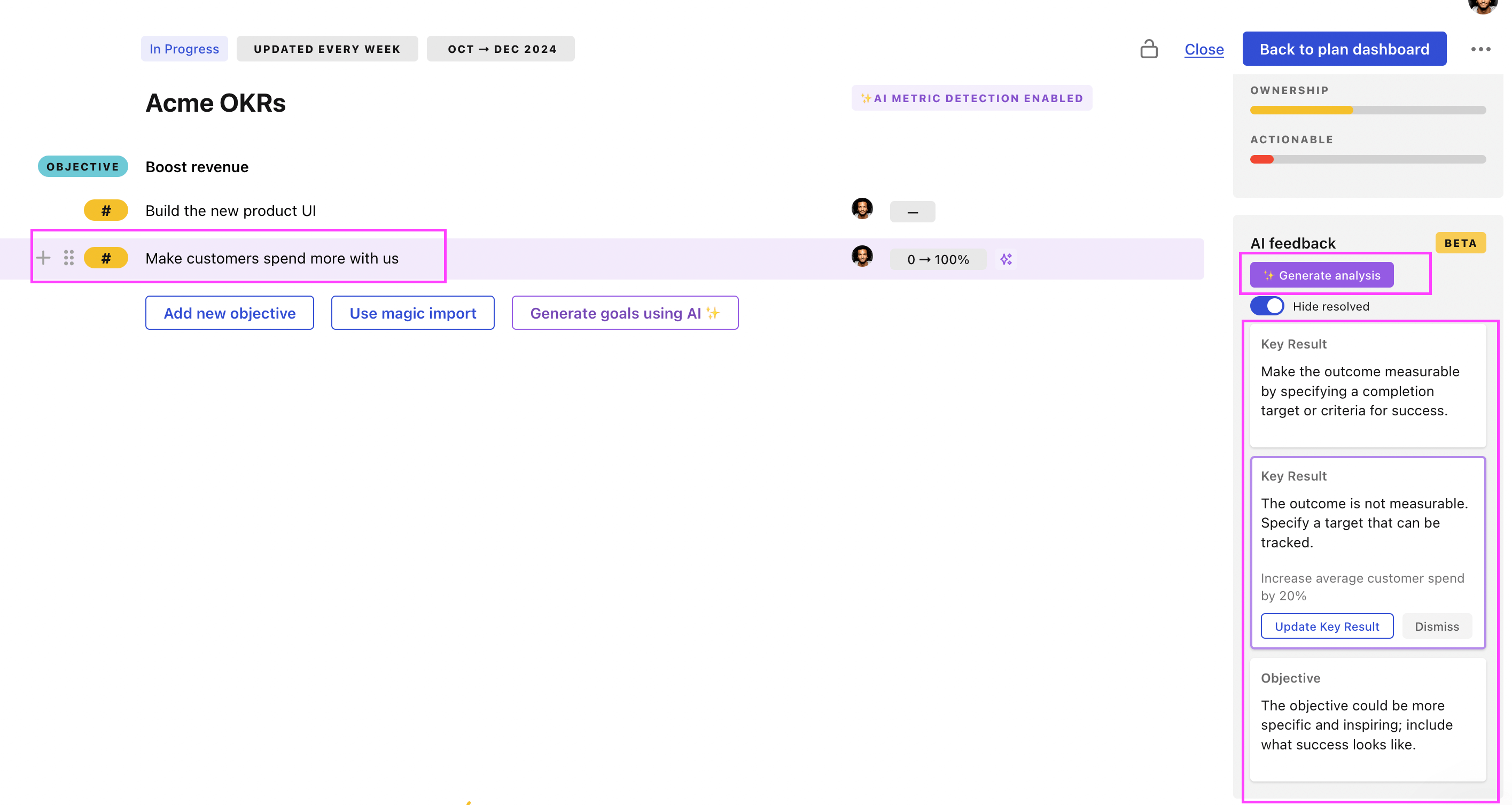
You can use Tability's AI feedback to improve your OKRs if you already have existing goals.
- 1. Create your Tability account
- 2. Add your existing OKRs (you can import them from a spreadsheet)
- 3. Click on Generate analysis
- 4. Review the suggestions and decide to accept or dismiss them
- 5. Publish to start tracking progress and get automated OKR dashboards

Tability will scan your OKRs and offer different suggestions to improve them. This can range from a small rewrite of a statement to make it clearer to a complete rewrite of the entire OKR.
Warehouse Team OKRs examples
You'll find below a list of Objectives and Key Results templates for Warehouse Team. We also included strategic projects for each template to make it easier to understand the difference between key results and projects.
Hope you'll find this helpful!
OKRs to enhance warehouse inbound efficiency and accuracy
ObjectiveEnhance warehouse inbound efficiency and accuracy
KRReduce inbound processing errors by 40%
Implement regular training sessions for processing teams
Establish a standard protocol for all inbound processing
Upgrade our processing software for better accuracy
KRAchieve at least 95% accuracy in inventory recording
Train personnel in inventory management best practices
Implement a digital system for inventory recording
Conduct regular audits of your current inventory
KRIncrease inbound processing speed by 30%
Streamline existing workflows for higher efficiency
Invest in advanced, faster inbound processing software
Train staff on speed optimization techniques
OKRs to implement uniform warehouse improvement program across all facilities
ObjectiveImplement uniform warehouse improvement program across all facilities
KRTrain 80% of warehouse staff on standardized continuous improvement program methodologies
KRAchieve a 10% increase in overall warehouse efficiency through program implementation
Research and select a suitable efficiency-improving program
Train staff and implement the selected program
Identify areas of inefficiency in the current warehouse operations
KRReduce reported warehousing errors by 15% following program implementation
Improve error reporting system for faster rectification
Regularly inspect for potential warehouse management issues
Implement rigorous warehouse operation training programs
OKRs to maximize warehouse revenue per square foot
ObjectiveMaximize warehouse revenue per square foot
KRGrow overall warehouse revenue by 30%
Increase sales through targeted marketing strategies
Develop partnerships for revenue sharing opportunities
Improve warehouse efficiency to increase order fulfillment
KREnhance inventory turnover by 15%
Increase marketing efforts to boost product demand
Implement inventory management software for efficiency
Provide staff training on inventory management
KRIncrease warehouse space utilization by 20%
Evaluate current inventory management strategy for inefficiencies
Implement a lean warehouse management system
Optimize warehouse layout using space utilization techniques
OKRs to boost gross margin in warehouse operations
ObjectiveBoost gross margin in warehouse operations
KRImprove warehouse inventory turnover rate by 20%
Implement an efficient automated inventory management system
Conduct regular stock evaluations and adjustments
Train staff on inventory turnover improvement strategies
KRIncrease efficiency of warehouse processes by 15% using lean methodologies
Monitor, assess and improve warehouse processes regularly
Train staff on efficiency-enhancing techniques and procedures
Implement lean methodologies for streamlined warehouse operations
KRImplement a 10% reduction in non-essential operational expenses by quarter-end
Review all non-essential expenses in detail
Develop and enforce a budget reduction plan
Identify areas for potential cost cuts
OKRs to enhance the efficiency of putaway and picking strategies
ObjectiveEnhance the efficiency of putaway and picking strategies
KRIncrease picking accuracy by 15%
Regularly audit and update inventory management software
Train workers on effective inventory management techniques
Implement barcode scanning system to reduce mispicks
KRImprove order fulfillment speed by 10%
Implement automated inventory tracking system
Train staff in efficient packing techniques
Review and streamline order processing procedures
KRReduce putaway errors by 20%
Monitor and address recurring putaway errors
Train staff on correct putaway procedures
Implement barcode scanning for increased inventory accuracy
OKRs to enhance warehouse labor productivity by implementing lean methodologies and automation
ObjectiveEnhance warehouse labor productivity by implementing lean methodologies and automation
KRImplement an automation system, reducing manual tasks by 30%
Identify repetitive tasks that are viable for automation
Research and select a suitable automation system
Train staff to effectively use the system
KRTrain 95% of warehouse staff on lean methodologies by end of the quarter
Monitor and document employee completion of training
Schedule mandatory training sessions for warehouse staff
Develop a comprehensive lean methodologies training program
KRAchieve a 15% decrease in labor time spent on non-value-added activities
Train staff in time management and productive work habits
Implement process optimization strategies to reduce inefficiencies
Introduce automation in repetitive, time-consuming tasks
OKRs to optimize putaway and picking strategies
ObjectiveOptimize putaway and picking strategies
KRImplement a new putaway and picking strategy into two additional warehouses
Train warehouse staff on new procedures
Monitor and assess strategy effectiveness
Identify necessary changes for new putaway and picking strategy
KRAchieve a 25% reduction in time spent on putaway processes
Train staff on efficient putaway methods
Streamline and optimize putaway process flow
Implement automated inventory management software
KRBoost picking accuracy to 98%
Train staff on best picking practices and techniques
Invest in advanced pick-to-light systems for increased accuracy
Implement regular accuracy audits and error tracking
OKRs to improve product excellence and expedite shipping
ObjectiveImprove product excellence and expedite shipping
KRShorten average shipping time by 20% across all product lines
Optimize warehouse organizational system to improve efficiency
Implement expedited processing for all product lines
Negotiate faster delivery times with shipping providers
KRImplement one new quality control technique and reduce customer complaints by 10%
Research and select a new quality control technique to implement
Train staff in the new quality control method application
Track customer complaints to measure improvements
KRAchieve a 15% decrease in product defects identified through quality checks
Develop new quality control procedures
Implement research on common defect trends
Conduct regular training sessions for staff
OKRs to streamline Inbound Procedures for Warehouse Efficiency
ObjectiveStreamline Inbound Procedures for Warehouse Efficiency
KRIncrease speed of inventory turnover by 20% with optimized inbound workflows
Implement streamlined processes in receiving and sorting inventory
Integrate technology for efficient inventory tracking
Enhance staff training on optimized inbound workflows
KRAchieve a 5% decrease in product damage during inbound operations
Provide intensive training for warehouse handling staff
Implement rigorous quality control checks on inbound products
Upgrade storage and transportation facilities
KRReduce inbound processing time by 30% through process automation
Identify repetitive tasks suitable for automation
Implement automation software into the inbound process
Train staff on using the new automation system
OKRs to enhance efficiency and effectiveness in logistics export
ObjectiveEnhance efficiency and effectiveness in logistics export
KRShorten average export delivery time by 15%
Enhance coordination with transportation partners
Invest in warehouse efficiency improvements
Implement optimized export routes and delivery schedules
KRIncrease export volume by 20%
Conduct market research to identify potential new international markets
Improve product packaging for international standards
Develop relationship with international distributors
KRImprove logistical error rate to below 5%
Update and enforce strict quality controls
Implement regular training programs for logistics staff
Integrate advanced logistics software
Warehouse Team OKR best practices
Generally speaking, your objectives should be ambitious yet achievable, and your key results should be measurable and time-bound (using the SMART framework can be helpful). It is also recommended to list strategic initiatives under your key results, as it'll help you avoid the common mistake of listing projects in your KRs.
Here are a couple of best practices extracted from our OKR implementation guide 👇
Tip #1: Limit the number of key results
The #1 role of OKRs is to help you and your team focus on what really matters. Business-as-usual activities will still be happening, but you do not need to track your entire roadmap in the OKRs.
We recommend having 3-4 objectives, and 3-4 key results per objective. A platform like Tability can run audits on your data to help you identify the plans that have too many goals.
Tip #2: Commit to weekly OKR check-ins
Don't fall into the set-and-forget trap. It is important to adopt a weekly check-in process to get the full value of your OKRs and make your strategy agile – otherwise this is nothing more than a reporting exercise.
Being able to see trends for your key results will also keep yourself honest.
Tip #3: No more than 2 yellow statuses in a row
Yes, this is another tip for goal-tracking instead of goal-setting (but you'll get plenty of OKR examples above). But, once you have your goals defined, it will be your ability to keep the right sense of urgency that will make the difference.
As a rule of thumb, it's best to avoid having more than 2 yellow/at risk statuses in a row.
Make a call on the 3rd update. You should be either back on track, or off track. This sounds harsh but it's the best way to signal risks early enough to fix things.
Save hours with automated Warehouse Team OKR dashboards

Your quarterly OKRs should be tracked weekly if you want to get all the benefits of the OKRs framework. Reviewing progress periodically has several advantages:
- It brings the goals back to the top of the mind
- It will highlight poorly set OKRs
- It will surface execution risks
- It improves transparency and accountability
Spreadsheets are enough to get started. Then, once you need to scale you can use Tability to save time with automated OKR dashboards, data connectors, and actionable insights.
How to get Tability dashboards:
- 1. Create a Tability account
- 2. Use the importers to add your OKRs (works with any spreadsheet or doc)
- 3. Publish your OKR plan
That's it! Tability will instantly get access to 10+ dashboards to monitor progress, visualise trends, and identify risks early.
More Warehouse Team OKR templates
We have more templates to help you draft your team goals and OKRs.
OKRs to enhance lead generation by delivering high-quality content
OKRs to enhance Direct-to-Consumer (DTC) conversion rates
OKRs to ensure effective management of EUC assets
OKRs to establish and implement a Jobs to be Done Framework in our team
OKRs to enhance knowledge and understanding through qualitative research
OKRs to ensure all company devices are asset tagged