Tability is a cheatcode for goal-driven teams. Set perfect OKRs with AI, stay focused on the work that matters.
What are Human Resource Managers OKRs?
The OKR acronym stands for Objectives and Key Results. It's a goal-setting framework that was introduced at Intel by Andy Grove in the 70s, and it became popular after John Doerr introduced it to Google in the 90s. OKRs helps teams has a shared language to set ambitious goals and track progress towards them.
Formulating strong OKRs can be a complex endeavor, particularly for first-timers. Prioritizing outcomes over projects is crucial when developing your plans.
We've tailored a list of OKRs examples for Human Resource Managers to help you. You can look at any of the templates below to get some inspiration for your own goals.
If you want to learn more about the framework, you can read our OKR guide online.
The best tools for writing perfect Human Resource Managers OKRs
Here are 2 tools that can help you draft your OKRs in no time.
Tability AI: to generate OKRs based on a prompt
Tability AI allows you to describe your goals in a prompt, and generate a fully editable OKR template in seconds.
- 1. Create a Tability account
- 2. Click on the Generate goals using AI
- 3. Describe your goals in a prompt
- 4. Get your fully editable OKR template
- 5. Publish to start tracking progress and get automated OKR dashboards
Watch the video below to see it in action 👇
Tability Feedback: to improve existing OKRs
You can use Tability's AI feedback to improve your OKRs if you already have existing goals.
- 1. Create your Tability account
- 2. Add your existing OKRs (you can import them from a spreadsheet)
- 3. Click on Generate analysis
- 4. Review the suggestions and decide to accept or dismiss them
- 5. Publish to start tracking progress and get automated OKR dashboards
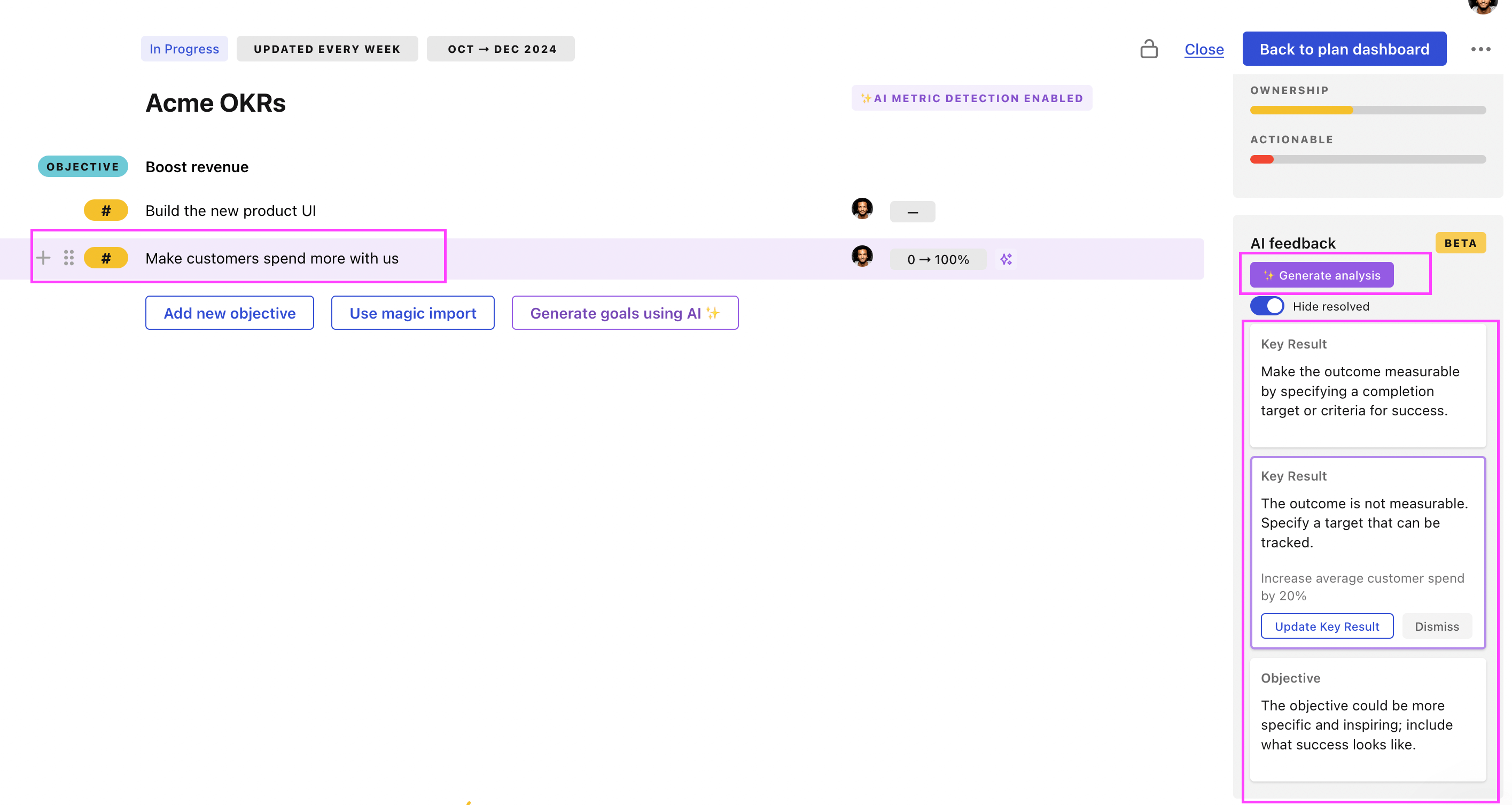
Tability will scan your OKRs and offer different suggestions to improve them. This can range from a small rewrite of a statement to make it clearer to a complete rewrite of the entire OKR.
Human Resource Managers OKRs examples
We've added many examples of Human Resource Managers Objectives and Key Results, but we did not stop there. Understanding the difference between OKRs and projects is important, so we also added examples of strategic initiatives that relate to the OKRs.
Hope you'll find this helpful!
OKRs to improve recruitment process and effectiveness
 ObjectiveImprove recruitment process and effectiveness
 KRIncrease number of quality candidates shortlisted by 25%
 Enhance job descriptions for better candidate attraction
- Expand referral networks for high-quality candidates
- Implement rigorous screening processes
- KRImprove candidate satisfaction score by at least 15% post-interview
- Improve communication during the hiring process
- Enhance interview environment comfort
- Provide clear, timely feedback post-interview
- KRDecrease the average hiring process duration by 30%
- Utilize efficient interviewing techniques
- Implement a streamlined applicant screening process
- Optimize the job offer negotiation phase
OKRs to boost overall employee happiness levels
- ObjectiveBoost overall employee happiness levels
- KRLaunch a peer recognition program to uplift morale by 5%
- Develop a comprehensive, engaging recognition program
- Implement the program and track its results
- Research effective peer recognition program strategies
- KRImplement weekly team-building activities, improving engagement scores by 7%
- Monitor engagement scores after each activity to evaluate improvement
- Identify various interactive team-building activities suitable for weekly implementation
- Schedule consistent weekly slots for these team-building exercises
- KREnhance work-life balance through flexible hours, reducing stress levels by 3%
OKRs to boost overall employee satisfaction and reduce turnover
- ObjectiveBoost overall employee satisfaction and reduce turnover
- KRDecrease voluntary employee turnover rate by 10%
- Implement a comprehensive employee engagement and satisfaction program
- Increase opportunities for employee advancement and skill development
- Enhance employee benefits and incentive packages
- KRIncrease employee engagement score by 15% in company-wide surveys
- Implement regular team-building events for employee bonding
- Provide regular recognition for employees' accomplishments
- Conduct an open forum for feedback and suggestions
- KREnhance internal promotion rate by 20%
- Increase communication about available promotion opportunities
- Implement ongoing skills training for all employees
- Develop clear promotion pathways with performance benchmarks
OKRs to enhance intra-team communication among managers and staff
- ObjectiveEnhance intra-team communication among managers and staff
- KRIncrease the participation in weekly team meetings by 50%
- Reward employee contributions to discussions
- Implement a rotating chair for each meeting
- Create engaging meeting agendas that promote discussion
- KRImplement a monthly feedback system for all employees by end of Q2
- Design survey for collecting employee feedback
- Schedule recurring monthly feedback sessions
- Establish a system for analyzing feedback
- KRAchieve a 30% improvement in communication-related scores on the annual employee survey
- Introduce communication skills training for all employees
- Implement weekly team meetings to discuss ongoing projects
- Establish an open-door policy for management
OKRs to successfully hire and onboard an Elementary Coordinator
- ObjectiveSuccessfully hire and onboard an Elementary Coordinator
- KRConduct a minimum of five interviews of eligible candidates by week three
- Schedule five interviews within the first three weeks
- Conduct and evaluate the interviews
- Identify eligible candidates for interviews
- KRDetermine and list down job role requirements by week one
- Review job descriptions for each role to identify duties
- Consult with department managers on specific requirements
- Compile and organize information into a comprehensive list
- KRComplete a comprehensive onboarding program for the selected candidate by week seven
- Assign mentors to guide the candidate during the onboarding process
- Schedule regular check-ins to monitor the candidate's progress
- Draft a detailed seven-week onboarding plan for the selected candidate
OKRs to enhance inter-team collaboration and knowledge transfer
- ObjectiveEnhance inter-team collaboration and knowledge transfer
- KRImplement weekly knowledge-sharing sessions with 90% employee attendance
- Establish a consistent weekly schedule for knowledge-sharing sessions
- Implement incentives for regular session attendance
- Develop engaging session content relevant to all employees
- KRIncrease utilization of collaboration tools by 40%
- Share success stories involving tool utilization
- Implement incentives for frequent tool usage
- Conduct training sessions on efficient collaboration tool usage
- KRAchieve at least 75% positive feedback on inter-team collaboration in next quarter's survey
- Regularly acknowledge and reward successful team collaboration
- Establish and enforce clear guidelines for respectful teamwork
- Implement regular inter-team communication and collaboration workshops
OKRs to drive productivity and success through team positivity
- ObjectiveDrive productivity and success through team positivity
- KRIncrease average team productivity by 20% via performance reviews
- Motivate improvement through incentives and recognition
- Implement feedback and targeted training from reviews
- Conduct regular, structured performance reviews for all team members
- KREnhance team collaboration efforts by implementing two team building activities
- Communicate event details to the entire team
- Research relevant team-building activities suitable for all staff
- Select and schedule two team-building events
- KRReduce interdepartmental conflicts by 30% measured through surveys
- Establish a clear, comprehensive dispute resolution process
- Implement mandatory conflict resolution training for all departments
- Schedule regular interdepartmental meetings for communication
OKRs to establish a comprehensive Career Development Program
- ObjectiveEstablish a comprehensive Career Development Program
- KREnroll 50% employees in career development courses or workshops
- KRMeasure and achieve a 25% increase in internal promotions or role advancements
- Regularly review individual performance and potential for advancement
- Implement robust employee development programs
- Define clear career progression pathways within the organization
- KRDesign a robust career development framework for all department employees
- Research successful career development frameworks in similar industries
- Survey employees to identify desired career progression and development areas
- Draft a tailorable framework focusing on development, progression, and mentorship
OKRs to streamline onboarding, supply management, and meeting organization
- ObjectiveStreamline onboarding, supply management, and meeting organization
- KRImplement a structured onboarding process for 90% of new hires
- Develop comprehensive onboarding guide for new hires
- Train managers on effective onboarding techniques
- Measure onboarding effectiveness regularly
- KRIncrease meeting efficiency by setting concise agendas for 80% of meetings
- Ensure frequent agenda adherence checks during meetings
- Draft detailed agendas before each meeting
- Apply strict time limitations to each agenda item
- KRReduce supply waste by 15% through a comprehensive inventory system
- Regularly analyze inventory data for wastage patterns
- Train staff on effective supply management and minimization
- Implement a reliable automated inventory tracking system
OKRs to improve indirect purchasing to support HR's talent strategies
- ObjectiveImprove indirect purchasing to support HR's talent strategies
- KRNegotiate 10% cost reduction in vendor contracts for HR tools and services
- Develop a negotiation strategy focusing on cost reduction
- Identify key vendors and analyze existing contracts for negotiation leverage
- Organize meetings with vendors to discuss contract renegotiations
- KREstablish long-term partnerships with 3 quality talent sourcing agencies
- Schedule meetings to discuss partnership opportunities
- Research and identify potential talent sourcing agencies
- Negotiate and finalize the agreements
- KRImplement benefits package appealing to 85% of potential talents by surveying industry standards
- Conduct a survey of industry standards for benefits packages
- Analyze survey results to identify popular benefits
- Design benefits package based on analyzed data
Human Resource Managers OKR best practices
Generally speaking, your objectives should be ambitious yet achievable, and your key results should be measurable and time-bound (using the SMART framework can be helpful). It is also recommended to list strategic initiatives under your key results, as it'll help you avoid the common mistake of listing projects in your KRs.
Here are a couple of best practices extracted from our OKR implementation guide 👇
Tip #1: Limit the number of key results
Having too many OKRs is the #1 mistake that teams make when adopting the framework. The problem with tracking too many competing goals is that it will be hard for your team to know what really matters.
We recommend having 3-4 objectives, and 3-4 key results per objective. A platform like Tability can run audits on your data to help you identify the plans that have too many goals.
Tip #2: Commit to weekly OKR check-ins
Setting good goals can be challenging, but without regular check-ins, your team will struggle to make progress. We recommend that you track your OKRs weekly to get the full benefits from the framework.
Being able to see trends for your key results will also keep yourself honest.
Tip #3: No more than 2 yellow statuses in a row
Yes, this is another tip for goal-tracking instead of goal-setting (but you'll get plenty of OKR examples above). But, once you have your goals defined, it will be your ability to keep the right sense of urgency that will make the difference.
As a rule of thumb, it's best to avoid having more than 2 yellow/at risk statuses in a row.
Make a call on the 3rd update. You should be either back on track, or off track. This sounds harsh but it's the best way to signal risks early enough to fix things.
Save hours with automated Human Resource Managers OKR dashboards
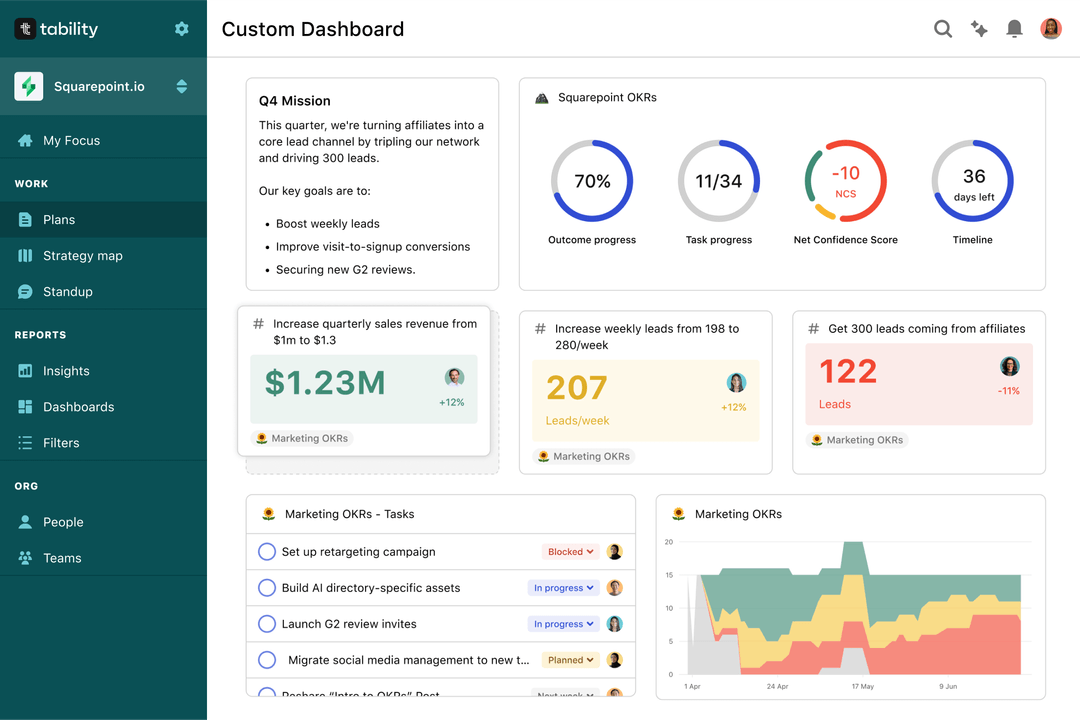
OKRs without regular progress updates are just KPIs. You'll need to update progress on your OKRs every week to get the full benefits from the framework. Reviewing progress periodically has several advantages:
- It brings the goals back to the top of the mind
- It will highlight poorly set OKRs
- It will surface execution risks
- It improves transparency and accountability
We recommend using a spreadsheet for your first OKRs cycle. You'll need to get familiar with the scoring and tracking first. Then, you can scale your OKRs process by using Tability to save time with automated OKR dashboards, data connectors, and actionable insights.
How to get Tability dashboards:
- 1. Create a Tability account
- 2. Use the importers to add your OKRs (works with any spreadsheet or doc)
- 3. Publish your OKR plan
That's it! Tability will instantly get access to 10+ dashboards to monitor progress, visualise trends, and identify risks early.
More Human Resource Managers OKR templates
We have more templates to help you draft your team goals and OKRs.
- OKRs to successfully migrate sales reports to in-house frontend and data warehouse cube
- OKRs to successfully execute and prepare RTM A Pilot for next year
- OKRs to enhance travel efficiency and punctuality
- OKRs to increase security architecture review visibility at the program level
- OKRs to boost Customer Retention Rate
- OKRs to achieve ISO 27001 certification with an action plan