Tability is a cheatcode for goal-driven teams. Set perfect OKRs with AI, stay focused on the work that matters.
What are Hr Management OKRs?
The Objective and Key Results (OKR) framework is a simple goal-setting methodology that was introduced at Intel by Andy Grove in the 70s. It became popular after John Doerr introduced it to Google in the 90s, and it's now used by teams of all sizes to set and track ambitious goals at scale.
How you write your OKRs can make a huge difference on the impact that your team will have at the end of the quarter. But, it's not always easy to write a quarterly plan that focuses on outcomes instead of projects.
We've tailored a list of OKRs examples for Hr Management to help you. You can look at any of the templates below to get some inspiration for your own goals.
If you want to learn more about the framework, you can read our OKR guide online.
The best tools for writing perfect Hr Management OKRs
Here are 2 tools that can help you draft your OKRs in no time.
Tability AI: to generate OKRs based on a prompt
Tability AI allows you to describe your goals in a prompt, and generate a fully editable OKR template in seconds.
- 1. Create a Tability account
- 2. Click on the Generate goals using AI
- 3. Describe your goals in a prompt
- 4. Get your fully editable OKR template
- 5. Publish to start tracking progress and get automated OKR dashboards
Watch the video below to see it in action 👇
Tability Feedback: to improve existing OKRs
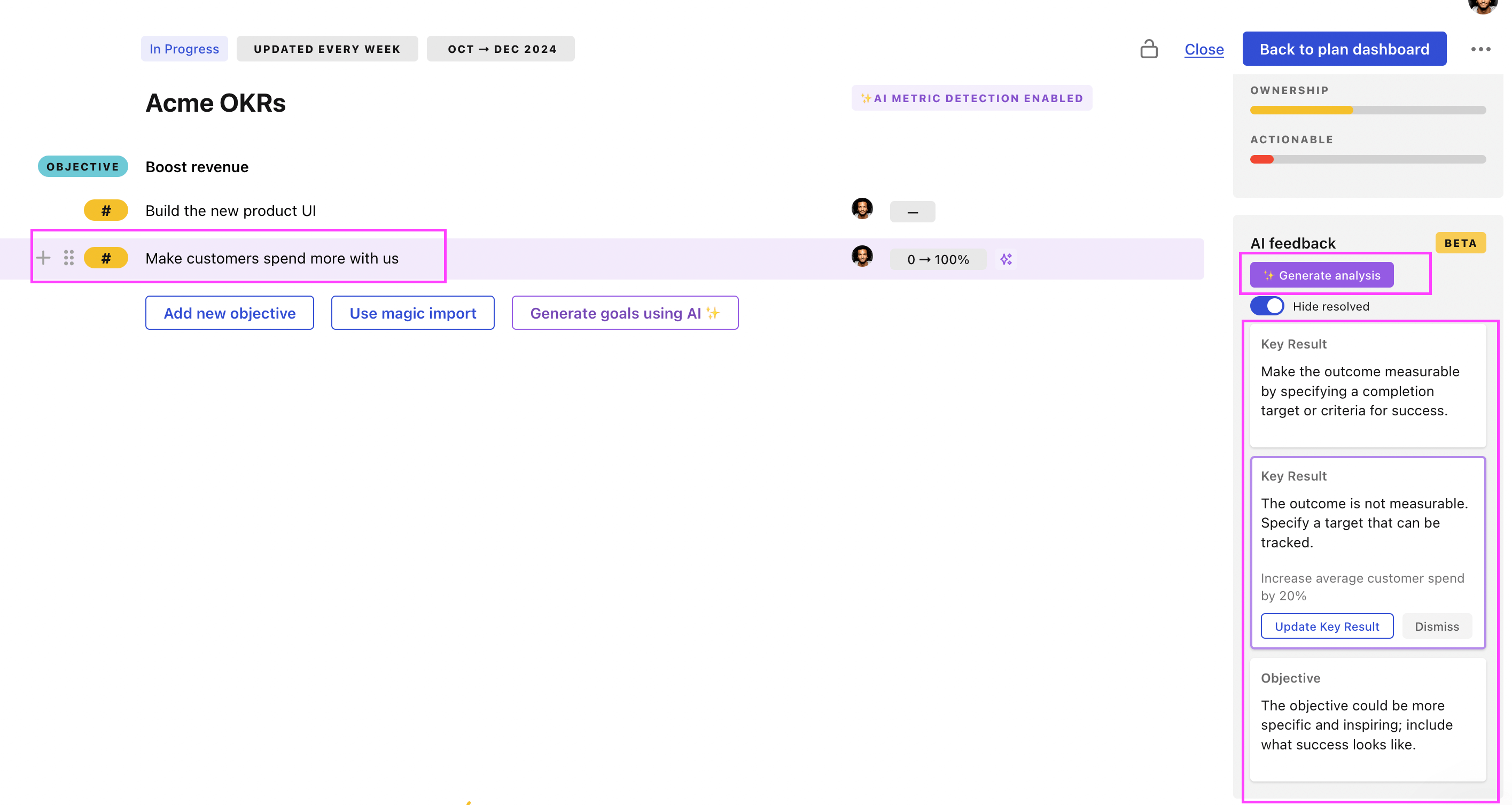
You can use Tability's AI feedback to improve your OKRs if you already have existing goals.
- 1. Create your Tability account
- 2. Add your existing OKRs (you can import them from a spreadsheet)
- 3. Click on Generate analysis
- 4. Review the suggestions and decide to accept or dismiss them
- 5. Publish to start tracking progress and get automated OKR dashboards

Tability will scan your OKRs and offer different suggestions to improve them. This can range from a small rewrite of a statement to make it clearer to a complete rewrite of the entire OKR.
Hr Management OKRs examples
You'll find below a list of Objectives and Key Results templates for Hr Management. We also included strategic projects for each template to make it easier to understand the difference between key results and projects.
Hope you'll find this helpful!
OKRs to streamline and optimize our HR data process
ObjectiveStreamline and optimize our HR data process
KRTrain 100% of HR team on new data processing procedures and software
Identify suitable training courses for new data processing software
Monitor and verify team members' training progress
Schedule training sessions for all HR team members
KRDecrease time spent on HR data processing by 25%
Implement efficient HR automation software
Streamline and simplify the data entry process
Conduct training on effective data management
KRImplement a centralized HR data management system by increasing efficiency by 30%
Identify and purchase a suitable centralized HR data management system
Train HR staff to properly utilize and manage the system
Monitor and adjust operations to achieve 30% increased efficiency
OKRs to streamline and optimize the HR data process
ObjectiveStreamline and optimize the HR data process
KRReduce HR data errors by 50%
Regularly review and verify recorded HR data
Implement automated data entry and validation systems
Train HR staff in accurate data handling practices
KRImplement a new HR data management system with 100% employee training completion
Initiate company-wide training on the new system
Monitor and confirm 100% training completion
Establish a timeline for the HR data management system implementation
KRIncrease HR data processing speed by 30%
Upgrade to a more efficient HR software system
Train HR staff on efficient data processing techniques
Automate repetitive data entry tasks
OKRs to streamline both physical and digital personnel file management
ObjectiveStreamline both physical and digital personnel file management
KRTrain all HR staff on updated filing procedures within the quarter
Evaluate staff comprehension and proficiency post-training
Develop comprehensive training materials for updated filing procedures
Schedule mandatory training sessions for all HR staff
KRConduct bi-weekly audits of filing accuracy to ensure 95% compliance rate
Bi-weekly, check selected files for accuracy
Calculate and record compliance rate after each audit
Compile list of physical and digital files for review
KRImplement a new, shared digital filing system by end of next quarter
Train staff on the selected filing system
Initiate system and migrate existing files
Research potential digital filing system options
OKRs to execute foundational groundwork for our 2025 performance management system
ObjectiveExecute foundational groundwork for our 2025 performance management system
KREvaluate and select two potential software providers for the new system
Identify two potential software providers based on system requirements
Make a final decision to select two suitable software providers
Compare features, prices, and customer reviews of selected providers
KRDevelop and secure approval for a detailed project implementation plan
Draft a detailed project implementation plan
Revise and secure approval for the plan
Submit proposal to decision-makers for review
KRGather performance related feedback from 80% of existing employees
Distribute the survey to all existing employees
Develop a concise survey for performance-related feedback
Remind employees to complete the survey
OKRs to eliminate disparities across mixed levels
ObjectiveEliminate disparities across mixed levels
KRDevelop a comprehensive plan to address identified disparities within a month
Draft an effective action plan to address disparities
Identify key disparities within the organization
Implement and monitor the devised plan of action
KRAchieve at least 90% uniformity across mixed levels by the end of the period
Implement uniform training across all levels
Monitor and adjust for uniformity progress
Define uniformity standards for all levels
KRIdentify all mixed level differences within two weeks of beginning
Schedule meeting to discuss identified differences
Organize findings and create a comprehensive report
Review all documents regarding mixed level differences
OKRs to successfully implement a robust talent management policy
ObjectiveSuccessfully implement a robust talent management policy
KRDraft and ratify a comprehensive talent management policy by involving all stakeholders
Develop a comprehensive draft of the talent management policy
Establish a committee comprising all stakeholder representatives
Conduct stakeholder meetings to review and ratify the policy
KRAchieve 90% employee understanding and satisfaction rates with the new policy
Conduct an informative meeting explaining the details of the new policy
Gather feedback through anonymous surveys to measure understanding
Implement any necessary adjustments based on feedback received
KRTrain 85% of HR staff on the newly implemented talent management policy
Identify HR staff members who need training on the new policy
Monitor and document each staff member's training progress
Schedule comprehensive training sessions for these HR staff
OKRs to enhance overall system access management
ObjectiveEnhance overall system access management
KRImplement two-factor authentication for 80% of users
Determine necessary resources for two-factor authentication implementation
Develop an implementation strategy focusing on 80% user coverage
Communicate these changes and provide user support for transition
KRDecrease unauthorized access attempts by 50%
Implement two-factor authentication for all system logins
Run frequent security training sessions for employees
Regularly update and strengthen password policies
KRTrain 90% of staff on new access management procedures
Identify employees needing training in access management procedures
Implement and monitor progress of training sessions
Coordinate with HR to schedule mandatory procedure training sessions
OKRs to secure a job in product management
ObjectiveSecure a job in product management
KRApply to at least 15 product management jobs per week
Identify 15 product management job postings weekly
Update resume to highlight product management skills
Submit applications to these postings
KRAttend at least 3 relevant networking events to meet potential employers
Prepare introductions and business cards to network effectively
Register and plan attendance for these events
Research and identify relevant networking events within your industry
KRImprove skills by completing two project management courses
Research reputable online platforms offering project management courses
Enroll in two selected project management courses
Complete coursework and assignments on time
OKRs to enhance proficiency in speaker management and resume writing
ObjectiveEnhance proficiency in speaker management and resume writing
KRManage and successfully coordinate at least five live or virtual speakers' presentations
Organize technical rehearsals for virtual presentations
Coordinate delivery of presentation materials and logistic needs
Establish contact with potential speakers and confirm their availability
KRComplete a certified course on Event Speaker Management by the quarter end
Select a certified course on Event Speaker Management
Finish and pass final examination before quarter end
Set aside time weekly to complete course modules
KRCraft and revise ten diverse professional resumes demonstrating various styles and focuses
Draft ten unique and diverse resumes
Research different professional resume styles and focuses
Review and revise each written resume
OKRs to implement comprehensive HR policies and procedures
ObjectiveImplement comprehensive HR policies and procedures
KRConduct an HR procedures training for all management personnel
KRDevelop and document 100% of HR policies by end of quarter
Identify all necessary HR policies requiring development or revision
Allocate resources for policy development and documentation
Finalize and document all identified HR policies
KRAchieve 95% employee understanding and compliance of new HR policies and procedures
Regularly assess employee understanding through quizzes or reviews
Develop comprehensive yet easily understandable HR policy documentation
Implement mandatory training sessions covering new policies
Hr Management OKR best practices
Generally speaking, your objectives should be ambitious yet achievable, and your key results should be measurable and time-bound (using the SMART framework can be helpful). It is also recommended to list strategic initiatives under your key results, as it'll help you avoid the common mistake of listing projects in your KRs.
Here are a couple of best practices extracted from our OKR implementation guide 👇
Tip #1: Limit the number of key results
Focus can only be achieve by limiting the number of competing priorities. It is crucial that you take the time to identify where you need to move the needle, and avoid adding business-as-usual activities to your OKRs.
We recommend having 3-4 objectives, and 3-4 key results per objective. A platform like Tability can run audits on your data to help you identify the plans that have too many goals.
Tip #2: Commit to weekly OKR check-ins
Having good goals is only half the effort. You'll get significant more value from your OKRs if you commit to a weekly check-in process.
Being able to see trends for your key results will also keep yourself honest.
Tip #3: No more than 2 yellow statuses in a row
Yes, this is another tip for goal-tracking instead of goal-setting (but you'll get plenty of OKR examples above). But, once you have your goals defined, it will be your ability to keep the right sense of urgency that will make the difference.
As a rule of thumb, it's best to avoid having more than 2 yellow/at risk statuses in a row.
Make a call on the 3rd update. You should be either back on track, or off track. This sounds harsh but it's the best way to signal risks early enough to fix things.
Save hours with automated Hr Management OKR dashboards

Quarterly OKRs should have weekly updates to get all the benefits from the framework. Reviewing progress periodically has several advantages:
- It brings the goals back to the top of the mind
- It will highlight poorly set OKRs
- It will surface execution risks
- It improves transparency and accountability
We recommend using a spreadsheet for your first OKRs cycle. You'll need to get familiar with the scoring and tracking first. Then, you can scale your OKRs process by using Tability to save time with automated OKR dashboards, data connectors, and actionable insights.
How to get Tability dashboards:
- 1. Create a Tability account
- 2. Use the importers to add your OKRs (works with any spreadsheet or doc)
- 3. Publish your OKR plan
That's it! Tability will instantly get access to 10+ dashboards to monitor progress, visualise trends, and identify risks early.
More Hr Management OKR templates
We have more templates to help you draft your team goals and OKRs.
OKRs to implement a laboratory procedure mentorship program
OKRs to enhance effectiveness of CEO Executive Assistant role
OKRs to enhance customer satisfaction in Japan with top-tier appearance solutions
OKRs to ensure financial efficiency at Wonderfly Arena
OKRs to enhance efficiency and productivity as a virtual assistant
OKRs to enhance the user experience across all platforms