Tability is a cheatcode for goal-driven teams. Set perfect OKRs with AI, stay focused on the work that matters.
What are Advanced Certification OKRs?
The Objective and Key Results (OKR) framework is a simple goal-setting methodology that was introduced at Intel by Andy Grove in the 70s. It became popular after John Doerr introduced it to Google in the 90s, and it's now used by teams of all sizes to set and track ambitious goals at scale.
Formulating strong OKRs can be a complex endeavor, particularly for first-timers. Prioritizing outcomes over projects is crucial when developing your plans.
To aid you in setting your goals, we have compiled a collection of OKR examples customized for Advanced Certification. Take a look at the templates below for inspiration and guidance.
If you want to learn more about the framework, you can read our OKR guide online.
The best tools for writing perfect Advanced Certification OKRs
Here are 2 tools that can help you draft your OKRs in no time.
Tability AI: to generate OKRs based on a prompt
Tability AI allows you to describe your goals in a prompt, and generate a fully editable OKR template in seconds.
- 1. Create a Tability account
- 2. Click on the Generate goals using AI
- 3. Describe your goals in a prompt
- 4. Get your fully editable OKR template
- 5. Publish to start tracking progress and get automated OKR dashboards
Watch the video below to see it in action 👇
Tability Feedback: to improve existing OKRs
You can use Tability's AI feedback to improve your OKRs if you already have existing goals.
- 1. Create your Tability account
- 2. Add your existing OKRs (you can import them from a spreadsheet)
- 3. Click on Generate analysis
- 4. Review the suggestions and decide to accept or dismiss them
- 5. Publish to start tracking progress and get automated OKR dashboards
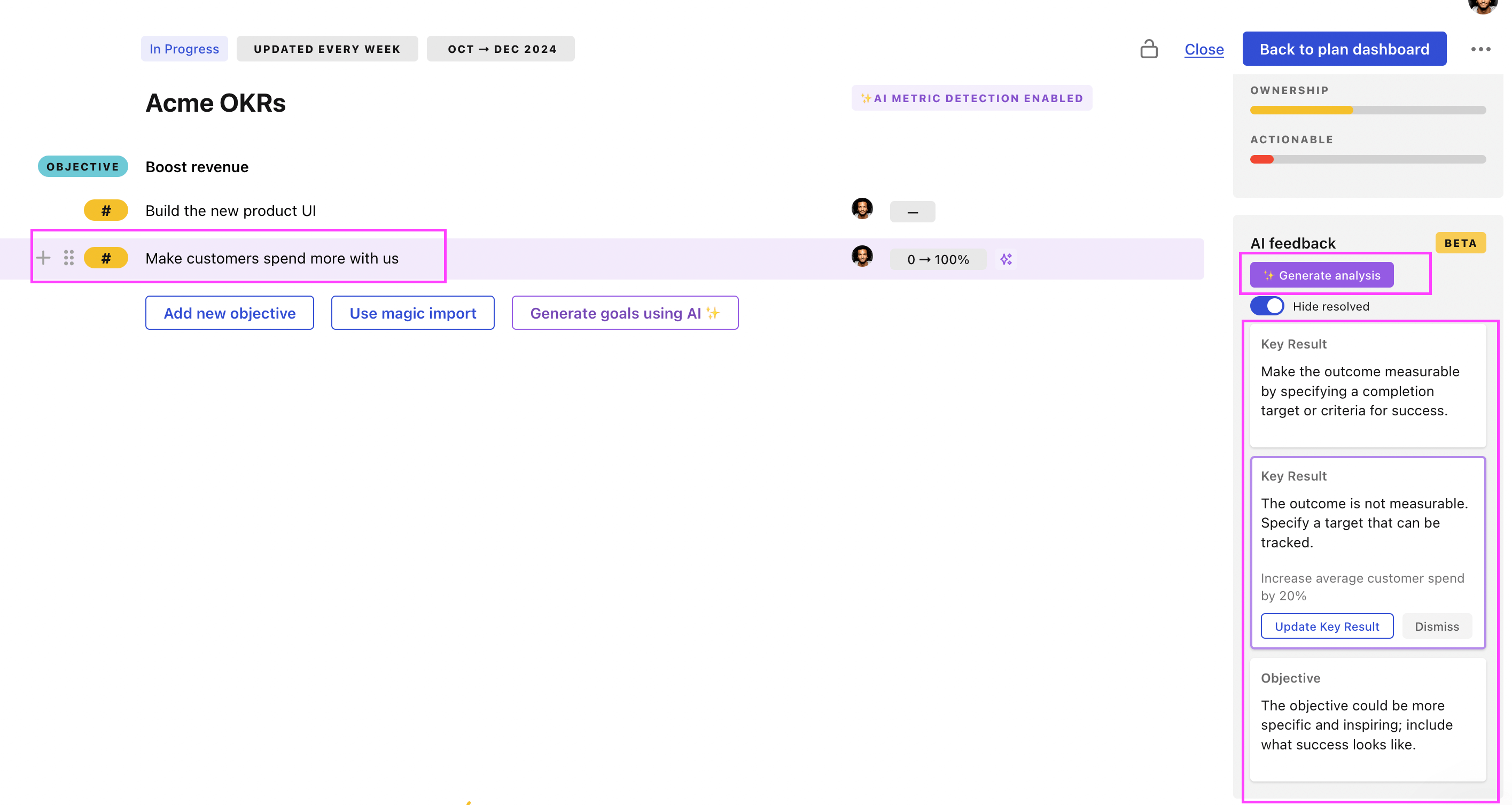
Tability will scan your OKRs and offer different suggestions to improve them. This can range from a small rewrite of a statement to make it clearer to a complete rewrite of the entire OKR.
Advanced Certification OKRs examples
You'll find below a list of Objectives and Key Results templates for Advanced Certification. We also included strategic projects for each template to make it easier to understand the difference between key results and projects.
Hope you'll find this helpful!
OKRs to enhance proficiency in ambulatory informatics
 ObjectiveEnhance proficiency in ambulatory informatics
 KRComplete an advanced certification course in ambulatory informatics
 Enroll and begin coursework based on selected program's structure
- Review lessons regularly; complete and pass all course exams
- Research and choose a suitable advanced certification course in ambulatory informatics
- KRIncrease system efficiency by 20% using informatics strategies
- Develop an automated data analysis program
- Implement machine learning algorithms to optimize system processes
- Upgrade system infrastructure for maximum performance
- KRImplement at least two key projects using ambulatory informatics
- Train team on ambulatory informatics tools and protocols
- Execute and monitor the two chosen projects
- Identify key projects suitable for ambulatory informatics implementation
OKRs to enhance team efficiency in managing Kubernetes across the organization
- ObjectiveEnhance team efficiency in managing Kubernetes across the organization
- KRTrain team to achieve 100% completion of Kubernetes Advanced certification
- Monitor progress and provide additional support as needed
- Identify necessary materials for Kubernetes Advanced certification training
- Schedule regular training sessions for the team
- KRImprove deployment speed by 25% through Kubernetes optimizations
- Implement and test optimization strategies for identified Kubernetes areas
- Audit the current Kubernetes settings and identify areas of potential improvement
- Adjust Kubernetes configurations for faster service deployment
- KRReduce Kubernetes-related errors by 20% with proactive monitoring
- Regularly update and optimize Kubernetes configurations
- Schedule routine check-ups to identify potential errors
- Implement a proactive monitoring system for Kubernetes
OKRs to acquire an advanced certificate
- ObjectiveAcquire an advanced certificate
- KRIdentify and enroll in the appropriate advanced certification course by week 2
- Review and identify relevant advanced certification courses
- Finalize enrollment in chosen course by week 2
- Consult with peers or mentors about course suitability
- KRPass the certification exam with a score of 85% or higher by week 12
- Review all materials and notes every week
- Attend exam-focused study groups
- Complete practice tests for each chapter
- KRComplete 75% of the course materials and assignments by the end of week 6
- Prioritize major assignments for early completion
- Review and finish 75% of course materials by week 6
- Create and stick to a daily study schedule
OKRs to enhance my SCRUM proficiency
- ObjectiveEnhance my SCRUM proficiency
- KRImplement effective SCRUM methodologies in three team projects to improve productivity
- Train the teams on SCRUM methodologies and principles
- Monitor and adjust SCRUM implementation regularly
- Incorporate SCRUM into the project management framework
- KRDeliver two presentations on newly acquired SCRUM knowledge to the team
- Schedule two team meetings for presentations
- Prepare outline summarizing key points of SCRUM knowledge
- Create engaging and informative presentations
- KRComplete two advanced SCRUM certification courses by the end of the quarter
- Research and select two advanced SCRUM certification courses
- Complete and pass all coursework
- Enroll in selected courses
OKRs to acquire advanced Data Science skills
- ObjectiveAcquire advanced Data Science skills
- KRObtain certification in Python and R programming from any reputed certification body
- Study thoroughly and pass certification exams
- Enroll in selected certification courses
- Research reputable bodies offering Python and R certifications
- KRImplement three Data Science projects using different datasets and algorithms
- KRComplete five online Data Science courses with at least 85% score
- Dedicate daily study time to complete coursework
- Aim for a minimum 85% score on all assignments
- Choose five online Data Science courses
Advanced Certification OKR best practices
Generally speaking, your objectives should be ambitious yet achievable, and your key results should be measurable and time-bound (using the SMART framework can be helpful). It is also recommended to list strategic initiatives under your key results, as it'll help you avoid the common mistake of listing projects in your KRs.
Here are a couple of best practices extracted from our OKR implementation guide 👇
Tip #1: Limit the number of key results
Focus can only be achieve by limiting the number of competing priorities. It is crucial that you take the time to identify where you need to move the needle, and avoid adding business-as-usual activities to your OKRs.
We recommend having 3-4 objectives, and 3-4 key results per objective. A platform like Tability can run audits on your data to help you identify the plans that have too many goals.
Tip #2: Commit to weekly OKR check-ins
Having good goals is only half the effort. You'll get significant more value from your OKRs if you commit to a weekly check-in process.
Being able to see trends for your key results will also keep yourself honest.
Tip #3: No more than 2 yellow statuses in a row
Yes, this is another tip for goal-tracking instead of goal-setting (but you'll get plenty of OKR examples above). But, once you have your goals defined, it will be your ability to keep the right sense of urgency that will make the difference.
As a rule of thumb, it's best to avoid having more than 2 yellow/at risk statuses in a row.
Make a call on the 3rd update. You should be either back on track, or off track. This sounds harsh but it's the best way to signal risks early enough to fix things.
Save hours with automated Advanced Certification OKR dashboards
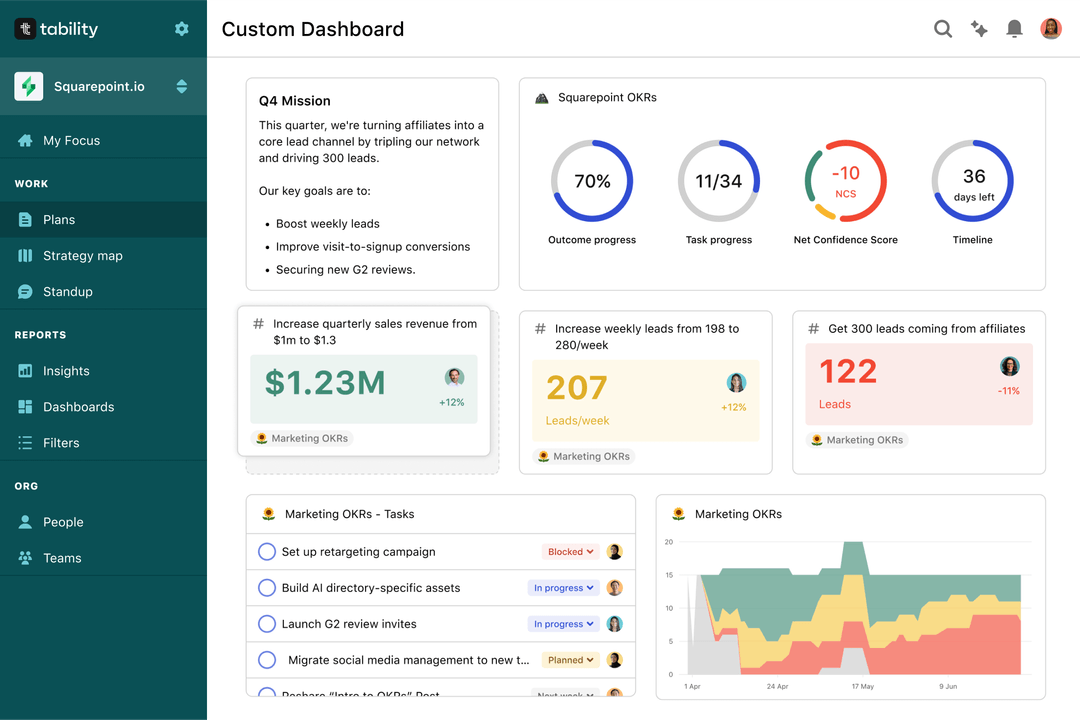
Your quarterly OKRs should be tracked weekly if you want to get all the benefits of the OKRs framework. Reviewing progress periodically has several advantages:
- It brings the goals back to the top of the mind
- It will highlight poorly set OKRs
- It will surface execution risks
- It improves transparency and accountability
Spreadsheets are enough to get started. Then, once you need to scale you can use Tability to save time with automated OKR dashboards, data connectors, and actionable insights.
How to get Tability dashboards:
- 1. Create a Tability account
- 2. Use the importers to add your OKRs (works with any spreadsheet or doc)
- 3. Publish your OKR plan
That's it! Tability will instantly get access to 10+ dashboards to monitor progress, visualise trends, and identify risks early.
More Advanced Certification OKR templates
We have more templates to help you draft your team goals and OKRs.
- OKRs to streamline financial processes for enhanced profit growth
- OKRs to boost enterprise team with 6 reps and 1 manager
- OKRs to implement effective annual success plans
- OKRs to enhance the efficiency of environmental risk management processes
- OKRs to implement AI tools for refining film production processes
- OKRs to implement effective product training plan for sales team