The AI Trading Strategy aims to develop a robust trading system in TradingView with an impressive 85% win rate, focusing on historical data analysis. This involves scrutinizing past market data to discern patterns that can inform future trades, such as trends in winning and losing trades. By employing statistical analysis, optimal data points are identified to train AI models, allowing them to effectively predict market movements and execute trades with precision.
Real-time market monitoring is also crucial, incorporating live data feeds and automated alerts to identify trading opportunities instantly. The AI is integrated with TradingView's API, allowing it to execute trades automatically while considering risk management strategies, such as setting stop-loss and take-profit points, to mitigate volatility.
Continual refinement and adaptation are key to the strategy’s success, ensuring the AI model evolves with changing market conditions. This involves utilizing supervised and reinforcement learning for ongoing improvement. Additionally, feedback loops and sentiment analysis enhance the AI’s ability to adapt, resulting in more accurate decision-making and improved performance over time.
The strategies
⛳️ Strategy 1: Leverage historical data analysis
- Collect and study historical market data for the relevant asset classes
- Identify key patterns and trends in past winning and losing trades
- Utilise statistical analysis to understand market cycles and behaviours
- Select optimal data points to train AI models to recognise successful trade setups
- Test different AI algorithms to determine which most accurately predicts market conditions
- Integrate optimal machine learning techniques for price forecasting
- Continuously refine the algorithm based on new data for improved accuracy
- Set up backtesting on TradingView to validate AI predictions
- Register metrics and refine parameters to meet the target win rate
- Monitor performance and make adjustments as needed
⛳️ Strategy 2: Employ real-time market monitoring
- Set up real-time data feeds from TradingView to ensure accurate information
- Create alerts for specific market conditions that signal potential trades
- Develop a dashboard to visualise current market conditions and potential opportunities
- Utilise cloud computing to process data and run algorithms swiftly
- Integrate AI with TradingView's API to execute trades automatically
- Establish a risk management plan to protect against market volatility
- Set stop-loss and take-profit points within AI strategy
- Monitor trades executed by AI to ensure compliance with the win rate objective
- Continuously adjust the algorithm for changes in market trends
- Ensure AI algorithm operates with minimal input for efficiency
⛳️ Strategy 3: Optimise AI learning and adaptation
- Identify key performance indicators (KPIs) for your AI trading strategy
- Initiate a supervised learning approach to teach AI to predict successful trades
- Accumulate and routinely update datasets for ongoing AI learning
- Use reinforcement learning to adapt to unforeseen market changes
- Implement a feedback loop to evaluate AI's decision-making process
- Incorporate sentiment analysis to factor in market sentiment
- Run simulations to test AI's response in various market conditions
- Enhance AI's neural networks for better pattern recognition
- Schedule regular reviews and updates based on AI’s performance metrics
- Collaborate with AI specialists to incorporate latest machine learning advancements
Bringing accountability to your strategy
It's one thing to have a plan, it's another to stick to it. We hope that the examples above will help you get started with your own strategy, but we also know that it's easy to get lost in the day-to-day effort.
That's why we built Tability: to help you track your progress, keep your team aligned, and make sure you're always moving in the right direction.
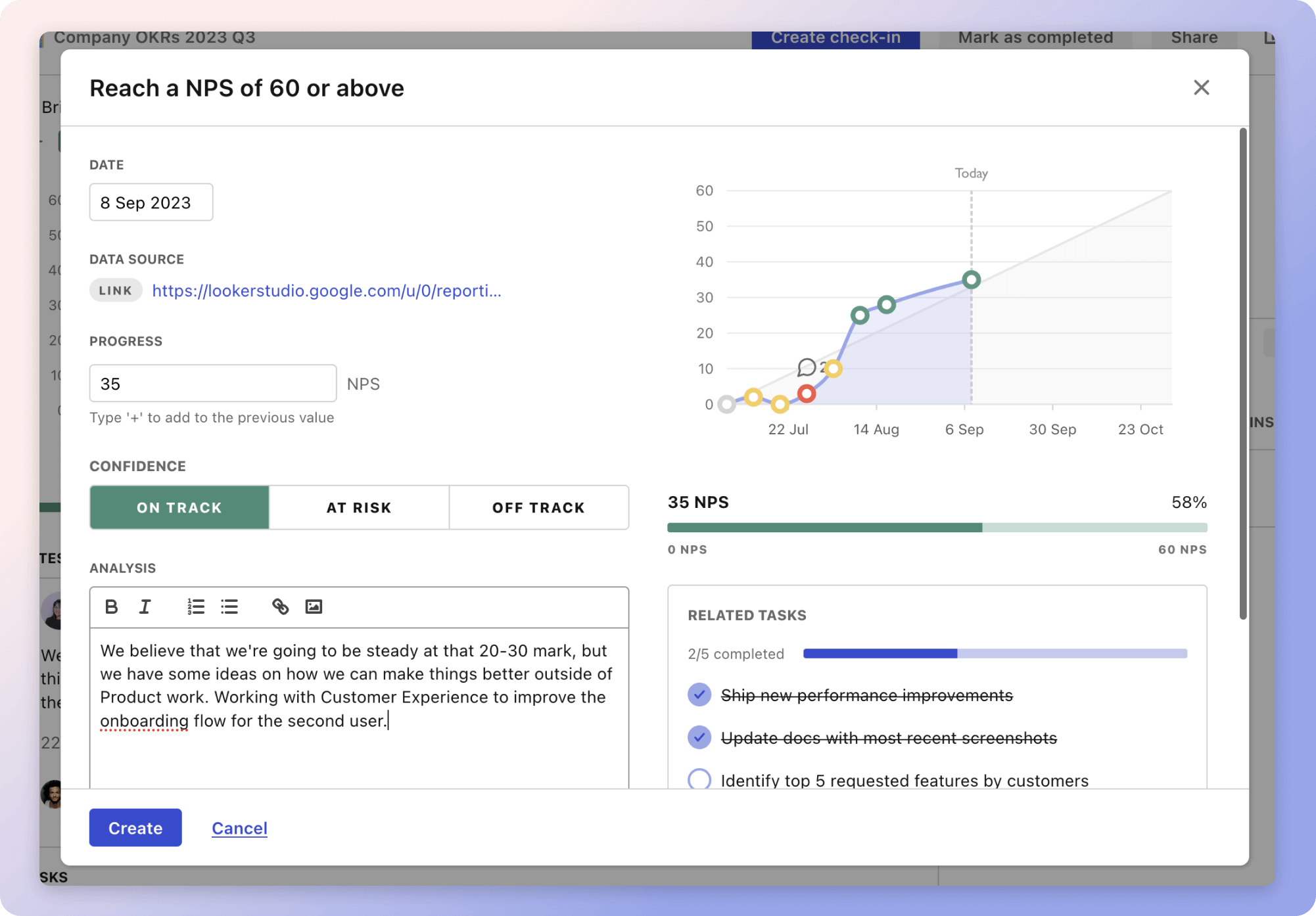
Give it a try and see how it can help you bring accountability to your strategy.