The "Implementing a dual moving average crossover trading strategy" aims to leverage the DEMA (Dual Exponential Moving Average) and MA (Simple Moving Average) indicators for trading decisions. By studying these indicators, traders can make informed buy and sell choices. For example, entering a buy position is recommended when the DEMA 9 crosses above the MA 9 low, while setting a stop-loss safeguards against potential losses. Regular backtesting and monitoring of past trades help refine this strategy.
Risk management is integral to the strategy, involving precise capital allocation and using stop-loss orders. Traders are encouraged to diversify their portfolios and establish a risk-reward ratio to balance potential profits and losses. For instance, limiting the number of simultaneous trades can effectively manage exposure.
To enhance technical analysis skills, traders should engage in ongoing education, including courses and community discussions. Practicing on demo accounts and following experienced traders can improve practical application of strategies. Staying updated with market news ensures adaptation to changing market conditions.
The strategies
⛳️ Strategy 1: Utilise technical indicators
- Study the fundamentals of dual exponential moving average (DEMA) and simple moving average (MA)
- Select a reliable trading platform that supports custom indicators
- Set up the DEMA 9 and MA 9 low on your chosen platform
- Monitor the charts regularly to identify potential crossover points
- Enter a buy position when DEMA 9 crosses above MA 9 low
- Set a stop-loss at 10% below the entry point to manage risk
- Exit the position when MA 9 low crosses above the DEMA 9
- Review past trades to understand patterns and outcomes
- Backtest the strategy with historical data to optimise parameters
- Keep a trading journal to record entries, exits, and emotions
⛳️ Strategy 2: Optimise risk management
- Determine the appropriate amount of capital to allocate per trade
- Calculate the position size based on a percentage of total capital
- Establish a risk-reward ratio for each trade setup
- Utilise stop-loss and take-profit orders for risk management
- Regularly reassess stop-loss placements based on volatility
- Limit the maximum number of concurrent trades to manage exposure
- Diversify trading across different asset classes or currency pairs
- Regularly review and adjust risk parameters as necessary
- Implement a trading suspension rule after consecutive losses
- Incorporate regular breaks to prevent emotional decision-making
⛳️ Strategy 3: Enhance technical analysis skills
- Engage in educational courses focused on technical analysis
- Join trading communities or forums for shared insights
- Follow experienced traders to observe practical application of strategies
- Read books and articles about advanced technical indicators
- Attend webinars and workshops related to technical analysis
- Develop a routine for analysing market trends and chart patterns
- Practice regularly on a demo account before committing real money
- Seek feedback from seasoned traders on current strategy effectiveness
- Evaluate the software tools available to assist in technical analysis
- Stay updated with market news which can influence chart patterns
Bringing accountability to your strategy
It's one thing to have a plan, it's another to stick to it. We hope that the examples above will help you get started with your own strategy, but we also know that it's easy to get lost in the day-to-day effort.
That's why we built Tability: to help you track your progress, keep your team aligned, and make sure you're always moving in the right direction.
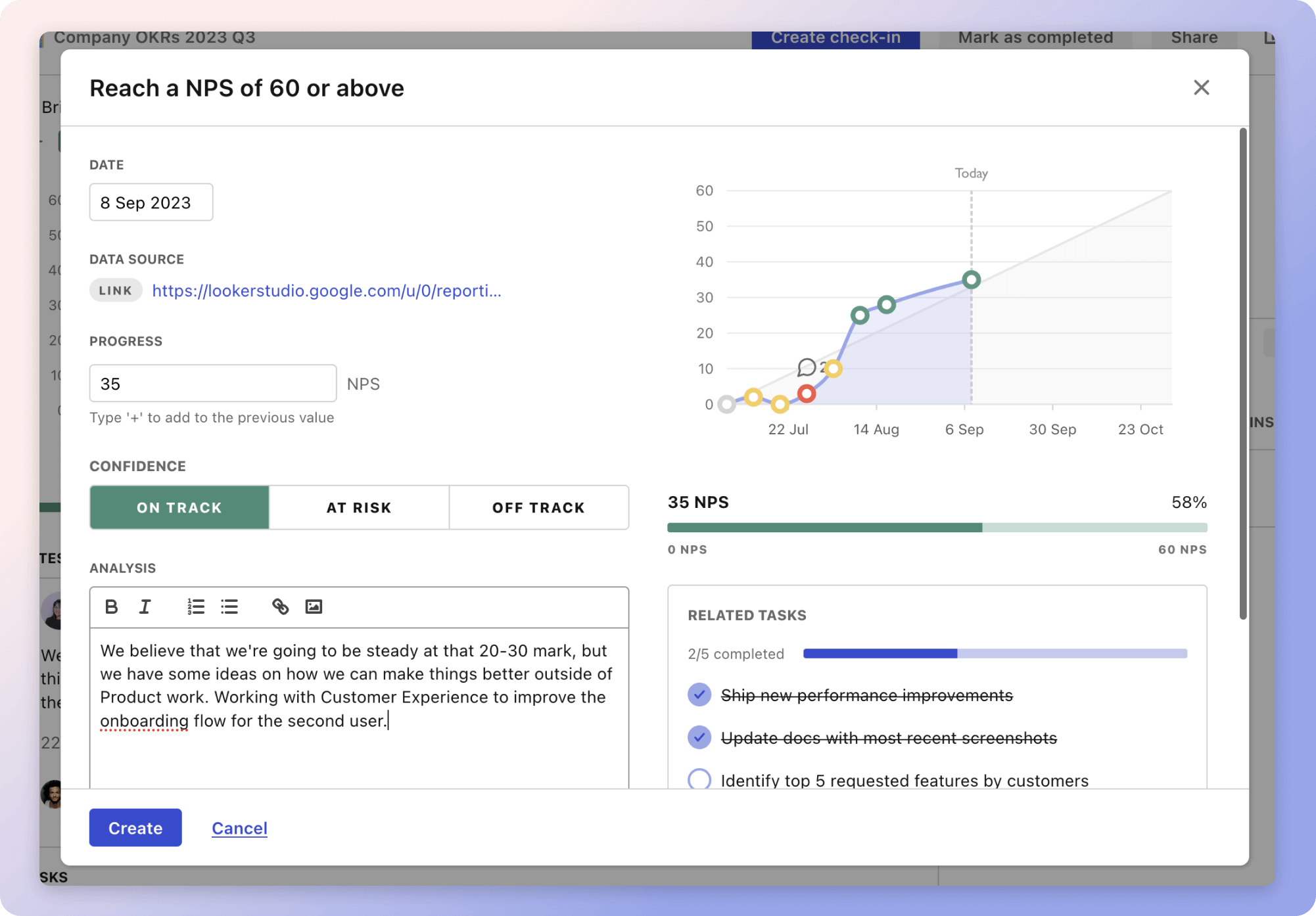
Give it a try and see how it can help you bring accountability to your strategy.