The strategy focuses on enhancing short-term trading by targeting price reversal patterns in the final two minutes of five-minute charts. The first approach involves analyzing historical data to identify trading patterns. By gathering data from reliable sources, traders can spot trends and validate instances of price reversals. For example, a trader might notice frequent reversals at a specific time, such as during the New York session.
Next, a trading plan with clear entry and exit rules is developed. Traders set entry conditions based on pattern observations and establish stop-loss levels to manage risk. For instance, avoiding trades during periods of low volatility helps mitigate unnecessary losses. Regular reviews ensure strategies remain effective.
Finally, technology is leveraged to enhance trade execution. Indicators like the Relative Strength Index (RSI) help identify potential reversals. Trading platforms automate alerts for entry conditions, while backtesting evaluates indicator efficiency. The inclusion of sentiment analysis tools and stop-loss software integrates technological advancements into traditional trading methods, offering improved decision-making.
The strategies
⛳️ Strategy 1: Analyse historical data for patterns
- Collect historical price data from a reliable source for analysis
- Identify price movement trends during the last two minutes of five-minute candlesticks
- Examine instances where price reversals occurred to validate initial observations
- Determine the average amplitude of price reversals to inform trade decisions
- Assess the impact of news events on last two-minute price changes
- Compare historical trends during different market sessions (e.g., Tokyo, London, New York)
- Create visual charts to illustrate discovered patterns
- Test findings with a backtesting tool or software
- Summarise findings into a concise report for future reference
- Use insights to adjust your trading plan or strategy
⛳️ Strategy 2: Develop a trading plan with entry and exit rules
- Set specific entry conditions for your two-minute trade based on observed patterns
- Define clear stop-loss levels to limit potential losses
- Establish take-profit levels based on average reversal range
- Include criteria for when not to trade, such as low volatility periods
- Implement a risk management strategy, limiting trades to a small percentage of capital
- Schedule regular reviews of your trades to assess performance
- Keep a journal to record each trade's context and outcome
- Craft a decision-making checklist to follow before executing any trade
- Utilise alerts or notifications to monitor key market conditions
- Reassess trading strategy monthly or quarterly to adapt to market changes
⛳️ Strategy 3: Utilise technology and indicators
- Identify indicators that highlight potential reversals, such as Relative Strength Index (RSI) or Moving Averages
- Set up a trading platform to automate alert notifications for entry conditions
- Incorporate support and resistance levels in your chart analysis
- Backtest your chosen indicators to evaluate efficiency and reliability
- Utilise software to simulate hypothetical trades without real capital
- Follow industry forums or groups to stay updated on market technology trends
- Incorporate a sentiment analysis tool to gauge market sentiment
- Use a stop-loss order execution software to ensure adherence
- Test various technical setups to improve entry accuracy
- Regularly update indicators based on feedback from test trades
Bringing accountability to your strategy
It's one thing to have a plan, it's another to stick to it. We hope that the examples above will help you get started with your own strategy, but we also know that it's easy to get lost in the day-to-day effort.
That's why we built Tability: to help you track your progress, keep your team aligned, and make sure you're always moving in the right direction.
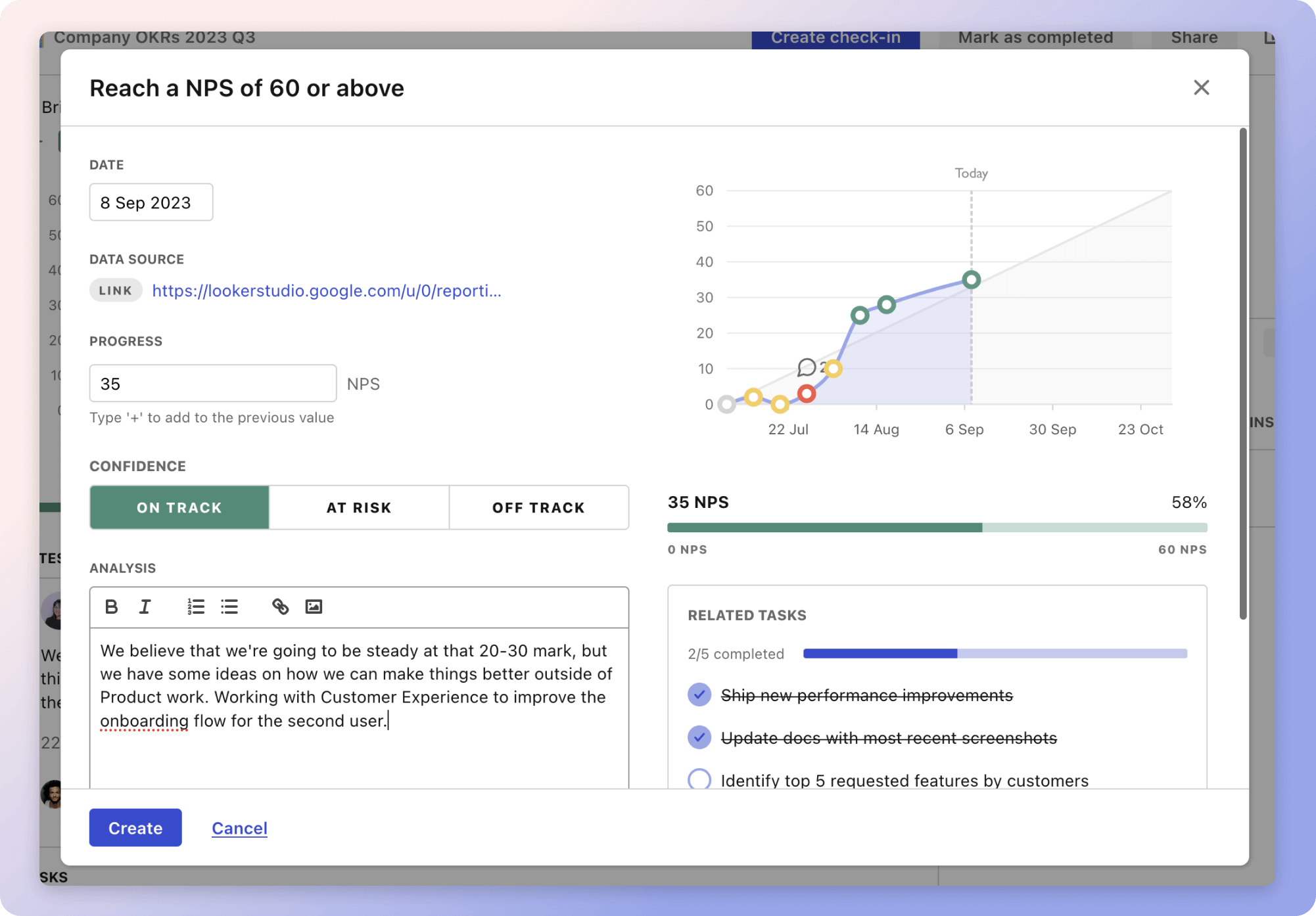
Give it a try and see how it can help you bring accountability to your strategy.