The strategy focuses on setting up an efficient administrative committee structure. It begins with defining committee roles and responsibilities. Key roles are identified, and detailed descriptions are drafted to ensure clarity. Members are assigned roles based on their skills and interests, with a hierarchy chart illustrating reporting lines. There’s a process for role rotation and regular evaluations, ensuring roles align with member capabilities, exemplified by role-specific training sessions and open communication for improvements.
Next, the strategy outlines developing committee goals and objectives. Through brainstorming sessions, goals are identified and prioritized using the SMART framework. Each goal is assigned to a member or subcommittee, with action plans and milestones established for progress tracking, illustrated by monthly meetings and celebrating achievements to sustain momentum.
Lastly, a financial structure and budget are formed. Financial requirements are assessed, and a budget proposal is created, highlighting income and expenses. A finance officer oversees the budget, ensuring adherence to financial constraints. Regular reviews and adjustments ensure financial discipline, demonstrated by establishing an emergency fund and performing an annual financial audit.
The strategies
⛳️ Strategy 1: Define committee roles and responsibilities
- Identify the key roles needed within the committee
- Draft clear descriptions for each role outlining responsibilities
- Assign roles to members based on skill sets and interests
- Create a hierarchy chart to show reporting and communication lines
- Establish a process for rotating roles and responsibilities
- Set specific performance criteria for each role
- Schedule regular check-ins to review role fulfilment
- Facilitate role-specific training sessions
- Encourage open communication for role improvements
- Evaluate roles and responsibilities after six months and make necessary adjustments
⛳️ Strategy 2: Develop committee goals and objectives
- Conduct a brainstorming session to identify possible goals
- Prioritise goals based on impact and feasibility
- Formulate specific, measurable, achievable, relevant, and time-bound (SMART) goals
- Assign each goal to a specific committee member or subcommittee
- Develop action plans for each goal with milestones
- Monitor progress through monthly update meetings
- Celebrate short-term wins to maintain momentum
- Identify potential challenges and develop mitigation strategies
- Communicate goals and progress to stakeholders
- Review and refine goals at mid-year and end-year evaluations
⛳️ Strategy 3: Establish a financial structure and budget
- Assess the financial requirements to achieve committee goals
- Draft a budget proposal detailing projected income and expenses
- Establish a funding strategy, exploring possible revenue streams or funding sources
- Present the budget proposal to stakeholders for approval
- Assign a finance officer to oversee budget management
- Set up regular financial reporting and review sessions
- Monitor and control expenses to stay within budget
- Adjust the budget as needed in response to financial reviews
- Create an emergency fund for unforeseen expenses
- Audit financial performance at the one-year mark for accountability
Bringing accountability to your strategy
It's one thing to have a plan, it's another to stick to it. We hope that the examples above will help you get started with your own strategy, but we also know that it's easy to get lost in the day-to-day effort.
That's why we built Tability: to help you track your progress, keep your team aligned, and make sure you're always moving in the right direction.
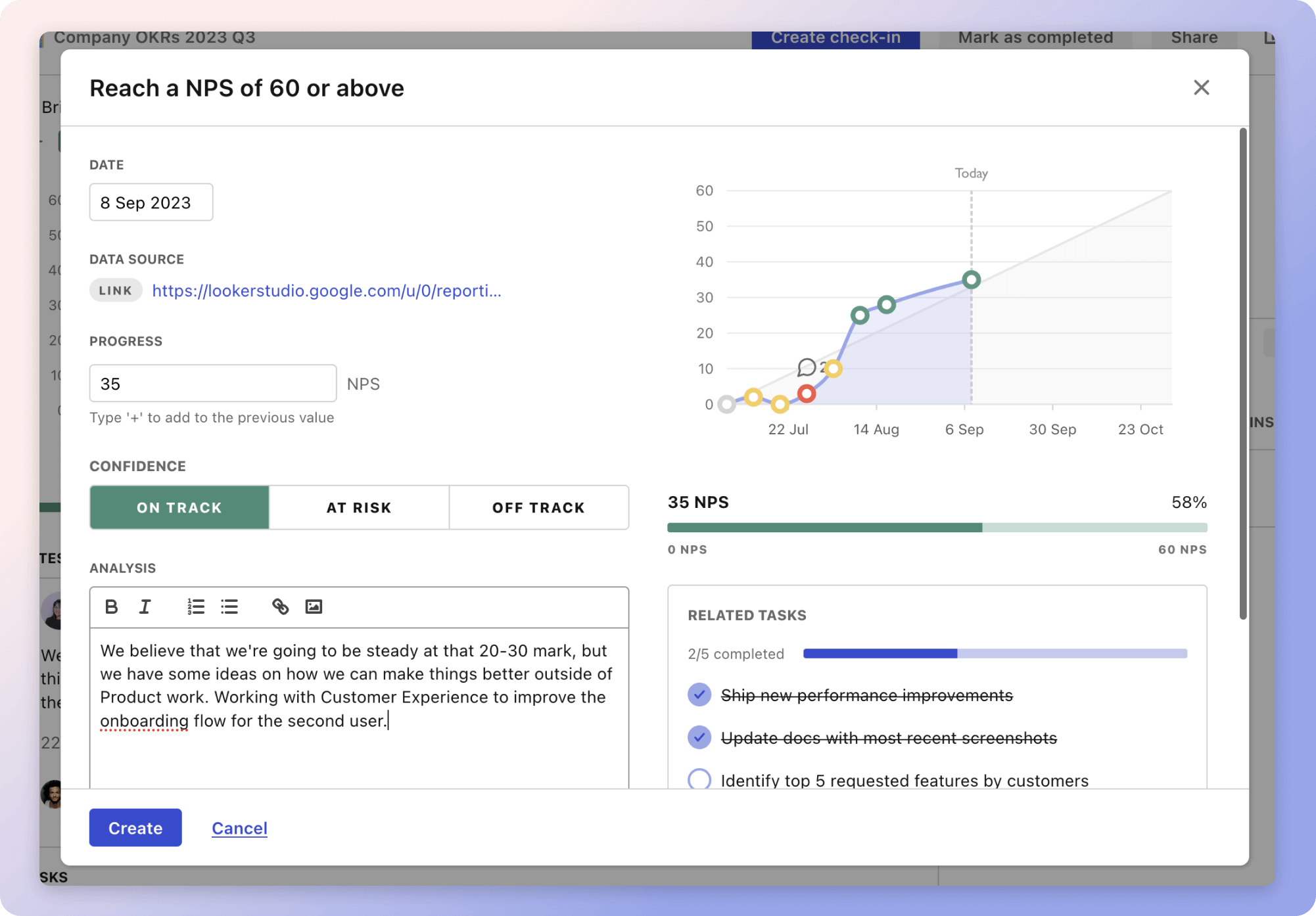
Give it a try and see how it can help you bring accountability to your strategy.