The strategy "Utilising Technical Analysis in Trading" focuses on improving trading decisions and increasing profitability through technical analysis techniques. It involves identifying support and resistance levels by analyzing historical price data and using line charts. For example, traders can use moving averages and volume analysis to confirm and adjust these levels over time, ensuring their validity and effectiveness.
Another key strategy is the application of Fibonacci retracement for determining entry and exit points. By identifying significant price peaks and troughs, traders use Fibonacci levels to anticipate reversals and potential take-profit targets. Combining this with confluence from other indicators enhances decision-making.
Lastly, the strategy emphasizes trend-following techniques. This involves analyzing price action and indicators like MACD to determine market trends, setting trailing stop losses, and entering trades during pullbacks—thus maximizing profit potential while minimizing risks. This comprehensive approach integrates backtesting, risk-reward calculations, and continuous learning to maintain effectiveness in dynamic markets.
The strategies
⛳️ Strategy 1: Identify Support and Resistance Levels
- Analyse historical price data to identify key levels where the price frequently reverses
- Use line charts to visualise horizontal lines at identified support and resistance levels
- Incorporate volume analysis to confirm the strength of support and resistance levels
- Observe the number of touches a level has received to determine its validity
- Watch for price action signals, like pin bars, at these levels to enhance decision-making
- Use moving averages to identify dynamic support and resistance levels
- Combine different time frames to check the consistency of these levels
- Backtest using historical data to evaluate the effectiveness of these levels
- Adjust and update support and resistance levels as new data becomes available
- Set stop-loss orders just below support levels for buy positions and above resistance for sell positions
⛳️ Strategy 2: Apply Fibonacci Retracement for Entry and Exit Points
- Identify significant peaks and troughs in price movements to draw Fibonacci retracement levels
- Use the drawn levels to anticipate potential reversal zones
- Integrate Fibonacci levels with other indicators for confirmation, such as moving averages
- Look for confluence between Fibonacci levels and previously identified support or resistance lines
- Set entry points near key Fibonacci levels such as 38.2%, 50%, and 61.8%
- Incorporate Fibonacci extensions to predict potential take-profit targets
- Monitor price action around Fibonacci levels for reversal patterns like engulfing candles
- Calculate risk-reward ratio considering Fibonacci levels for precise trade planning
- Refine approach by backtesting with different market conditions
- Stay updated on news events that might affect the reliability of these levels
⛳️ Strategy 3: Utilise Trend Following Techniques
- Identify the current market trend direction by analysing price action and indicators
- Implement moving averages with different time periods to confirm trend direction
- Utilise trend lines to visually represent and confirm the ongoing trend
- Adopt technical indicators like MACD and ADX to gauge trend strength
- Wait for pullbacks or retracements to enter trades in the direction of the trend
- Set up trailing stop losses to maximise profits while protecting gains
- Avoid trading against established trends to minimise risk
- Periodically review and adjust analysis as trends evolve over time
- Attend webinars or courses to deepen understanding of trend-following methods
- Keep a detailed trading journal to learn from past trend-following trades
Bringing accountability to your strategy
It's one thing to have a plan, it's another to stick to it. We hope that the examples above will help you get started with your own strategy, but we also know that it's easy to get lost in the day-to-day effort.
That's why we built Tability: to help you track your progress, keep your team aligned, and make sure you're always moving in the right direction.
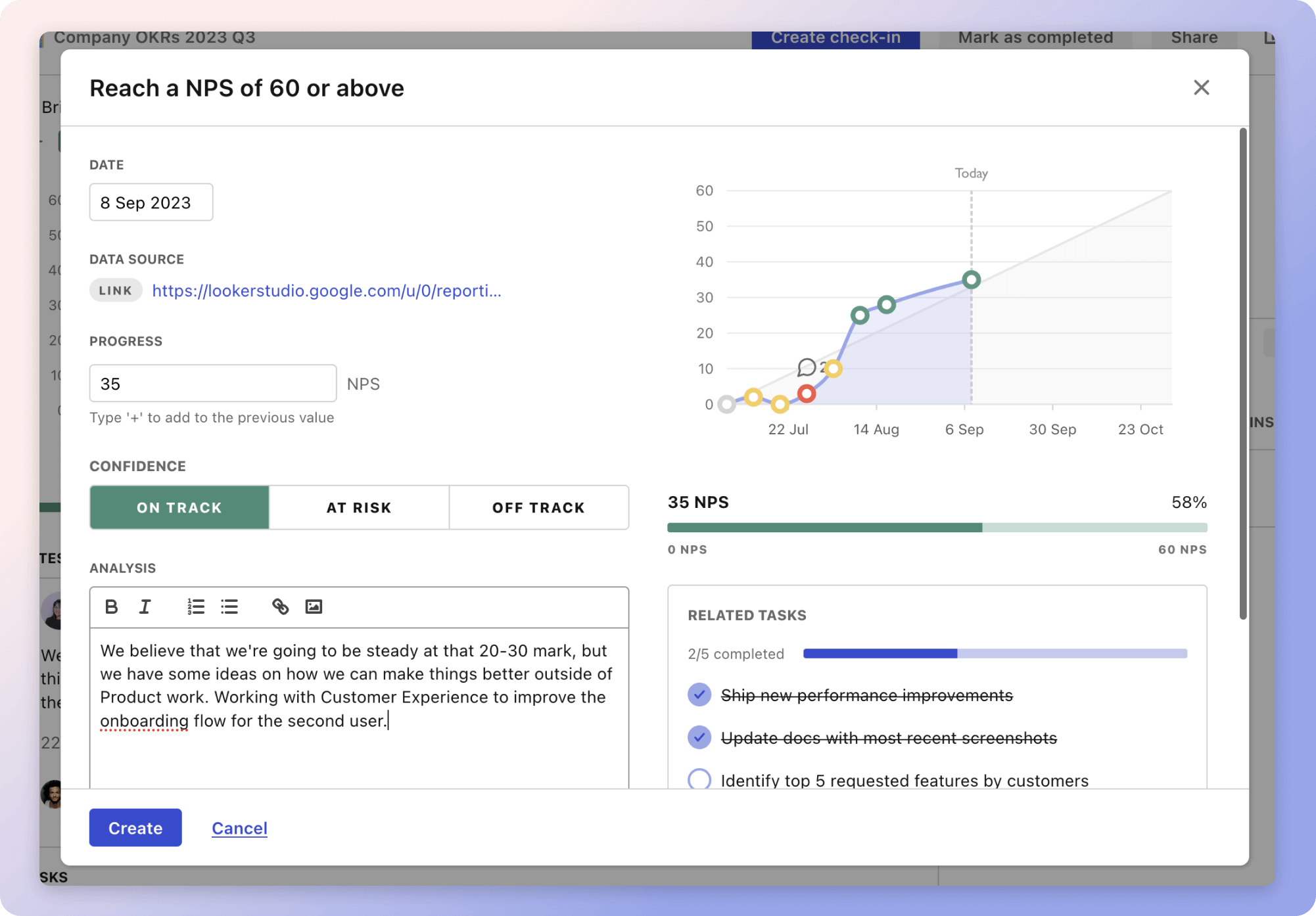
Give it a try and see how it can help you bring accountability to your strategy.